Once again, it was another session that presented mixed signals from President Trump, with the pendulum swinging from peace talks, war exits, and threats of further destruction. This is nothing new, and major US stock benchmarks wrapped up another day largely on the ropes.
Another Day on the Ropes for Equities
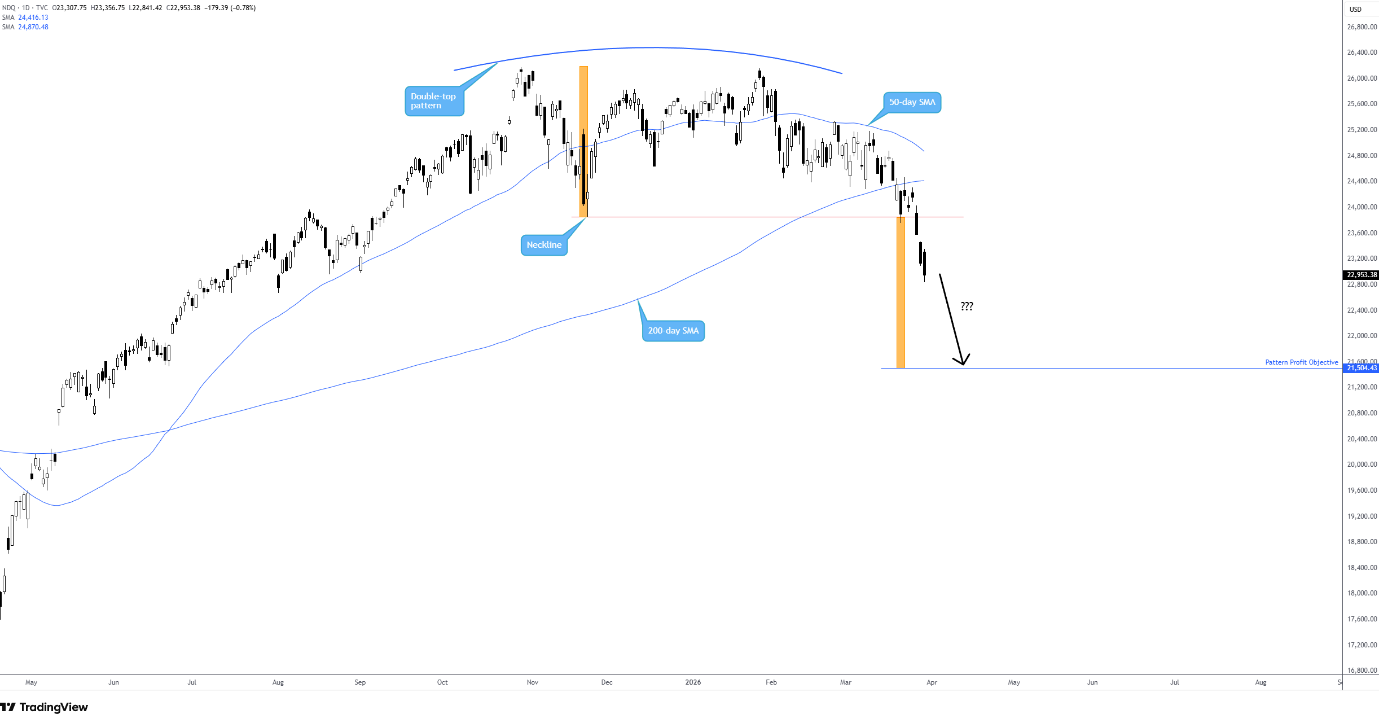
The Nasdaq 100 tunnelled further into correction territory, down 179 points (0.8%) to 22,953, and the S&P 500 slipped 25 points (0.4%) to 6,343, also placing the average in correction watch territory. The Dow Jones, however, managed to eke out a win, closing 49 points higher (0.1%) at 45,216.
As shown below, the double-top pattern on the Nasdaq 100 formed around 26,150 is playing out nicely, with price finding acceptance south of the formation’s neckline at 23,854. The question is about whether the market average has enough gas in the tank to shake hands with the pattern’s profit objective as far south as 21,504.
Oil Treading Water Above US$100
In the commodities complex, oil prices are pretty much back where they started at the open this week, following a move higher yesterday and a subsequent pullback today. However, WTI and Brent spot prices remain north of US$100/barrel, bolstered by inflation fears and recession risks. Trump’s recent 10-day extension until 6 April did little to reassure investors.
US Bond Yields Bull Steepening
The bond market was interesting yesterday, with US Treasury yields bull-steepening, sending the benchmark 10-year yield to 4.35% and helping the 30-year yield remain contained south of 5%. I think the move in Treasuries was down to two things.
Brent Oil Price Forecast
Every new Brent Oil analysis as it publishes, today's technical signal and key levels, live price — on one page.
See all Brent Oil forecastsFirstly, with oil prices continuing to trade at elevated levels, recession concerns are coming to the fore, as higher oil prices strain aggregate economic output, which tends to provide a tailwind for bonds.
Secondly, Fed Chair Jerome Powell’s comments yesterday added fuel to the rally, essentially emphasising that the central bank tends to look past supply shocks and that longer-run inflation expectations remain well anchored. Markets are clearly trying to determine whether this conflict is an inflation issue, a growth problem, or an uncomfortable combination of the two.
FX: USD Pencils in Fifth Day in the Green
In the FX space, the USD index notched up a fifth consecutive day in the green yesterday, consequently weighing on the EUR and GBP. Both Europe and the UK are in a bad spot, given their energy-dependent status, the possible second-round effects of inflation, and, as I am sure you have seen, potential rate hikes, even as both economies offer little in terms of growth right now.
The JPY was the outlier, with USD/JPY pencilling in a 0.4% loss and forming what technical analysts will recognise as a bearish outside day. This is a challenging market. As I noted in the week-ahead, Japan is in a similar situation to Europe and the UK, and given that the JPY is overstretched to the downside and USD/JPY is treading water in intervention territory, a short squeeze could soon materialise.
Today’s data docket offers a European morning story followed by a US story. At 10:00 am GMT, traders will welcome the March eurozone HICP CPI inflation print. Economists expect the YY headline measure to nearly double to 2.6% from February’s reading of 1.9%. If inflation pushes higher than expected at the headline level – >3% – and core nudges north of 2.5%, this will likely reinforce current ECB pricing (71 bps of tightening by year-end), and potentially trigger a modest relief rally versus the buck. A softer print, on the other hand, could unwind some of the hawkish tightening bets and deepen the sell-off.
Additionally, Stateside, the US February JOLTS Job Openings data and the Conference Board consumer confidence numbers land at 3:00 pm. Markets have priced out Fed rate cuts this year, though signs of deterioration in the jobs market could prompt investors to increase rate-cut bets, potentially taming USD upside. The key here is whether JOLTS and consumer confidence data present a unified picture of a decelerating economy, which would likely add fuel to the rise in bond prices.
Written by FP Markets Chief Market Analyst Aaron Hill