


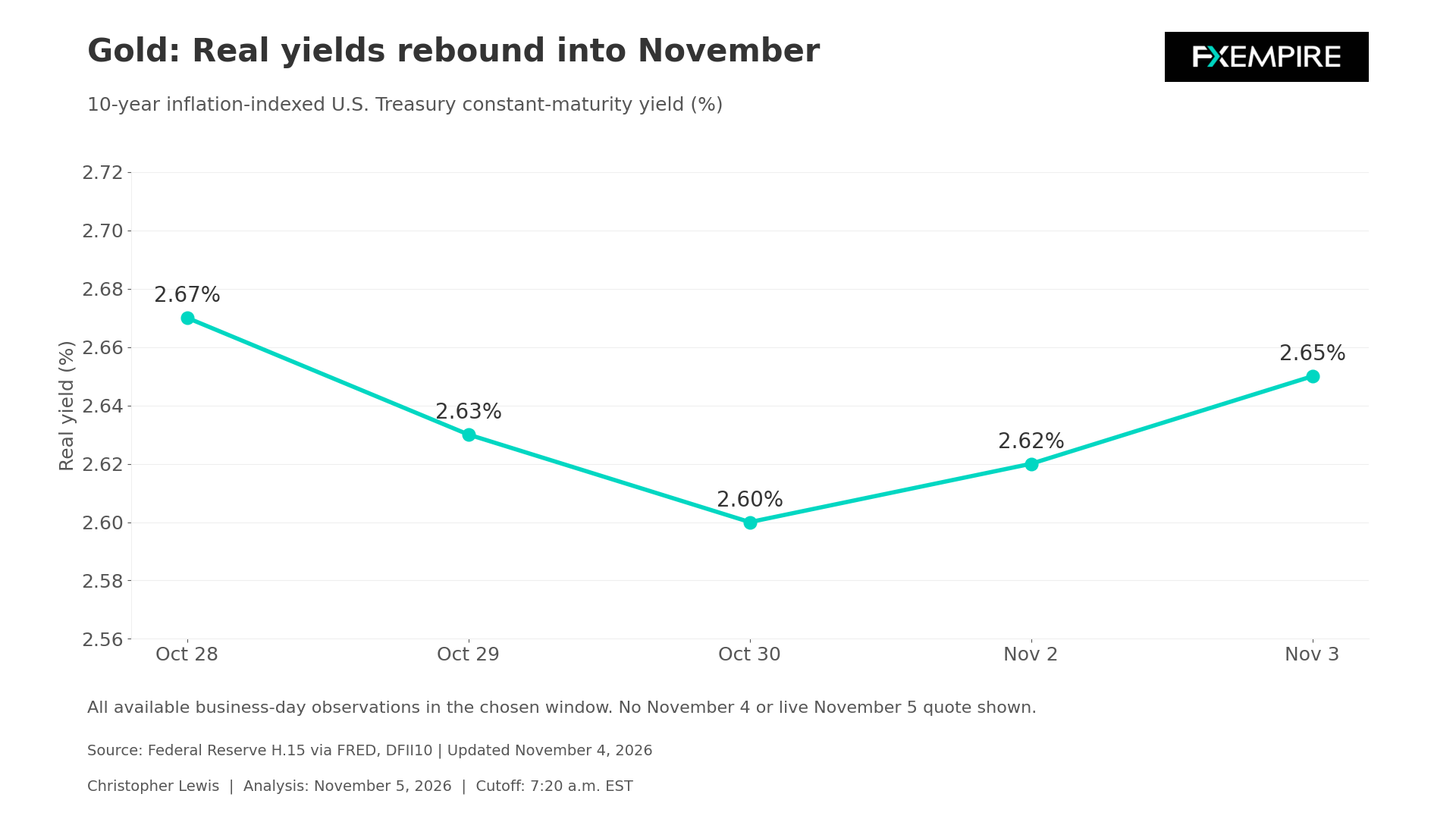
Gold kicks off the Thursday session with a measurable financing-cost hurdle. The latest observation from the Federal Reserve’s 10-year inflation-indexed Treasury yield series was 2.65% for November 3, published through FRED on November 4. That compares with 2.60% on October 30 and 2.67% on October 28.
The recent rebound is relevant to gold’s opportunity cost. Real yields will matter because investors can obtain an inflation-adjusted return from government securities, while bullion provides no actual income. All else being equal, a higher real return can make holding gold much less attractive.
However, this relationship is just one piece of the puzzle. Demand for insurance against financial or geopolitical uncertainty can outweigh the yield disadvantage.
FOMC Rate Policy
The latest Federal Reserve decision on October 28 was the FOMC maintaining its policy rate range at 3.75% to 4.00%. The vote was 10-2, with two dissenters preferring a 25-basis-point increase. The statement mentioned inflation as being elevated. This was a hold, but the dissents were toward a tighter policy. It should be thought of as a potential sign of things to come.
For gold, the analytical issue is how much evidence would be needed to change the expected policy path. Softer activity alone may not settle that question if inflation remains overly persistent. Conversely, slowing inflation alongside resilient growth could improve the outlook for lower rates without requiring a recession in the United States.
BEA’s Inflation Figures
The BEA’s September inflation figures illustrate the challenge. Released October 29, they show PCE prices increasing 0.5% over the month and 3.6% from a year earlier. Core PCE increased 0.3% monthly and 3.1% annually. Real consumer spending rose less than 0.1%, even though nominal spending increased 0.5%. These numbers are from September.
I suspect that inflation and spending should be considered together. A nominal spending increase driven heavily by prices offers a different signal from rapid growth in purchase volumes. For bullion, persistent inflation could support demand for a store of value while simultaneously encouraging restrictive monetary policy.
Gold Price Forecast
Every new Gold analysis as it publishes, today's technical signal and key levels, live price — on one page.
See all Gold forecastsJOLTS
Recent labor information does not establish an abrupt collapse in hiring conditions. The November 3 JOLTS release reported September job openings at 7.5 million, with hires at 5.4 million and layoffs and discharges at 1.6 million. The BLS described each as little changed. These figures help frame the discussion, but vacancies and turnover are different measures from the payroll change that traders will receive on the next release.
Busy Calendar
The immediate calendar has a certain amount of influence. Preliminary third-quarter productivity costs are scheduled for 8:30 a.m. Eastern today. October’s employment situation follows Friday, November 6, at 8:30 a.m. Eastern. Neither release is going to be a definitive policy changer, but they are pieces of the larger puzzle.
The productivity release deserves some attention due to the idea that stronger output per hour can help absorb wage increases without equivalent pressure on unit labor costs. Friday’s employment figures will then provide another test of the overall growth backdrop in the United States. A response in real yields could offer a useful check on the market’s interpretation.
For now, the biggest headwind is a positive real yield available on Treasuries, with a small rebound in the latest observation. A softer inflation and employment combination could ease that headwind, but we will have to wait and see.
Technical Analysis
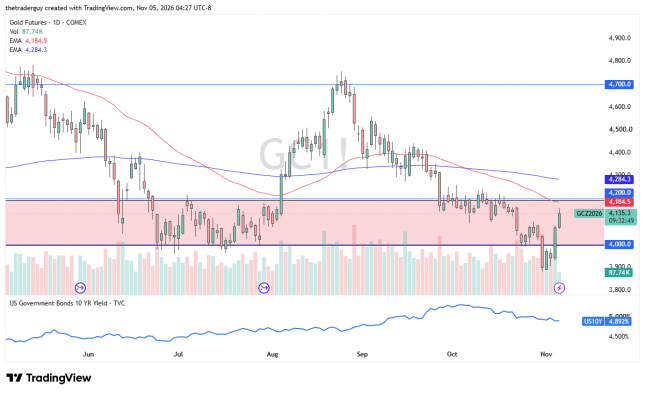
We have seen a big shot higher, but some of this could be short covering ahead of the nonfarm payroll announcement. As things stand right now, I’m still looking to short the gold market, but have not seen enough exhaustion. The $4,200 level above should be a significant barrier. Breaking above there after the jobs report could be very bullish.
If you’d like to know more about how to trade gold and silver, please visit our educational area.