


In 2008, Gold gave traders that exact opportunity. By the time the S&P 500 finally hit bottom, Gold had already climbed almost 30%. Over the next two and a half years, the yellow metal almost tripled from that March 2009 price.
Today, central banks are buying hundreds of tonnes and The Gold & Silver Club sees a rare opportunity for traders to accumulate Gold more than $2,000 an ounce below its peak. In the words of Lars Hansen, Head of Research at The Gold & Silver Club, “this could become one of the greatest wealth creation opportunities of our lifetime.”
The 166% Rally Started When Buying Gold Felt Hardest
On 24 October 2008, an ounce of gold fetched $712.50, down from $1,011.25 in March. Lehman Brothers had failed. Stocks were still falling. A trader who wanted to wait for a calmer week had every reason to do so.
Yet on 9 March 2009, the day U.S stocks reached their closing low, that ounce cost $923.75. Waiting for Equities to find a floor had added $211 to the entry price. By September 2011, Gold had reached $1,895 an ounce, a gain of 166% from the October low.
Anyone who has ever missed a market bottom should look at that $923.75 price again. Even after the first $200 of the rally had gone, there was still another $970 an ounce ahead. Recognizing that a new trend was under way mattered far more than catching its first tick.
Central Banks Have Switched Sides
Gold bulls have a buyer on their side today that they lacked in 2008. Back then, Central Banks were net sellers of Gold, releasing 235 tonnes over the year. In the first nine months of 2026, central banks and other official institutions bought a net 675 tonnes, according to the World Gold Council. China and Poland led reported purchases in the third quarter.
Gold Price Forecast
Every new Gold analysis as it publishes, today's technical signal and key levels, live price — on one page.
See all Gold forecastsThat puts sustained demand behind a market that once had to absorb official sales. And lower prices are bringing physical buyers back, too. Data tracked by GSC Commodity Intelligence shows that buying strengthened in India and China in the week to 20 November as bullion became cheaper.
Reserve managers have already committed the capital. What could happen to the price if Western funds start competing for those same ounces?
The Next Tech Sell-off Could Give Gold Traders Their Cue
When a trading desk faces a margin call on its technology positions, bullion is an easy source of cash. A manager can be bullish on Gold for the next twelve months and still need to sell it before lunch. Once the desk has raised enough cash, its reason for selling disappears. The central bank diversifying its reserves still has a reason to buy.
The European Central Bank puts big technology firms’ off-balance-sheet commitments at more than $4 trillion as of the second quarter. With so much borrowing tied to the AI build-out, Gold traders have good reason to keep an eye on the Nasdaq. The interesting day will be the one when the two markets part company.
Imagine tech shares hitting a fresh low while Gold recovers its morning losses and closes higher. If buyers then step in earlier on the next pullback, a trader has a place to look for an entry and a recent low against which to judge the trade. In 2008, that kind of relative strength was visible in Gold months before Equities recovered.
Gold Can Deliver a Big Trade Long Before $5,600
On 20 November, spot gold touched $3,513 an ounce, down from January’s $5,595 record. Goldman Sachs sees gold at $4,650 by the end of 2027 and $5,600 by the end of 2028. From that November price, the first target implies a gain of about 32%. The second implies roughly 59% and would put bullion just five dollars above its old record high.
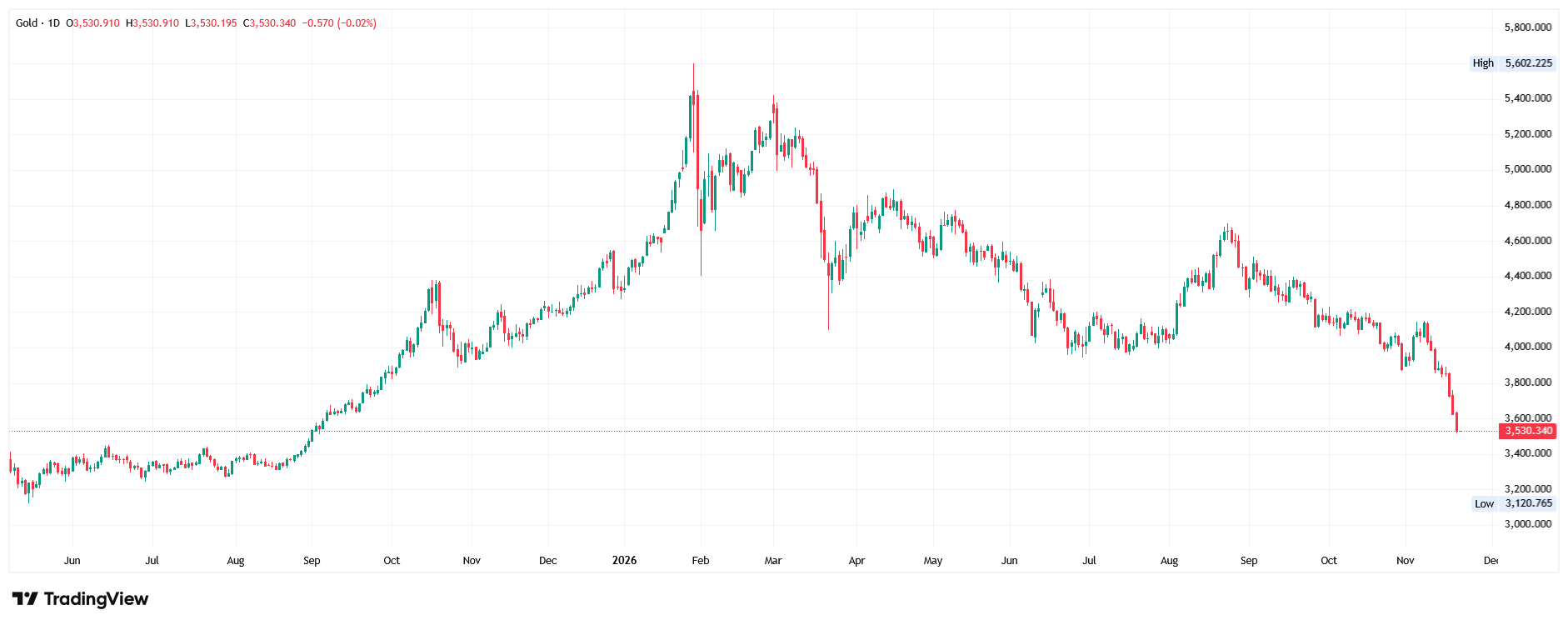
The immediate hurdle is U.S interest rates. Markets are pricing in another Fed increase and higher real yields could push bullion lower. Goldman’s longer-term case assumes eventual rate cuts draw Western funds back into Gold. For an active trader, the opportunity could arrive months before the first cut. Markets can reprice the prospect of cheaper money in a single session.
Think in Years. Trade in Months
“An opportunity in a long-term secular market does not require a long-term holding period,” says Hansen. “You can believe in the destination while trading the journey.”
That is how The Gold & Silver Club approaches The Hard Asset Decade. A trader can build a position as a recovery takes shape, take profits into strength and look for the next pullback. Even a partial recovery towards January’s high could offer several distinct swings, each with its own entry, target and exit.
“Waiting until confidence returns can mean paying a higher price for the same underlying opportunity,” says Hansen.
With Gold 34% below its record and central banks still accumulating, we believe that opportunity is being built now.
In 2008, Gold’s correction was followed by a historic rise. Gold prices almost went onto triple. For traders watching this correction, the work starts now.
“Gold’s greatest rallies often begin when sentiment is at its worst. Those who wait for confirmation usually pay higher prices”, Hansen concludes.
The window to accumulate is open. But if history is any guide, it may not stay open for long.
Where are prices heading next? Watch The Commodity Report now, for my latest price forecasts and predictions: