
Gold Prints Reversal Signal Amid Holiday Trading
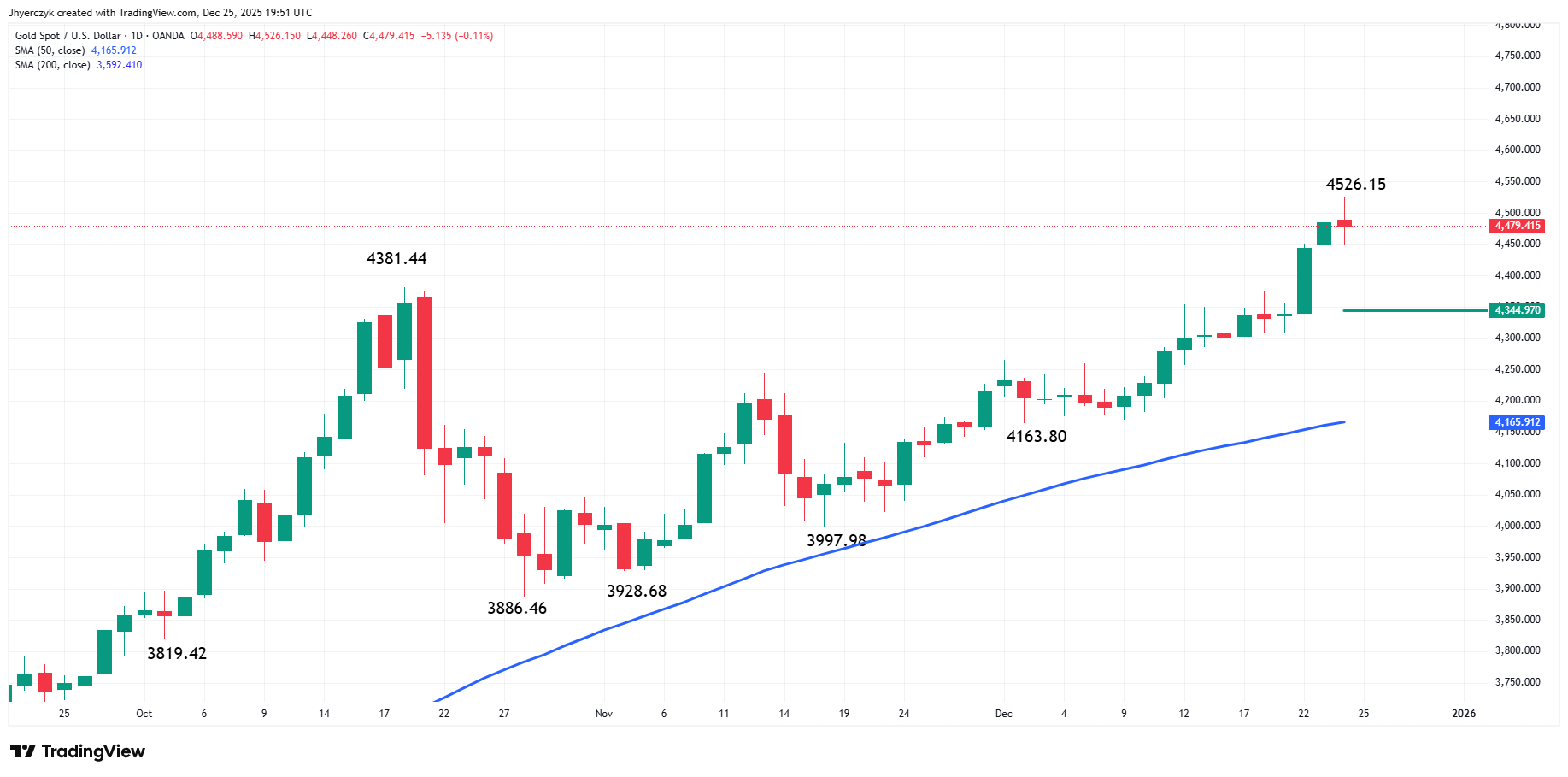
Spot Gold closed lower on Wednesday, producing a closing price reversal top in the process. This doesn’t mean the trend is changing, but it could mean that the selling is greater than the buying at current price levels. Given the timing of the signal, it may be related to thin-holiday trading and end-of-the-year profit-taking.
On Wednesday, XAUUSD settled at $4479.41, down $5.13 or -0.11%.

Key Technical Levels to Watch on Friday’s Open
The key to the signal is the follow-through. If sellers take out Wednesday’s low at $4448.26 when trading resumes on Friday, then this will confirm the chart pattern. This could trigger the start of a 2 to 3 day correction with $4344.97, the primary downside target.
With the main trend up, look for buyers on the original test of this pivot price. If this level is taken out with conviction then look for the selling pressure to possibly accelerate, putting the long-term trend indicator, the 50-day moving average at $4165.91, on the radar.
A trade through $4526.15 will signal a resumption of the uptrend. It will also negate the reversal pattern.
Federal Reserve Rate Cut Probabilities Shape 2025 Outlook
Fundamentally, the market is being supported by expectations of at least one or perhaps two rate cuts by the Fed in 2026. A rate cut in January seems to be off the table. With 34 days until the next Fed interest rate decision on January 28, the probability of a 25-basis point rate cut is 15.5%, the probability of no rate cut is 84.5%.
Gold Price Forecast
Every new Gold analysis as it publishes, today's technical signal and key levels, live price — on one page.
See all Gold forecastsIn March, the probability of a 25-basis point rate cut rises to 42.2% and the probability of no rate cut falls to 51.8%.
In fact, there is no certainty at this time in the financial markets, however, that’s not what gold traders think as evidenced by this week’s surge in prices to a record high and record high close.
Geopolitical Tensions and Dollar Weakness Fuel Safe-Haven Demand
The escalation of the war between Ukraine and Russia is also seen as a bullish concern as well as simmering tensions between the United States and Venezuela. Historically, these conditions have produced a surge in safe-haven demand for the U.S. Dollar, but this has not been the case in 2025, with the U.S. Dollar dropping nearly 10% this year, providing a huge boost to dollar-denominated gold prices.
Expectations of lower interest U.S. rates are also pressuring the dollar, creating ripe conditions for bullish investors.
Long-Term Bullish Case Remains Intact Despite Pullback Risk
The long-term forecast is bullish, given dovish Fed expectations, but traders are going to have to deal with short-term pullbacks. Nonetheless, this situation works out well because gold has not overheated this year with numerous vertical moves. In fact, for most of the year, gold has steadily climbed, well-supported by the 50-day moving average.
On October 20, XAUUSD peaked at $4581.44. The distance between that price and the 50-day moving average at that time was $685.00. As of the close on December 24, that space between the current price and the 50-day MA is $360.24, suggesting the metal is far from being overbought.
Trading Strategy: Buying Strength vs. Buying Dips
It’s best to trade the trend, even at current record price levels, but traders have to read the overflow in order to determine if they should buy strength through $4526.15 or buy dips into pivot prices like $4344.97, or moving average trend-indicators like $4165.91.
More Information in our Economic Calendar.