
Gold Price Holds Below $4,000 as Dollar Strength and Fed Uncertainty Cap Upside
Spot gold (XAU/USD) edged lower Tuesday, pressured by a stronger dollar and shifting expectations around U.S. rate cuts, as the market held just under the $4,000 mark. A pause in Treasury yield gains and some mild risk-off flows helped gold trim earlier losses, but traders remain cautious ahead of key U.S. data releases.
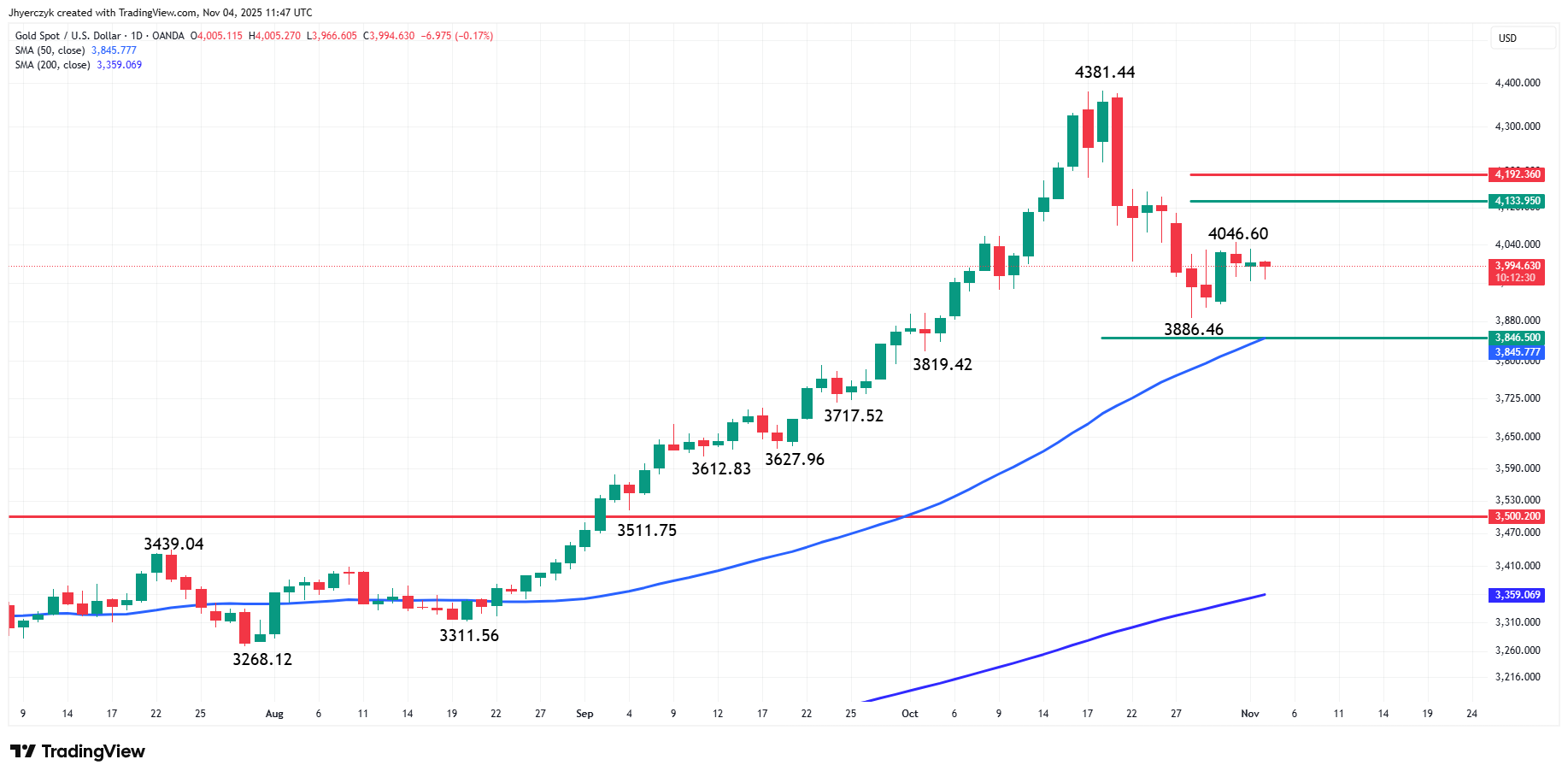
Gold briefly dipped below $4,000 on Monday, triggering technical selling and long liquidation, before clawing back ground as the U.S. dollar rally stalled.
The Dollar Index rose 0.20% intraday to hit a fresh three-month high, while benchmark 10-year Treasury yields eased to 4.089%, down nearly 2 basis points from Monday’s close. Lower yields typically support non-yielding assets like gold, but dollar strength continues to cap upside momentum.

Fed Signals Mixed as December Cut Odds Fall Below 70%
Fed policy signals remain mixed. While the central bank cut rates for the second time this year last week, Chair Jerome Powell stressed another cut in 2025 was “not a foregone conclusion.”
Market pricing now shows a 65% chance of a December cut, down sharply from 94% just a week ago, according to CME FedWatch. Fed Governor Lisa Cook supported the latest cut, citing downside employment risks, while Vice Chair Michelle Bowman is set to speak later Tuesday in Madrid, with traders watching for clarity on the Fed’s rate path.
Data Delays Leave Gold Traders Focused on ADP and ISM Reports
In the absence of official U.S. economic data due to the ongoing government shutdown, traders are relying on third-party reports.
The ISM manufacturing index for October came in at 48.7, below expectations of 49.3, reinforcing concerns about the U.S. growth outlook.
Gold Price Forecast
Every new Gold analysis as it publishes, today's technical signal and key levels, live price — on one page.
See all Gold forecastsFocus now turns to Wednesday’s ADP payrolls and ISM services data, which may offer more direction on Fed policy and gold’s next move.
Gold Technical Levels: Watching $4046.60 Breakout While Support Sits Distant
Technically, gold remains range-bound with price consolidating below the $4,000 mark. A decisive breakout above $4046.60 would open the door toward the resistance zone between $4133.95 and $4192.36. That zone marks a key test for bulls, and failure to clear it could trigger a reversal back toward recent lows.
On the downside, a break below the swing bottom at $3886.46 would signal weakness. The next downside target sits much lower at $3846.50, near the 50-day moving average at $3845.78. While this zone isn’t in play yet, it remains a key area to monitor on any deeper pullback. A clean break below it would likely accelerate downside momentum.
Gold Price Forecast: Neutral Bias with Downside Risk if Support Breaks
Gold is currently consolidating under $4,000 with short-term sentiment cautious. Without a clear break above $4046.60 or below $3845.78, the outlook remains neutral. However, if the 50-day moving average fails to hold, we could see a bearish move accelerate toward lower support. All eyes now turn to upcoming ADP and ISM data for the next major catalyst.
More Information in our Economic Calendar.