
Gold Slides on Friday as Traders Book Profits Ahead of Key Fed Meeting
Spot Gold (XAUUSD) prices eased on Friday, December 5, closing at $4,198.69 per ounce, down $10.08 or 0.24%, as traders locked in profits after an impressive midweek rally. Spot gold had briefly pushed to $4,259.34 during the session before retreating to an intraday low of $4,192.05—just under key Fibonacci support at $4,192.36—but buyers managed to reclaim that level into the close, showing some resilience ahead of next week’s policy risk.

Profit-Taking Caps a Strong Week
The rally earlier in the week was driven by growing conviction that the Federal Reserve will cut rates at its December meeting. Fed funds futures on Friday showed markets assigning an 87% probability of a 25 bp cut. But with gold up roughly 60% year-to-date, and more than 20% above its 200-day moving average, many traders saw Friday as a logical point to reduce exposure. The rejection just below $4,264.70—a weekly high—suggested buying fatigue at elevated levels and a market in need of fresh drivers.
U.S. Data Offers Mixed Signals
Friday’s economic releases offered no strong incentive for fresh gold buying. The long-delayed September PCE data showed core inflation easing slightly to 2.8% from 2.9%, while headline PCE rose 0.3% month-over-month and 2.8% year-over-year. These figures supported the Fed-dovish narrative but weren’t enough to justify chasing prices above multi-year highs. Sentiment data from the University of Michigan improved slightly to 53.3, and inflation expectations for both the one-year (4.1%) and five-year (3.2%) horizon ticked lower, signaling softening but persistent inflation concerns.
Dollar Holds Up Despite Weak Jobs Data
Despite weak labor readings—ADP showed a 32,000 drop in private payrolls and Challenger layoffs hit 71,321—the U.S. dollar remained firm. The greenback’s resilience likely capped gold’s upside, as a stronger dollar tends to weigh on international gold demand by making the metal more expensive in other currencies. With yields drifting lower but not collapsing, the interest rate picture remains fluid.
Outlook: Cautious but Constructive
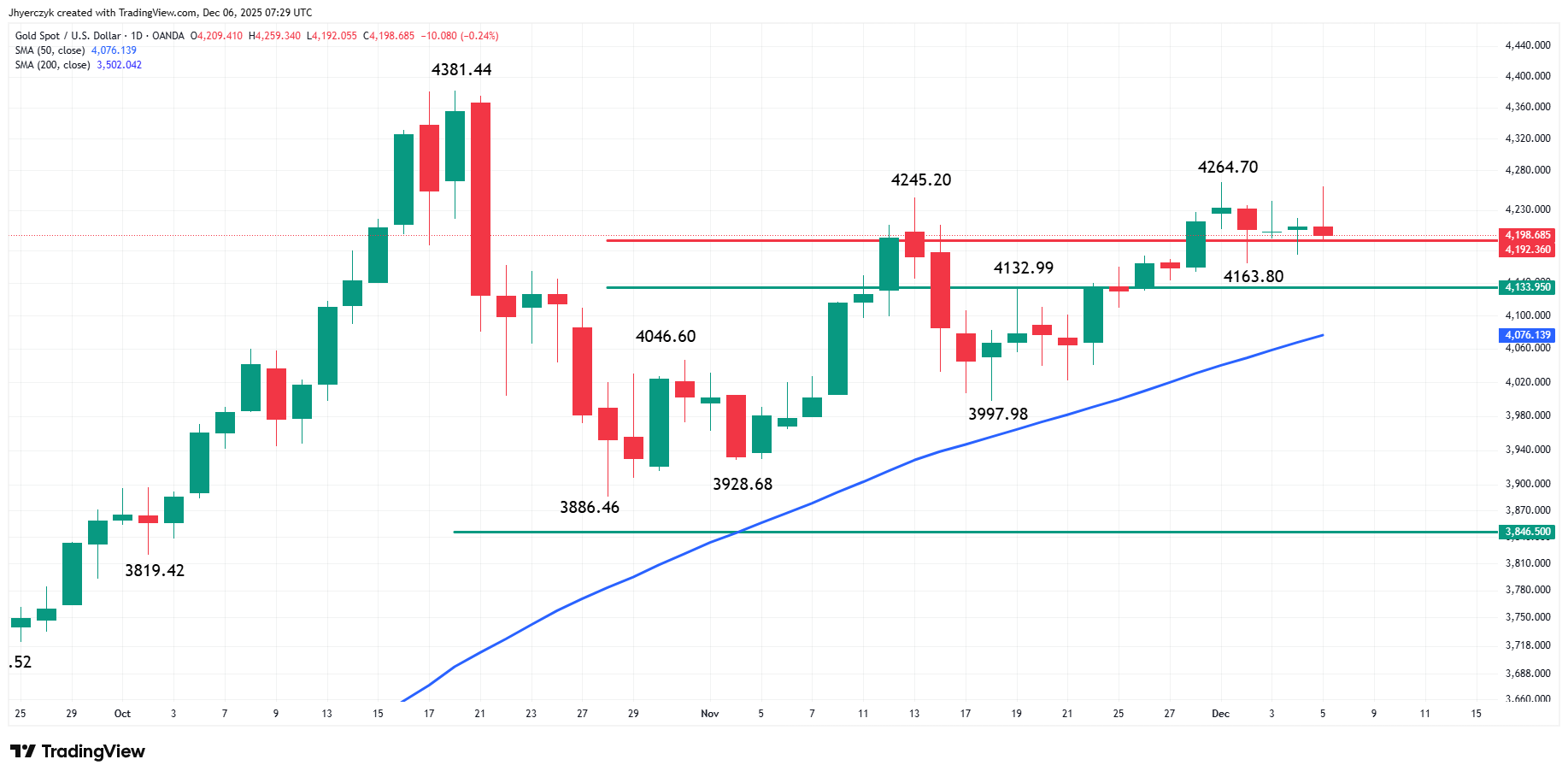
Gold remains supported by dovish Fed expectations, steady central bank demand, and geopolitical tail risks. But after failing to break through $4,264.70, the market now needs a fresh catalyst to retest the highs.
Gold Price Forecast
Every new Gold analysis as it publishes, today's technical signal and key levels, live price — on one page.
See all Gold forecastsA clean break below $4,192.36 could put $4,133.95 in play, followed by more significant trend support at the 50-day moving average of $4,076.14.
More likely than not, gold consolidates ahead of the Fed’s December decision, with bulls watching $4,264.70 and bears eyeing $4,192.36 for short-term direction.
More Information in our Economic Calendar.