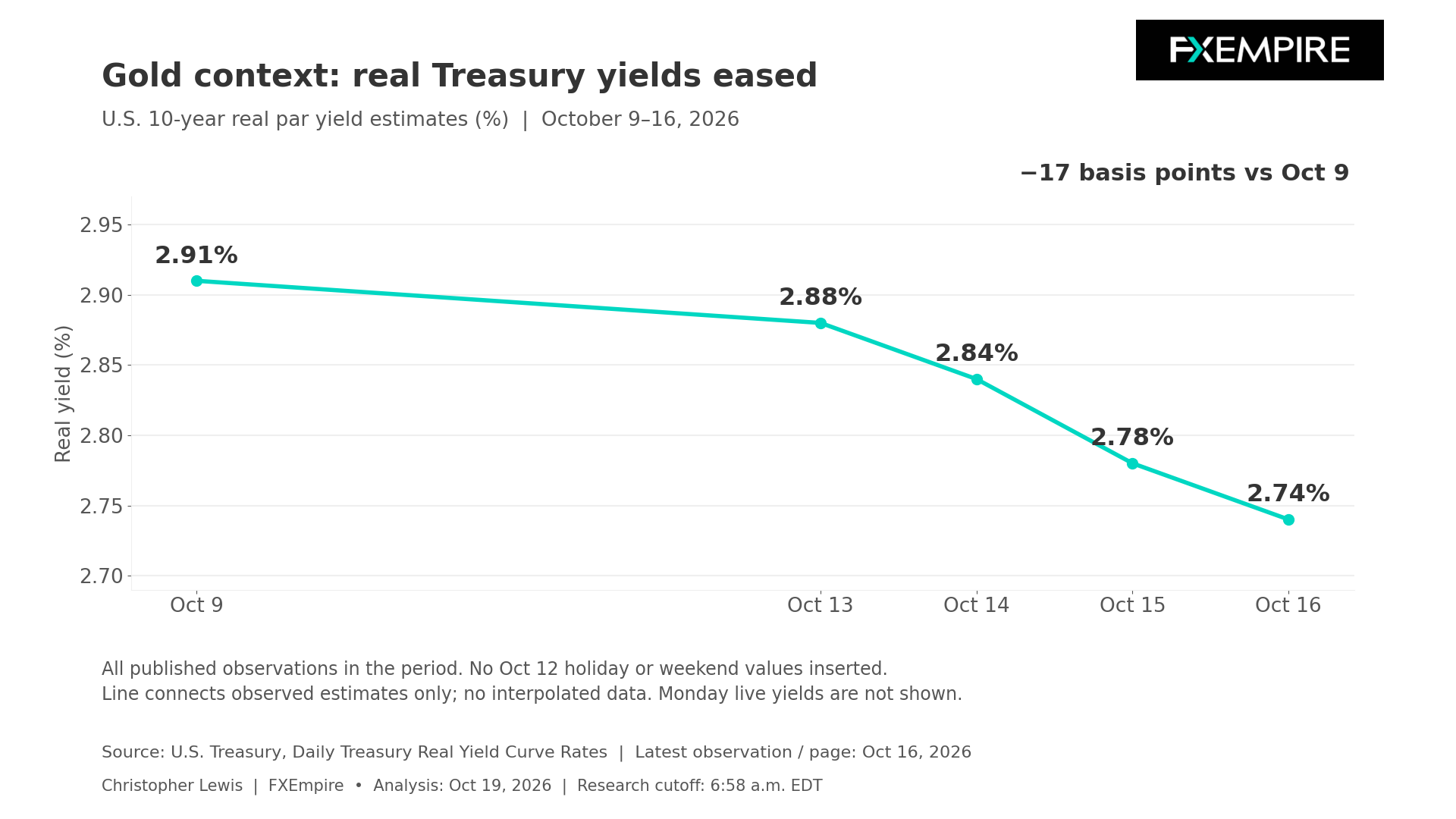
Gold started Monday with a more accommodating real yield backdrop than it faced a week earlier, but inflation continues to complicate the monetary outlook for the United States, Germany, and others. The U.S. Treasury’s 10-year real par yield estimate finished Friday at 2.74% last week, down 4 basis points from Thursday and 17 from the previous Friday. This does reduce one important opportunity cost in holding gold. It is a supportive fundamental input rather than proof that a move is coming into metals prices, though.

Real Yields
The chart below includes every published observation in the 10-year real yield par estimate between October 9 and October 16. There is no value for the October 12 session, as it was a federal holiday in America. These are Treasury estimates derived from inflation-protected securities, not a forecast of gold’s movement. This distinction is useful because the decline in nominal yields alone does not necessarily mean that inflation-adjusted returns will have also fallen.
Nominal rates also ended Friday lower. The Treasury reported a 2-year par yield of 4.74% and a 10-year par yield of 5.09%. Both remain interest-bearing alternatives to a metal that obviously distributes no income. Lower yields can improve gold’s relative appeal, but positive real returns still represent competition for gold to consider. Currency fluctuations, liquidity needs, and portfolio flows can offset the influence of rates, so the relationship should be treated as conditional and just one input.
CPI
The relevant comparison is also forward-looking. Subtracting the latest 12-month CPI rate from a nominal Treasury yield would mix different horizons and not reproduce the official real yield measure. For analyzing gold, keeping these concepts separate helps distinguish a change in the return investors can attain from an announcement about inflation that has already occurred.
Inflation evidence available on Monday is still last week’s September data. CPI released on the 14th increased 0.6% month-over-month on a seasonally adjusted basis and 3.7% over 12 months before adjustment. Excluding food and energy, the corresponding increases were 0.3% and 2.6%.
Gold Price Forecast
Every new Gold analysis as it publishes, today's technical signal and key levels, live price — on one page.
See all Gold forecastsPPI
PPI published on the 15th added a separate warning. Final demand prices increased 1.3% monthly on a seasonally adjusted basis and 6.3% annually before adjustment. The measurement excluding food, energy, and trade services rose 0.5% monthly. Producer prices cover a different basket of inputs from CPI, and their increases do not pass through to households one for one. Nevertheless, the breadth of evidence argues against the idea that inflation has disappeared from the United States economy.
The import price report on Friday broadened the picture, with September import prices increasing 1.1% from August, including a 0.7% rise excluding fuel, without seasonal adjustment. That release is relevant background for policy expectations, not an additional amount that we should be adding to the CPI for gold.
The Analytical Tension Is Straightforward
Persistent price pressure can increase interest in protecting purchasing power, while a restrictive policy response can raise the return available elsewhere, causing conflicting momentum. Activity offers a reason now to avoid a simple, easy narrative. The Federal Reserve report on October 16th showed industrial production increased 0.7%, with manufacturing output up 0.3%. Those preliminary estimates also indicate expansion in the measured month rather than a collapse that would by itself justify assuming immediate policy relief is coming out of the Federal Reserve.
The policy starting point remains the September 16 decision to raise the federal funds target range to 3.75% to 4%. The next FOMC meeting is scheduled for October 27 and 28. Neither last week’s inflation releases nor the decline in Treasury yields constitutes a new Federal Reserve decision. Market expectations of tighter or easier policy would also require separate evidence before they could be relied upon.
Yields Will Continue to Matter
For Monday’s outlook, persistence matters more than extrapolating one observation. Further declines in real yields would reinforce the supportive financing environment. A reversal, as investors reassess inflation and activity, would weaken it. A dollar move could alter the balance also, but no broad dollar direction is assumed at the moment through a comparable official series.
The gold market did initially try to rally a bit during the trading session, but has given back gains above the $4,200 level. This is a market that has been somewhat sideways over the last couple of weeks as we continue to wait to see whether or not the Federal Reserve is likely to hike rates between now and the end of the year. As things stand right now, it is expected to do so in December, so that provides a little bit of a counterweight to the idea of financial protection.
Technical Analysis
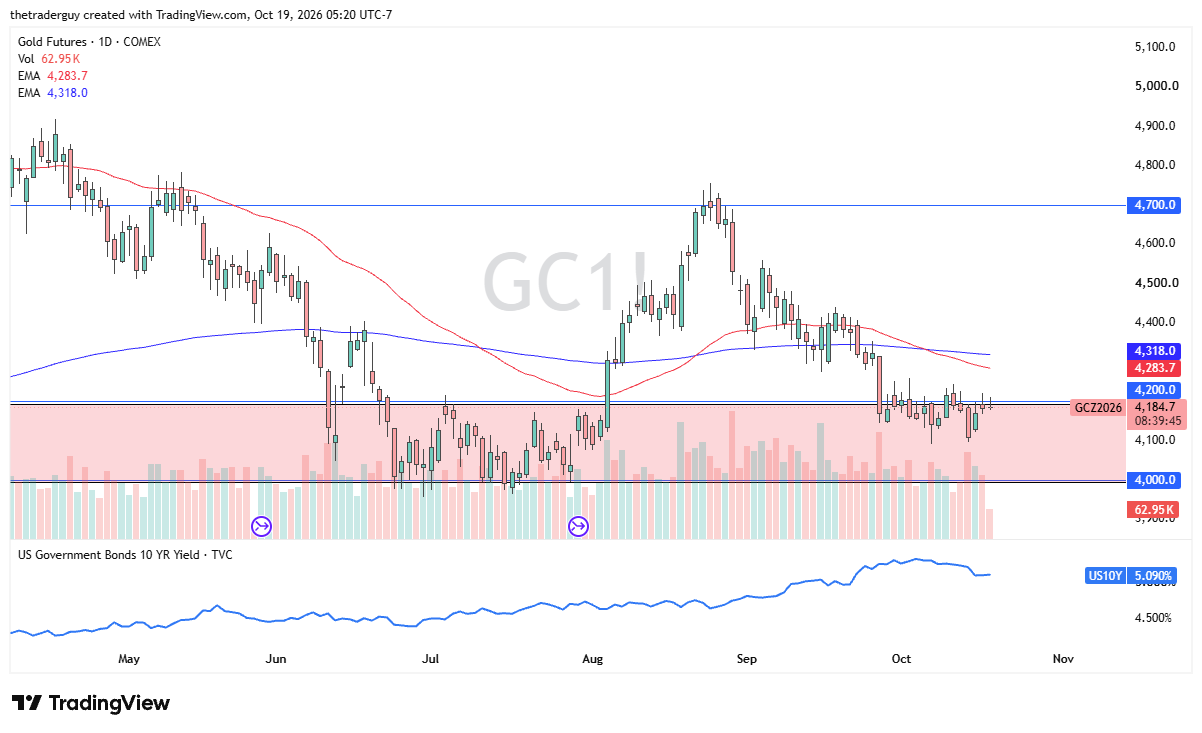
We are sitting at the top of a demand zone, and it looks like gold is simply killing time trying to figure out where to go next. It does have more of a buy-on-the-dip mentality to it, but if we were to break down below $4,000, that would be toxic for this market. To the upside, the upside seems somewhat limited currently.