



Following a retreat of more than 28% from January’s $5,595 record, The Gold & Silver Club believes the correction has opened a compelling accumulation window within a much larger bull market.
The attraction is substantial: a recovery to $5,000 would deliver more than 25% upside from below $4,000. Yet traders who wanted a cheaper entry now face the hardest part of buying a correction: acting while confidence remains fragile.
“Everyone wants a lower price and a stronger outlook simultaneously,” says Lars Hansen, Head of Research at The Gold & Silver Club. “Markets rarely make that combination comfortable. The opportunity lies in recognizing when the potential reward justifies the uncertainty.”
The 1970s Lesson: Deep Corrections Can Precede Explosive Gains
Gold’s great 1970s bull market repeatedly tested traders’ nerve. Data compiled by GSC Commodity Intelligence shows a roughly 29% decline in 1973 and a 46% fall between late 1974 and 1976. Both were followed by powerful triple-digit rallies to fresh record highs.
The pattern reappeared in 2008, when Gold fell around 30% before advancing to fresh records in the following years. Traders who interpreted the sell-off as the end of the opportunity missed the recovery.
For GSC, those episodes reinforce a powerful argument: a dramatic correction can create an attractive entry point within a continuing secular advance.
The Gold & Silver Club believes today’s monetary uncertainty, fiscal pressures and geopolitical fragmentation sustain the case for Gold. A lower price makes exposure to that thesis cheaper.
Gold Price Forecast
Every new Gold analysis as it publishes, today's technical signal and key levels, live price — on one page.
See all Gold forecastsThe $31 Billion Gold Rush Beneath the Sell-Off
Physically backed Gold exchange-traded funds attracted $10 billion in September, lifting third-quarter inflows to a record $31 billion, according to the World Gold Council. Holdings reached a record 4,256 tonnes despite September’s price decline.
Global Gold funds recorded inflows in 12 of the 13 weeks through 25 September, their most consistent run since 2022.
The divergence is striking. COMEX managed-money net long positions fell by the equivalent of 84 tonnes in September, even as ETF holdings increased. The Gold & Silver Club sees strategic demand persisting through a sharp reduction in speculative bullish exposure.
Central banks reported net purchases of 39 tonnes in August. China subsequently added 23 tonnes in September, its largest monthly purchase since October 2023 and its 23rd consecutive month of accumulation.
GSC interprets that persistence as evidence that substantial buyers are looking through the immediate weakness. Capital is already committing to Gold while the debate over its next move continues.
“Price weakness can dominate the headlines while accumulation continues underneath,” Hansen says. “That divergence deserves attention from anyone assessing Gold beyond the next trading session.”
Gold at $5,000: Waiting Could Become Expensive
Over the past 15 years, The Gold & Silver Club has built a reputation as the most accurate forecaster of precious metal prices, a record well documented across leading financial publications and institutional research reports.
The firm’s proprietary models have consistently pinpointed major turning points in both Gold and Silver – earning GSC recognition as a trusted authority among institutional investors and private wealth clients alike.
The Gold & Silver Club’s models project a base-case Gold target of $4,900–$5,000 an ounce by the first quarter of 2027.
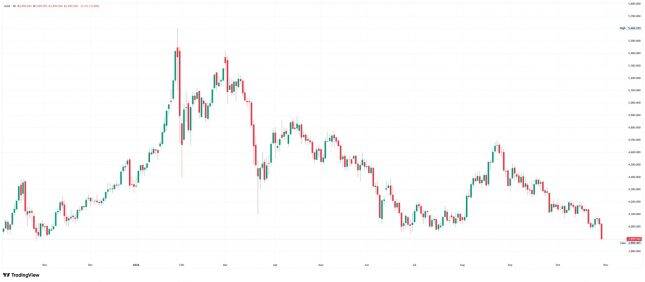
From below $4,000, the upper end implies more than 25% potential upside. A return to January’s record would offer still greater gains.
The arithmetic becomes less generous as the entry price rises. If Gold reaches $4,400 before a hesitant buyer acts, the remaining potential return to $5,000 falls to approximately 13.6%. Reassurance could come with a substantially higher purchase price.
GSC sees the correction as a moment to assess positioning seriously. Traders who believe in the longer-term thesis risk surrendering a meaningful portion of a recovery while waiting for the outlook to become convincing.
An easing dollar, lower real yields and renewed demand for monetary protection could strengthen the recovery case. Persistent dollar strength and restrictive interest rates could still delay a rebound or drive prices lower.
For traders, the firm also sees tactical opportunities in the metal’s week-to-week, macro-driven swings. Hansen summarizes the short-term playbook as: “Buy low, sell high. Rinse, repeat and do it all over again.”
The Hard Asset Decade Could Reward Those Who Act Early
The Gold & Silver Club’s conviction extends beyond a single price target. Its Hard Asset Decade thesis anticipates a world where resource constraints, monetary uncertainty and geopolitical competition increase the strategic importance of tangible wealth.
Within that framework, Gold below $4,000 could represent a consequential opportunity to accumulate before the next major advance.
“The Hard Asset Decade requires traders and investors to think beyond the next headline,” Hansen says. “Volatility will test conviction. The opportunity is to build that conviction on evidence, then act when price and strategy align.”
Gold’s next rally does not need universal confidence to begin. A recovery can gather speed while traders are still debating whether the low has passed.
If The Gold & Silver Club’s forecast proves correct, today’s uncertainty could look considerably less expensive than tomorrow’s reassurance.
“Gold’s greatest rallies often begin when sentiment is at its worst. Those who wait for confirmation usually pay higher prices”, Hansen concludes.
The window to accumulate is open. But if history is any guide, it may not stay open for long.
Where are prices heading next? Watch The Commodity Report now, for my latest price forecasts and predictions: