


Gold kicks off Friday’s session with inflation information fresh on the minds of traders. Released yesterday, the BEA’s September PCE prices rose 0.5% month over month and 3.6% from a year earlier in the United States. Excluding food and energy, prices increased 0.3% monthly and 3.1% annually.
The interpretation that I take away from this is that the release reinforces the need to distinguish an inflation concern from an automatic bullish signal. For gold, persistent price pressure can encourage demand for purchasing-power protection. That protection, though, can wane. It can also encourage investors to expect more restrictive policy for longer, increasing the appeal of competing interest-bearing assets. The balance between those effects matters more than the inflation headline itself.
Fed Rates
The policy backdrop is already past us, with the October 28 Federal Reserve meeting maintaining its target range of 3.75% to 4%, with two dissenters preferring a quarter-point increase. An unchanged target does not establish that the next move will be a cut. In fact, traders are betting on an interest-rate hike in December.
GDP Release
The BEA’s separate GDP release estimated third-quarter PCE inflation at 2.1% annualized and core PCE inflation at 2.5%. Those quarterly rates are different calculations from September’s year-over-year readings. A slower quarterly average and firm inflation at the end of the quarter can coexist, so make sure to compare these figures from a different timeframe scenario.
Yields Are Crushing Gold
The market, from a technical analysis standpoint, looks as if it is threatening a serious breakdown. Real yields provided a counterweight on Thursday. The Treasury’s 10-year real par yield fell to 2.63% from 2.67% on October 28, while the 5-year yield declined to 3.21% from 2.36%. In principle, lower returns can reduce the opportunity cost of owning a non-interest-bearing asset such as gold, yet gold does not necessarily track that mechanism perfectly. Currency conditions, liquidity preferences, positioning, and demand for defensive exposure can overwhelm that concern.
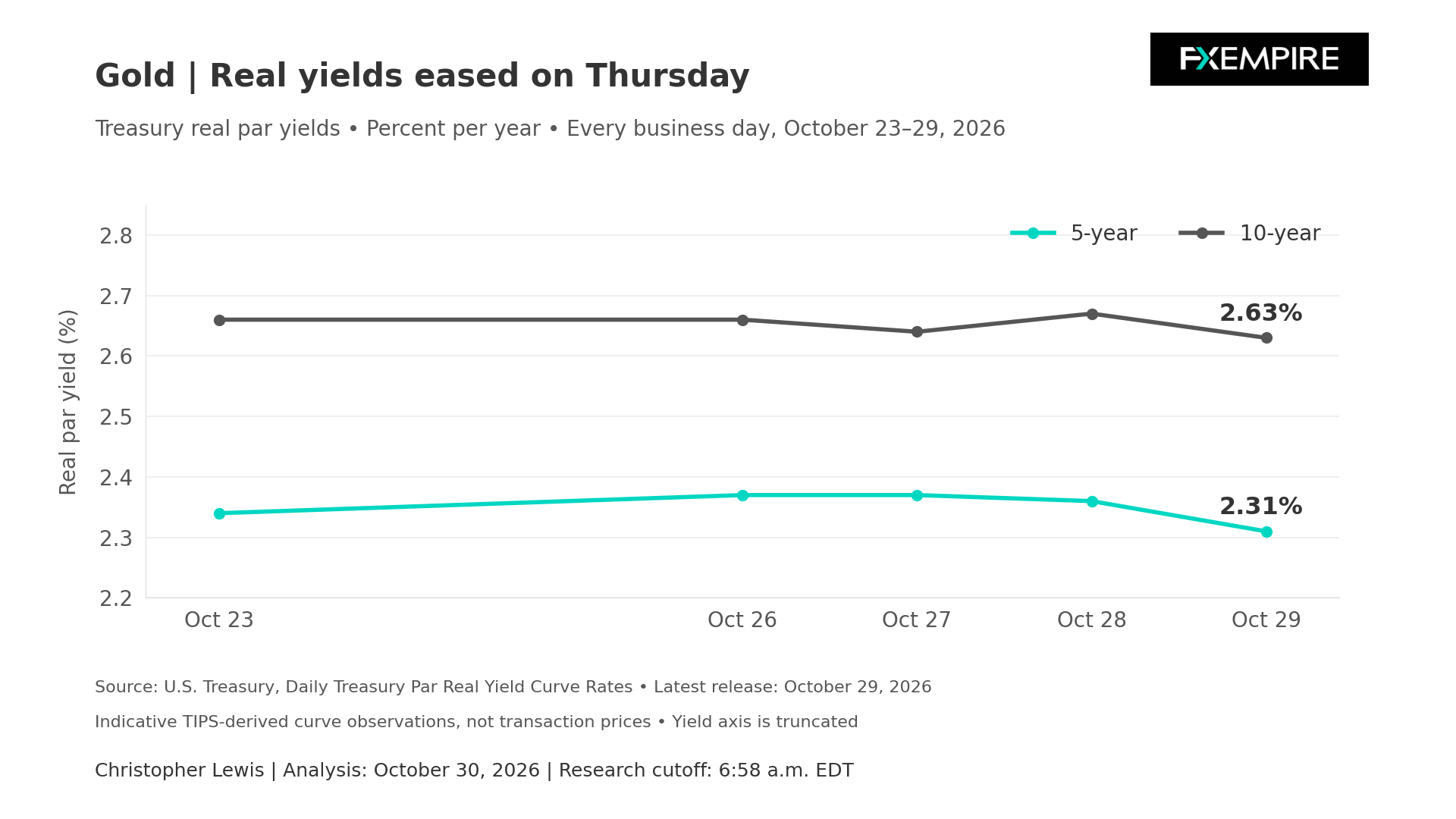
CME’s preliminary October 29 bulletin records December 2026 COMEX gold settling at $4,031.40 per ounce, down $20.20. The lower settlement price alongside lower real yields illustrates why the relationship cannot be treated as a fixed rule.
Gold Price Forecast
Every new Gold analysis as it publishes, today's technical signal and key levels, live price — on one page.
See all Gold forecastsToday, we get the third-quarter Employment Cost Index at 8:30 a.m., which can give us a bit of an idea as to what wage inflation may be, but it should be thought of as a small piece of the puzzle, not necessarily anything groundbreaking.
Price Pressures and Economic Activity
Gold needs to see evidence that underlying price pressure is moderating without a severe deterioration in economic activity. If that helped drive real yields lower, it could improve the appeal of bullion. A less constructive scenario would involve continued inflation persistence and a renewed expectation of restrictive policy.
The market, from a technical analysis standpoint, looks as if it is threatening a serious breakdown as it is below the $4,000 level. The $3,950 level is the next support level. After that, we could see a significant drop in gold as yields remain elevated despite the fact that they are declining.
Yields and Technical Setup
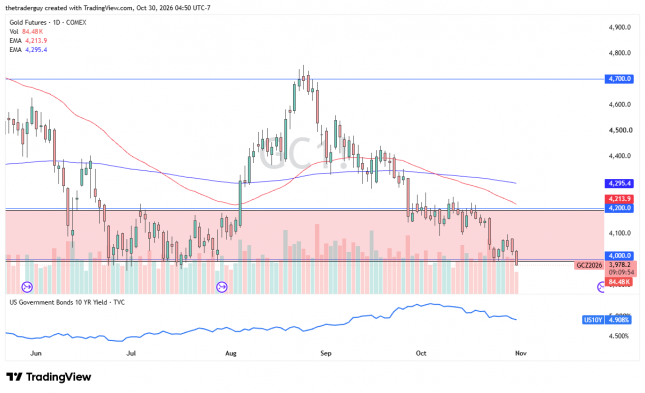
Gold versus real yields is the story here, not the nominal yield. So, depending on what inflation does and what rates do, we may continue to see pressure in this market. As things stand right now, jumping in on Friday and trying to catch a falling knife may not be the best move. Below $3,950, I become much more bearish.