


Gold kicks off the Wednesday session with a firmer real-yield backdrop pushing it, as well as fresh labor market information that does not establish a sharp deterioration in employment demand. The question at this point is going to be whether or not the data coming over the next couple of days will justify easier monetary policy while inflation remains persistent. This makes the response of inflation-adjusted government yields especially important.
The December 2026 gold futures settled yesterday at $3,940.40 per troy ounce, down $29.20 on the session. This decline establishes the previous session’s direction, but we have seen the market turn around during the early part of the session.
Real Yields
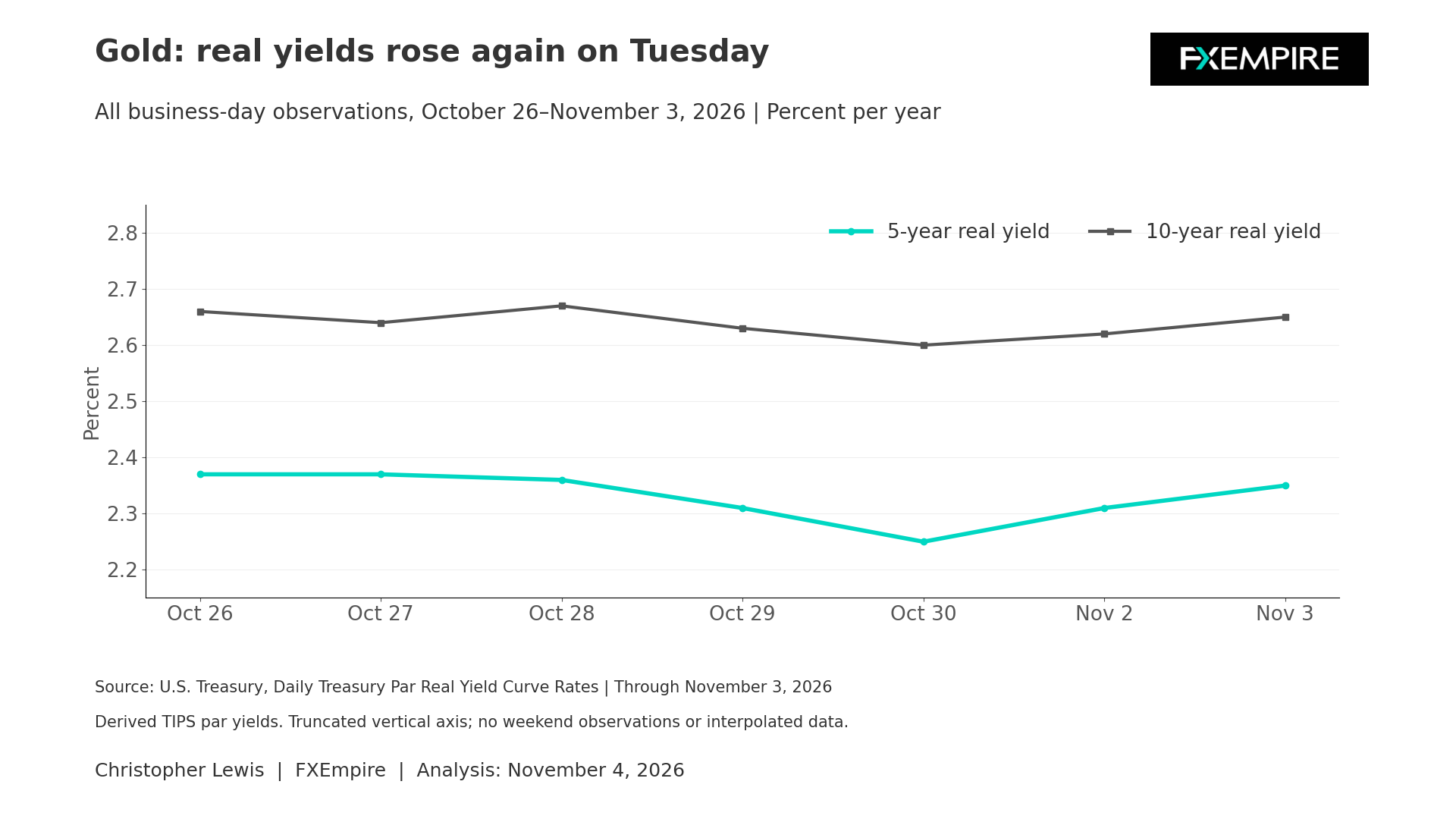
Treasury data shows the 5-year real yield rising from 2.31% on Monday to 2.35% on Tuesday, while the 10-year real yield increased from 2.62% to 2.65%. Both were above Friday’s readings. These are Treasury-derived inflation-indexed par yields rather than the yield on a particular transaction. The chart below shows the observations from October 26 through November 3 for gold. Rising real yields increase the return available from an interest-bearing alternative after accounting for the market’s inflation compensation. But it is not the only part of pricing gold.
I believe at this point it creates a less supportive environment for holding the non-yielding asset. Perceived risk, changing investment demand, and currency conditions can all outweigh that relationship at times, though.
For example, headlines that the Iranians and the Americans might be able to talk again certainly would provide a little bit of momentum. And, of course, the election results may have something to do with this as well, although it’s difficult to imagine that the situation changes much, as the strikes against the Iranians have had fairly strong Democratic support as well.
JOLTS Remains Strong
Tuesday’s JOLTS release supplies the most recent economic development. The Bureau of Labor Statistics reported 7.5 million job openings in September and described openings as little changed. Hires were 5.4 million, while layoffs and discharges were little changed at 1.6 million. The release is for September and was published yesterday. It is not an estimate of the jobs market going forward.
Gold Price Forecast
Every new Gold analysis as it publishes, today's technical signal and key levels, live price — on one page.
See all Gold forecastsThis does limit a little bit of the conviction that the JOLTS report provides ahead of payrolls this Friday. While JOLTS measures unfilled positions, hiring measures actual employment flows. Neither is interchangeable with the monthly change in nonfarm payroll employment.
Fed Target Range
Monetary policy remains a relevant backdrop as well. On October 28, the Federal Reserve retained its 3.75% to 4.00% target range. Two dissenters preferred a quarter-point increase. That decision doesn’t support presenting lower rates as an official commitment. In fact, gold’s outlook there will depend on subsequent evidence that changes the balance between inflation persistence and employment risk.
Inflation remains part of the balance. The BEA’s October 29 release showed September PCE inflation at 3.6% year over year and the measure excluding food and energy at 3.1%. Those are published September readings, not a new release today. What this means is they leave a material inflation issue for policymakers, even if an upcoming labor indicator softens.
NFP on Friday
Thursday’s preliminary third-quarter productivity and costs report and Friday’s October employment situation are both scheduled for 8:30 a.m. Eastern. Neither the productivity release nor the non-farm payroll announcement will necessarily move gold, but they will give us clues as to where monetary policy may end up.
A softer employment report accompanied by declining real yields would strengthen gold’s monetary case. Weak employment and a retreat in inflation pressure would present a more complicated outcome because a policy response would remain constrained. Conversely, strong employment and persistent cost pressure could sustain the opportunity-cost headwind, putting negative pressure on gold.
The yield curve also deserves attention beyond a single maturity. If only shorter real yields retreat while longer real yields remain firm, the easing signal is less comprehensive. A broad decline across maturities would provide broader evidence for that opportunity-cost environment improving.
Technical Analysis
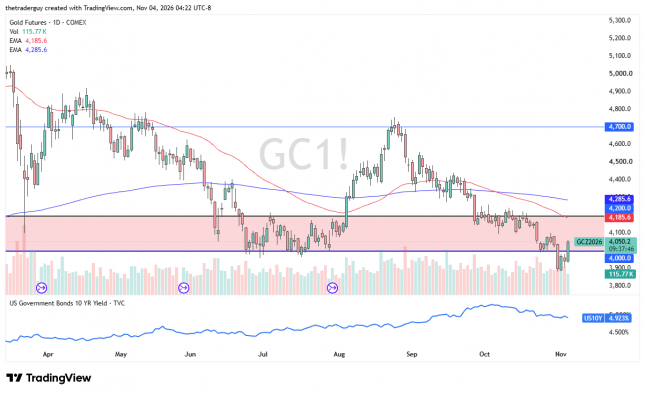
The technical analysis certainly is strong during the Wednesday session, although I have to question how long this actually lasts. The election results, of course, will have some people excited about the prospects of peace, but we have been some time away from the resolution of the conflict in the Middle East, although any good news is welcomed.
At this point, I still look at this as a market that cannot be trusted with rallies quite yet. By the end of the week, things may change, but between now and the employment numbers, I look at rallies with suspicion and may look to fade them on signs of exhaustion.