


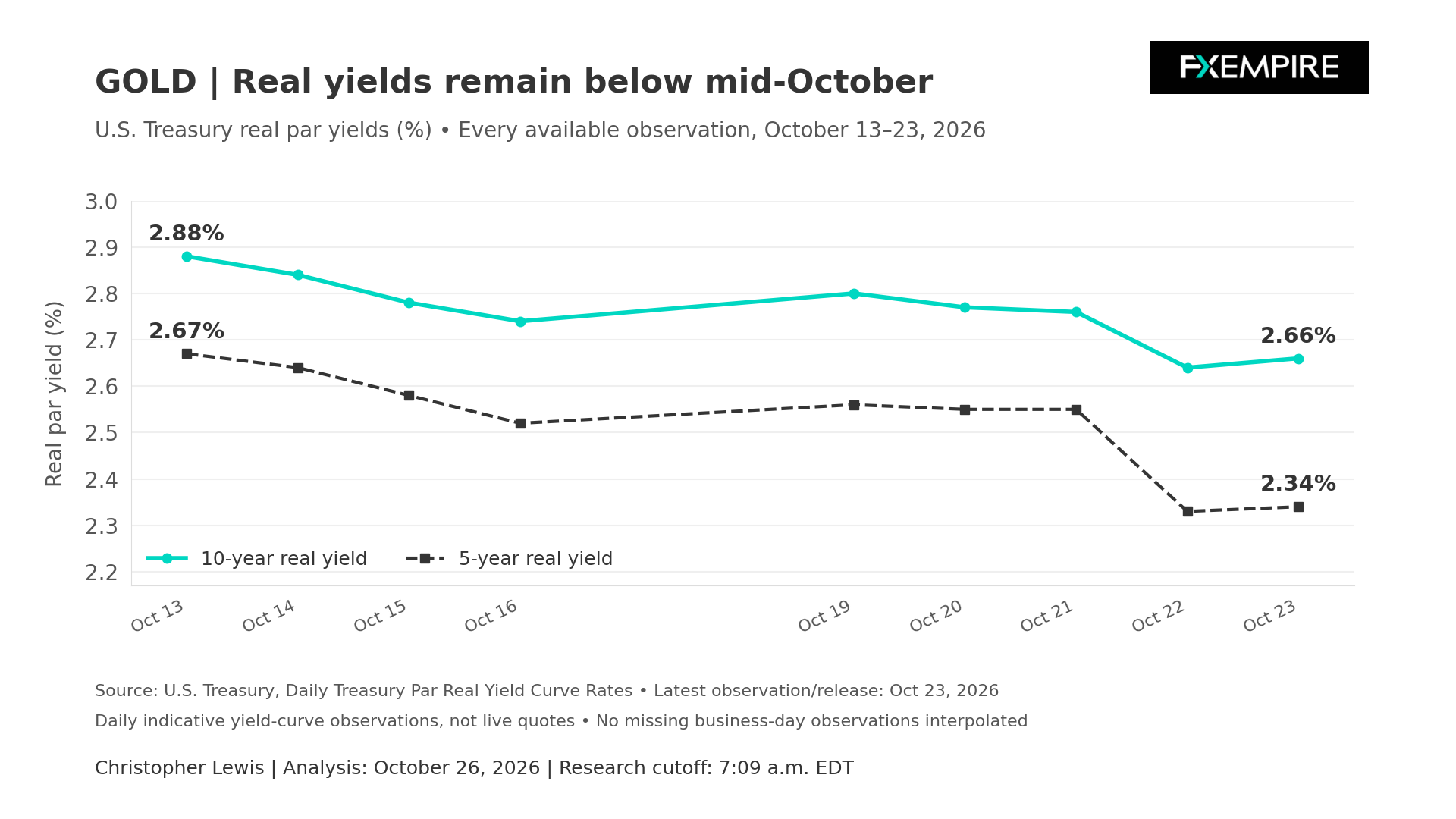
Gold markets opened the week with a much less demanding real yield backdrop than earlier this month, but Friday’s modest rebound cautions against calling that permanent support. The 10-year real yield finished October 23 at 2.66%, compared with a reading of 2.64% Thursday and 2.74% the previous Friday. Those dated U.S. Treasury observations describe the competing inflation-adjusted return available in bonds, though they do not necessarily predict what happens later on Monday.
The broader interest-rate picture is a bit mixed as well, with the nominal 10-year yield on Friday at 5%, up from 4.96% on Thursday, while the 2-year measure rose from 4.65% to 4.69%. The rebound late in the week gives the opportunity-cost argument the ability to reverse. For gold, the level and persistence of real returns matter alongside the direction of the daily move, particularly when an important policy decision is close.
Lower real yields could improve gold’s relative appeal, mainly due to the fact that gold does not pay any interest. The relationship is somewhat conditional, though, as investors may also respond to currency changes, demand for protection, or just simple liquidity needs. A decline in yields is therefore supporting evidence for a monetary narrative, not a mechanical instruction that gold must rise over time.
CFTC Positioning
Friday’s CFTC publication adds a view of positioning with an important lag. As of October 20, managed money held 120,970 long and 16,764 short standard gold futures contracts on the COMEX. The calculated net long was 104,206 contracts, down 2,883 from the preceding report. The distinction between positioning and physical demand is also useful: futures traders can reduce exposure while other investors retain bullion, and changes in gross longs and shorts can produce the same net movement through different behavior. A positive net long leaves scope for additional buying and liquidation. This does not identify how crowded every part of the gold market actually is.
Inflation Still High
The inflation backdrop still remains a problem for gold, with the September CPI numbers released on October 14 showing an increase of 0.6% month over month on a seasonally adjusted basis and 3.7% over 12 months before seasonal adjustment. Core CPI rose 0.3% monthly and 2.6% annually. These are dated background figures, not the latest action in inflation, but they do give us a strong backdrop from which to work.
Inflation can work through competing channels for gold. Consider traders being concerned about purchasing power that could encourage demand for protection, while a forceful policy response can raise real returns on competing assets. The question now is which channel the evidence reinforces. A report showing persistent price pressures would not automatically be bullish for bullion if bond yields also increased at the same time.
Interest Rate Decision
The central event this week is going to be the Federal Reserve announcement on Wednesday, scheduled for 2 p.m. Eastern, with a press conference at 2:30 p.m. The emphasis on inflation persistence, employment risk, and conditions for future decisions may matter just as much as immediate rate action, although there is no consensus that the Federal Reserve will necessarily raise rates.
Gold Price Forecast
Every new Gold analysis as it publishes, today's technical signal and key levels, live price — on one page.
See all Gold forecastsAdvanced GDP
Thursday brings advanced third-quarter GDP and September personal income and outlays at 8:30 a.m. Eastern, including PCE inflation. Friday’s third-quarter Employment Cost Index follows at the same time. These releases can test the Fed’s assessment of demand and domestic cost pressures. For gold, the relevant combination is the economic information and the response in real yields rather than a particular headline or quote.
The latest fundamental outlook is somewhat supportive on recent opportunity-cost comparisons, but vulnerable to policy and inflation reassessment. If lower yields can be sustained, that could reinforce support for the market, while a persistent rebound would work against it.
Looking at the Technical Analysis
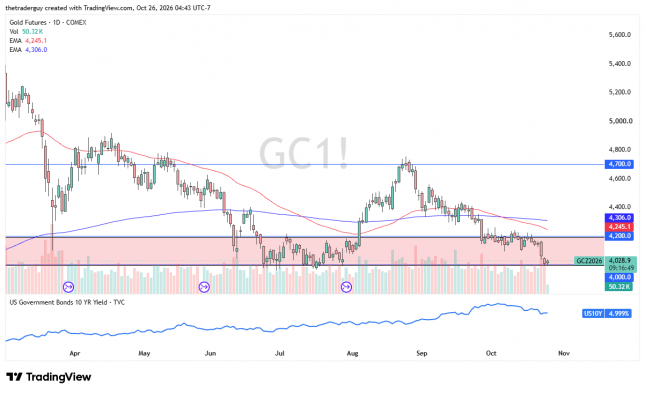
It is worth noting that the $4,000 level has remained supportive, and we have, in fact, bounced slightly from there. This could be a sign that the market is trying to turn things around. We will have to wait and see whether or not we have the ability to hold on to any gains over the next couple of days, and I suspect that the market is likely to see a certain amount of hesitation to get too overly aggressive between now and that interest-rate decision on Wednesday.