


Gold‘s fundamental outlook for the week ending November 6 rests on a difficult combination of issues: a labor market that continues to expand and inflation that still batters monetary policy. Friday’s employment release strengthened the evidence of U.S. economic resilience, while Thursday’s productivity figures offered a more encouraging signal on business costs. Together, they leave a more nuanced picture rather than a straightforward argument for immediate easing or inevitable tightening.
Jobs Continue to Surprise
The November 6 BLS report showed October payrolls rising 165,000, unemployment at 4.1%, and a combined upward revision of 84,000 jobs to August and September employment. Average hourly earnings increased 0.4% during October and 3.1% year-over-year.
For gold, the immediate implication is that weak hiring alone cannot presently carry the case for easier policy. A resilient economy gives policymakers more scope to focus on inflation. However, wages are only one part of the inflationary concerns. Whether firms offset compensation increases through higher productivity, accept lower margins, or raise prices all come into the mix.
Thursday’s preliminary productivity report supplies an important counterweight. BLS estimated third-quarter nonfarm business productivity growth of 3.6% at a seasonally adjusted annual rate, alongside a 0.7% annualized decline in unit labor costs. Unit labor costs were still 2.4% higher than a year earlier. This improvement does, therefore, offer a slight disinflation possibility without establishing that inflation has returned to target.
JOLTS
Earlier in the week, the November 3 JOLTS release reported September job openings of 7.5 million, hires of 5.4 million, and layoffs and discharges of 1.6 million, all described as basically little changed. This is a different survey and an earlier reference month than Friday’s payroll report. It adds evidence about labor market turnover.
Gold Price Forecast
Every new Gold analysis as it publishes, today's technical signal and key levels, live price — on one page.
See all Gold forecastsThe Interest Rate Backdrop Remains Demanding
The November 5 Federal Reserve H.15 release contains observations through November 4, with the 5-year Treasury inflation-indexed yield rising from 2.25% on October 30 to 2.39%, while the 10-year measure moved from 2.60% to 2.64%. The chart below includes every available business-day observation in that time sequence.
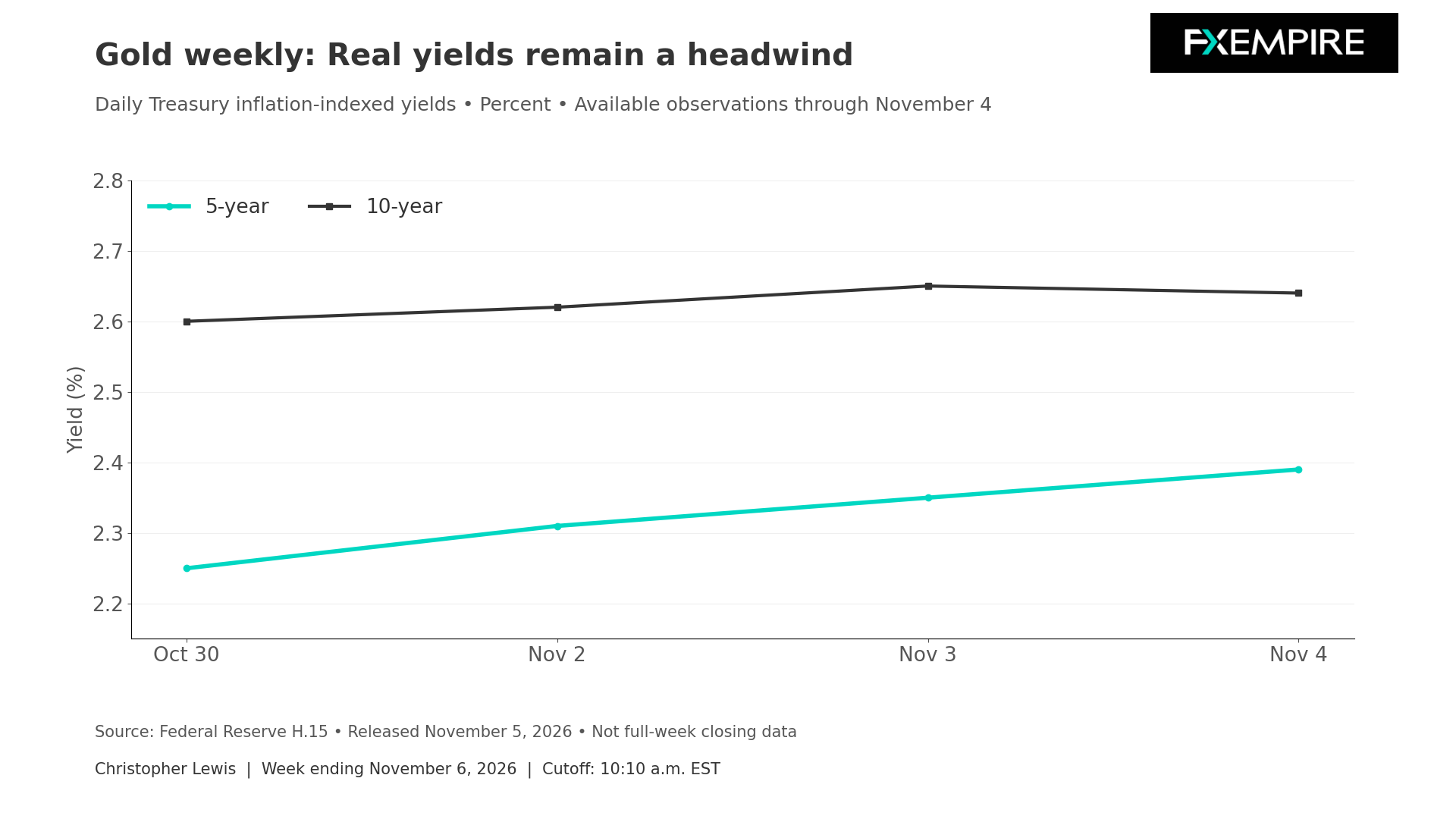
Positive yields create competition for an asset that does not pay any interest. That relationship is economically meaningful, but it is not a fixed trading rule. Demand for diversification or protection against uncertain outcomes can sustain gold even when bond yields rise.
Rate Policy and Upcoming Announcements
The policy framework was set previously on October 28, as the Federal Reserve held its target range at 3.75% to 4.00%. There were two dissenters preferring a 25-basis-point increase, though. The September PCE report released on October 29 showed annual inflation of 3.6% and core inflation of 3.1%.
The main theme of the outlook will be distinguishing between inflation protection and monetary restraint. Persistent price increases can encourage interest in gold, yet the policy response may raise the return available on competing assets such as government paper.
Next week brings October CPI on Tuesday, November 10, and October PPI on Friday, November 13, both scheduled for 8:30 a.m. Eastern Standard Time. The combination of details and subsequent yield response will be more information for gold traders to assess.
Technical Outlook on the Weekly Charts
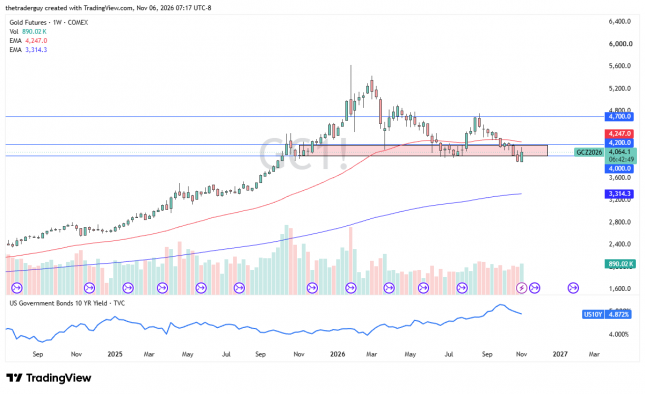
Looking at the technical analysis, the week has been positive, but we have clearly shied away from the $4,200 level, especially as the employment figures came out. With this being the case, the market is still in somewhat of a holding pattern. But if we were to give up $4,000 and start dropping from there, we could see further deterioration, perhaps down to the $3,600 level.
Breaking above the $4,200 level has me thinking that perhaps $4,700 might be possible, but we need yields to calm down.