
Gold Price Analysis as Traders Lean on the $4192.36 Pivot
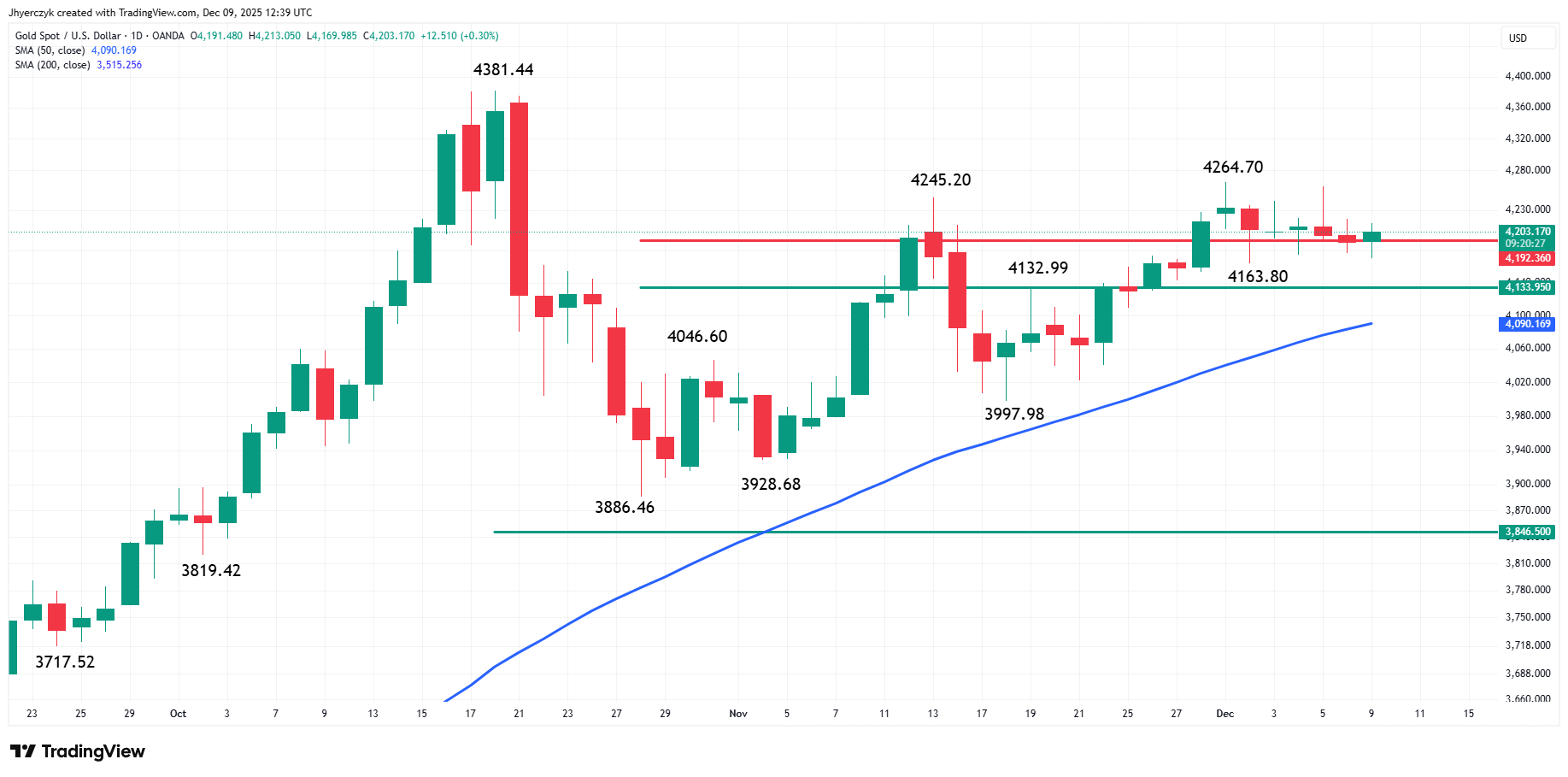
Here’s what’s moving Spot Gold prices right now — traders are locked onto the 61.8% retracement at $4192.36, which is the immediate line in the sand for short-term direction.
Spot prices are drifting slightly higher as buyers defend that Fib level, treating it as the nearest area of value. The 50-day moving average at $4090.16 remains broader trend support, but with nearly $100 of air between current trade and that indicator, the market is concentrating squarely on the pivot.
If gold clears the last swing top at $4264.70, the recent decline will likely be viewed as a clean pullback into the Fib zone at $4192.36, the minor swing bottom at $4163.80, or even the 50% retracement at $4133.95. Some traders still prefer value near the 50-day MA at $4090.18, but the more active debate right now is whether to buy strength above the pivot or lean into weakness if the level briefly fails.
At 12:37 GMT, XAUUSD is trading $4202.37, up $11.71 or +0.28%.

Fed Expectations Take Center Stage for Gold Traders
Gold is holding firm as markets assign an 89.4% probability of a 25-basis-point cut, but traders are more focused on the Fed’s path after December. Bond desks are scaling back expectations for meaningful easing in 2026, reflecting skepticism that Kevin Hassett — viewed as the frontrunner to replace Powell — will take a dovish stance. That caution matters for gold because long-run rate expectations influence real yields and overall demand.
Powell’s tone is the real volatility trigger. A message that the Fed may pause after this meeting would stabilize the dollar and keep yields contained. A dovish signal that leaves January on the table would weaken the USD and support another push higher in gold. ActivTrades’ Ricardo Evangelista said gold could revisit $4300 if the Fed confirms softer guidance and appears comfortable with additional easing ahead.
Gold Price Forecast
Every new Gold analysis as it publishes, today's technical signal and key levels, live price — on one page.
See all Gold forecastsYields, Dollar Tone, and Key Data in Play
Treasury yields held steady, with the 10-year near 4.164%, as traders waited for October JOLTS — expected at 7.15 million. The dollar index at 99.125 shows limited repositioning ahead of Powell’s remarks. The euro ticked higher, and the yen eased after early quake-related caution faded.
Gold Price Forecast: Bullish Bias Holds While $4192.36 Acts as Support
The near-term bias stays bullish as long as buyers continue to defend the 61.8% retracement at $4192.36. A breakout above $4264.70 could attract momentum buying if the Fed leans dovish. A sustained drop toward $4090.16 would signal a deeper pullback and challenge the broader dip-buying strategy.
More Information in our Economic Calendar.