
Margin Hike Triggers Sharp Selloff, But Uptrend Holds
Spot Gold (XAUUSD) settled sharply lower last week. The sell-off wasn’t the result of a major shift in the fundamentals, but rather a dramatic change in futures margins, which triggered a cascade of sell orders. Despite the steep loss, the uptrend remained intact, but the move left investors looking for value areas for their next buys.
Raising the margin makes trading more expensive, so investors have to be more selective about their entry prices. For months, traders chased the market higher by taking out offers. Now I think they are going to be more selective until upside momentum returns to the market.
Last week, XAUUSD settled at $4332.06, down $201.14 or -4.44%.

Technical Picture: Key Levels to Watch
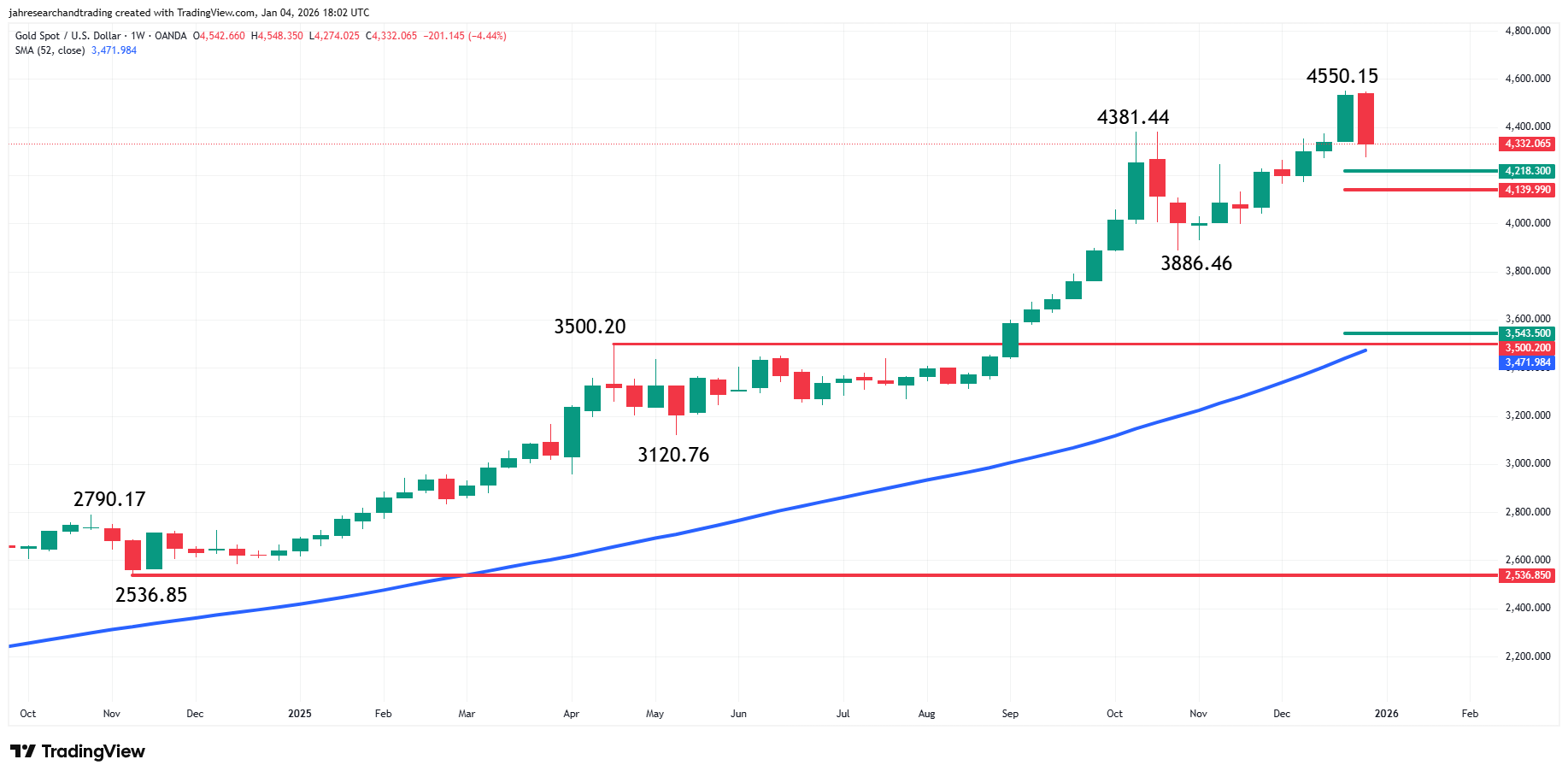
Technically, the main trend is up. A trade through $4,550.15 will signal a resumption of the uptrend. The main trend will change to down according to the weekly swing chart if $3,886.46 is taken out with conviction.
In between these two points is a retracement zone at $4,218.30 to $4,139.99. Trader reaction to this area should set the near-term tone. If buyers come in on the first test of this zone, then a new secondary higher bottom could form, eventually leading to a test of the record high at $4,550.15.
On the flipside, a failure at $4,139.99 will be a sign of weakness and lower prices to follow. This could create the downside momentum needed to drive XAUUSD into the main bottom at $3,886.46.
Long-Term Value Zone: Where the Smart Money Waits
For longer-term traders looking for the best value zone, the weekly chart is flashing a support cluster at $3,543.50 to $3,471.98. The first support is 50% of the rally from the November 2024 bottom at $2,536.85, and the second is the 52-week moving average at $3,471.98. The moving average is the long-term trend indicator. As long as this indicator holds as support, the market will remain in “buy the dip” mode.
Gold Price Forecast
Every new Gold analysis as it publishes, today's technical signal and key levels, live price — on one page.
See all Gold forecastsVenezuela Crisis Injects Fresh Uncertainty
Fundamentally, news over the weekend injected a fresh dose of geopolitical uncertainty into the gold market. Throughout the week, gold traders will be monitoring new developments in Venezuela after the U.S. launched a military strike and “arrested” President Nicolás Maduro on criminal charges.
It’s unclear what the U.S. role will be in maintaining stability in the country after President Trump said the U.S. would “run” Venezuela until an orderly transition is possible.
December Jobs Report Back in Focus
Gold traders will also be monitoring real-time U.S. employment data for the first time in months. On Friday, the Bureau of Labor Statistics (BLS) will release the December jobs report as originally scheduled.
This report is important because Fed officials have indicated that a weakening labor market could lead the central bank to make more interest rate cuts in 2026 than previously projected. Last week’s release of the Fed December minutes revealed that labor market data is one of the sources of division among Fed officials. The other being inflation.
Week Ahead: Venezuela Takes Center Stage
Looking ahead, I’m looking for short-term volatility in reaction to the Venezuelan situation. Traders will likely be leaning to the upside until the uncertainty either escalates or dissipates. The jobs data is on Friday, so we’re not likely to see the true reaction to the news until the following week. But for now, all eyes will be on Venezuela.
More Information in our Economic Calendar.