
Market Overview
Gold ticked higher in early European trading on Tuesday, and was back above $4,360, a rebound after a 4.5% whiplash drop in the previous session, its biggest single-day tumble since October. That sell-off was put down to the CME Group hiking margin requirements on Gold, Silver, and other metal futures, effectively forcing traders to stump up extra cash to stay in a trade.
Markets still reckon there’s a reasonable chance the Federal Reserve might cut rates in January, with a 16.1% chance, according to the CME FedWatch tool.

Gold Faces Limited Gains Amid Strong US Data and Holiday-Thin Trading
On the other hand, strong US economic data has limited Gold’s upside. The US Pending Home Sales Index increased by 3.3% month-on-month in November, after a revised 2.4% rise in October, according to the National Association of Realtors. This was much higher than the expected 1.0% and marked the highest level since February 2023. Stronger housing data shows that the US economy is holding up well. This can support the US Dollar and make it harder for Gold prices to move sharply higher.
On the other hand, strong US economic data has limited Gold’s upside. The US Pending Home Sales Index increased by 3.3% month-on-month in November, after a revised 2.4% rise in October, according to the National Association of Realtors. This was much higher than the expected 1.0% and marked the highest level since February 2023. Stronger housing data shows that the US economy is holding up well. This can support the US Dollar and make it harder for Gold prices to move sharply higher.
Additionally, trading volumes are expected to stay low as the markets approach the New Year holidays. This means Gold price movements may remain unpredictable, but without strong momentum in either direction.
Looking ahead, traders will keep an eye on the FOMC Minutes, expectations for Fed rate cuts, and global geopolitical events. As a result, Gold is likely to remain sensitive to changes in the interest rate outlook or rising global tensions, keeping overall support near the $4,360 level.
Gold Price Forecast
Every new Gold analysis as it publishes, today's technical signal and key levels, live price — on one page.
See all Gold forecastsGold Prices Forecast: Technical Analysis
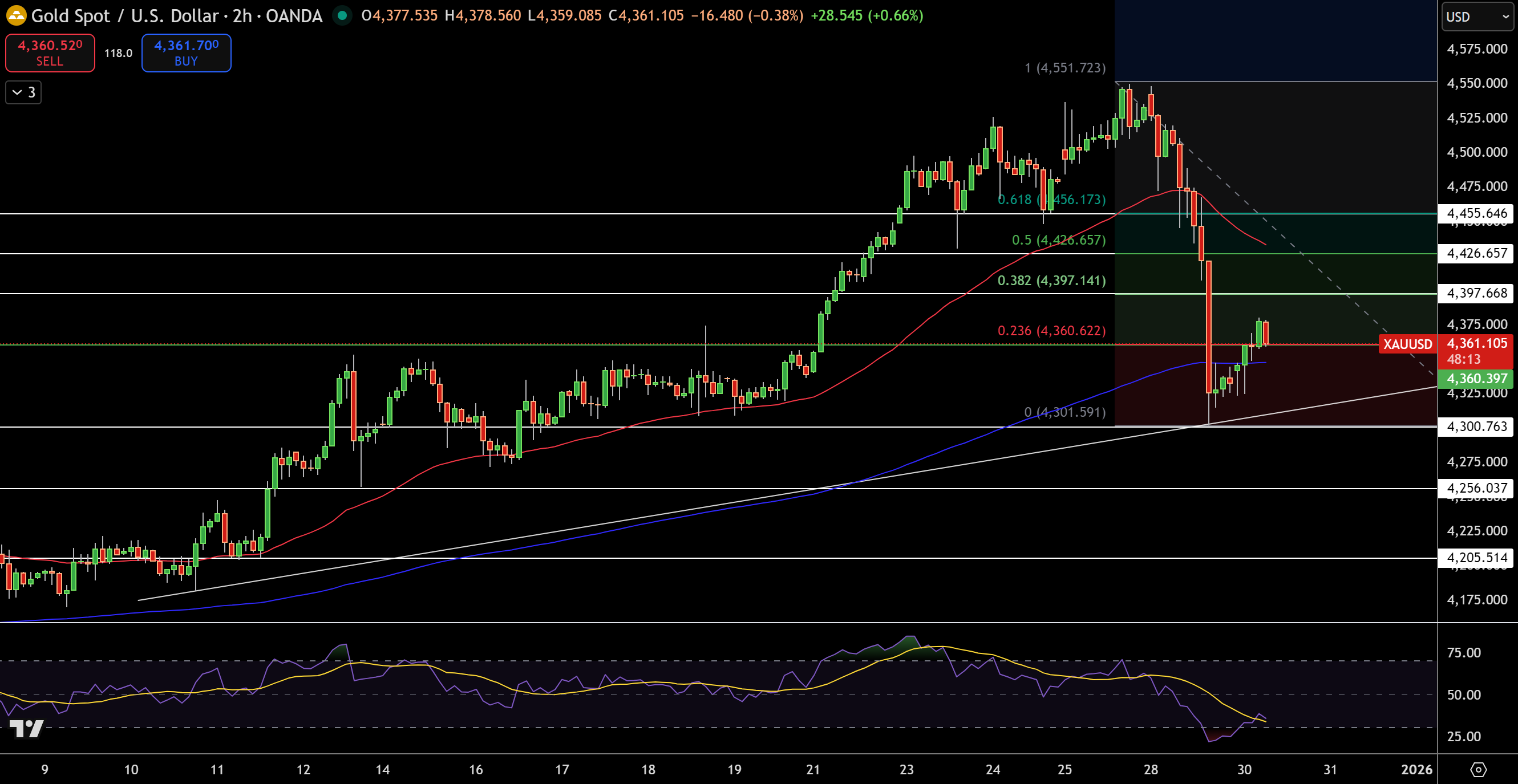
Gold (XAU/USD) is trading at around $4363 after an abrupt pullback from $4550, which is now sending the price into a sideways phase. Some somewhat bearish-looking candles came in and managed to cut through the 38.2% Fib at $4400 – they even briefly tested the 50% Fib near $4427 before buyers started to step in around the 61.8% level at $4357.
So for now, the price remains above the long-term rising trendline and the 200 EMA at $4300, which is good news for the overall trend.
To open up the strong resistance zone at $4480-$4520, we need to see gold move above $4400; if it breaks below $4300, then $4257 could come into view. And on a tactical level, it’s still good for dip buying around $4350 with a tight stop in place.
Silver (XAG/USD) Price Forecast: Technical Outlook
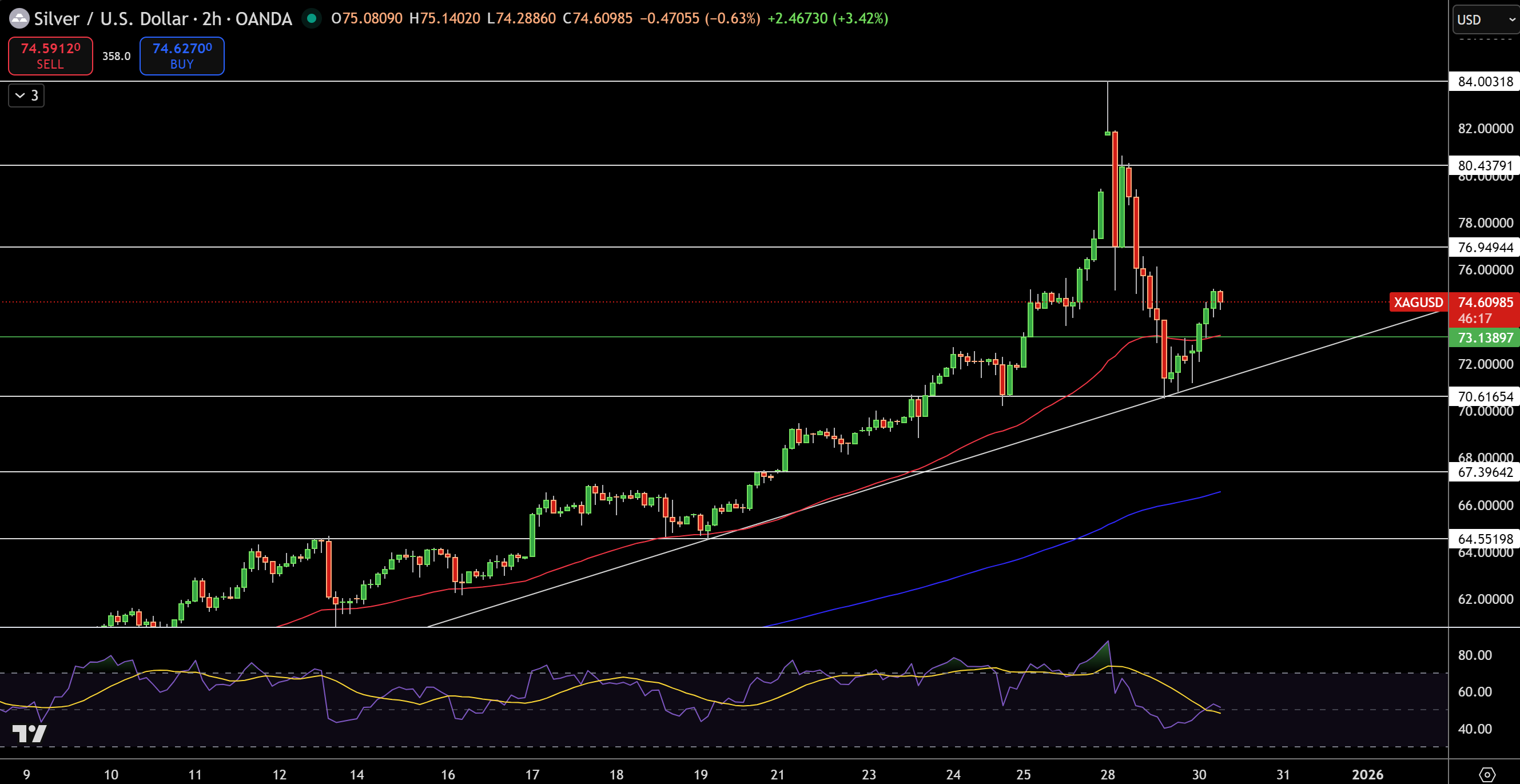
Silver (XAG/USD) is trading near $74.60 after a sharp rejection from the $82.00–$84.00 resistance zone, shifting the market into a corrective pause. Strong bearish candles erased a large portion of the rally, but recent price action shows stabilization above the rising trendline near $73.00, which has acted as dynamic support.
The structure still reflects higher highs and higher lows on the broader view, keeping the uptrend intact. The 50-EMA is flattening just below price, while the 200-EMA remains well below, reinforcing longer-term strength.
A push above $76.00 could reopen $79.50–$80.40, while a break below $72.80 risks deeper consolidation, making pullback buys near trend support attractive with controlled risk.