



Market Overview
Gold (XAU/USD) failed to maintain its bullish momentum and dropped sharply after surging more than 25% since the start of the month and a series of record highs set over the past two weeks or so. As of now, it is trading near the 5,210 level, hitting an intra-day low of 5,112.
However, the reason for its bearish bias can be attributed to profit-taking on news of a deal to avoid a US government shutdown, which boosted the dollar and triggered fresh selling. Despite this, ongoing threats to the Fed’s independence, trade tensions, and geopolitical risks continue to provide some support to the safe-haven gold.
Meanwhile, Silver (XAG/USD) is trading at 112.43, down 2.89%, as sellers stepped in after recent gains. However, the decline was mainly due to a stronger US dollar and news of a deal to avoid a US government shutdown.
US Dollar Gains Amid Government Funding Deal, Gold Faces Pressure
On the US front, the broad-based US dollar gained traction after Congress reached an agreement to fund the government through the end of the year. This eased worries about a possible government shutdown, leading some traders to sell gold.
At the same time, the ongoing worries about the Federal Reserve losing its independence and the chance of lower interest rates capping the gain in the dollar. Former President Trump criticized Fed Chair Powell and suggested big rate cuts, but the Fed kept rates unchanged. Investors are now waiting for the new Fed chair announcement, the upcoming US Producer Price Index (PPI) report, and comments from Fed officials.
Gold Gains Support Amid US Geopolitical Tensions and Russia-Ukraine Conflict
On the geopolitical front, US President Donald Trump’s tariff threats and ongoing global tensions are helping gold price to limit its losses. On Thursday, Trump said he wants to avoid using military force against Iran, which gave markets a small boost. However, concerns remain as he threatened to impose 50% tariffs on Canadian-made aircraft until American jets are certified in Canada.
Meanwhile, the US is sending warships and fighter jets to the Middle East, and Secretary of War Pete Hegseth said that America is prepared to take decisive action under Trump’s orders. This keeps the possibility of a military conflict alive, which usually boosts demand for safe-haven assets like gold.
Gold Price Forecast
Every new Gold analysis as it publishes, today's technical signal and key levels, live price — on one page.
See all Gold forecastsOn the other hand, tensions between Russia and Ukraine also add uncertainty. Russia invited Ukrainian President Zelensky to Moscow for peace talks, but no deal has been reached. Ukraine rejected Russia’s demand to give up the Donbas region, keeping the conflict unresolved and markets on edge.
Gold Prices Forecast: XAU Slips Below $5,250 as Uptrend Faces Its First Real Test
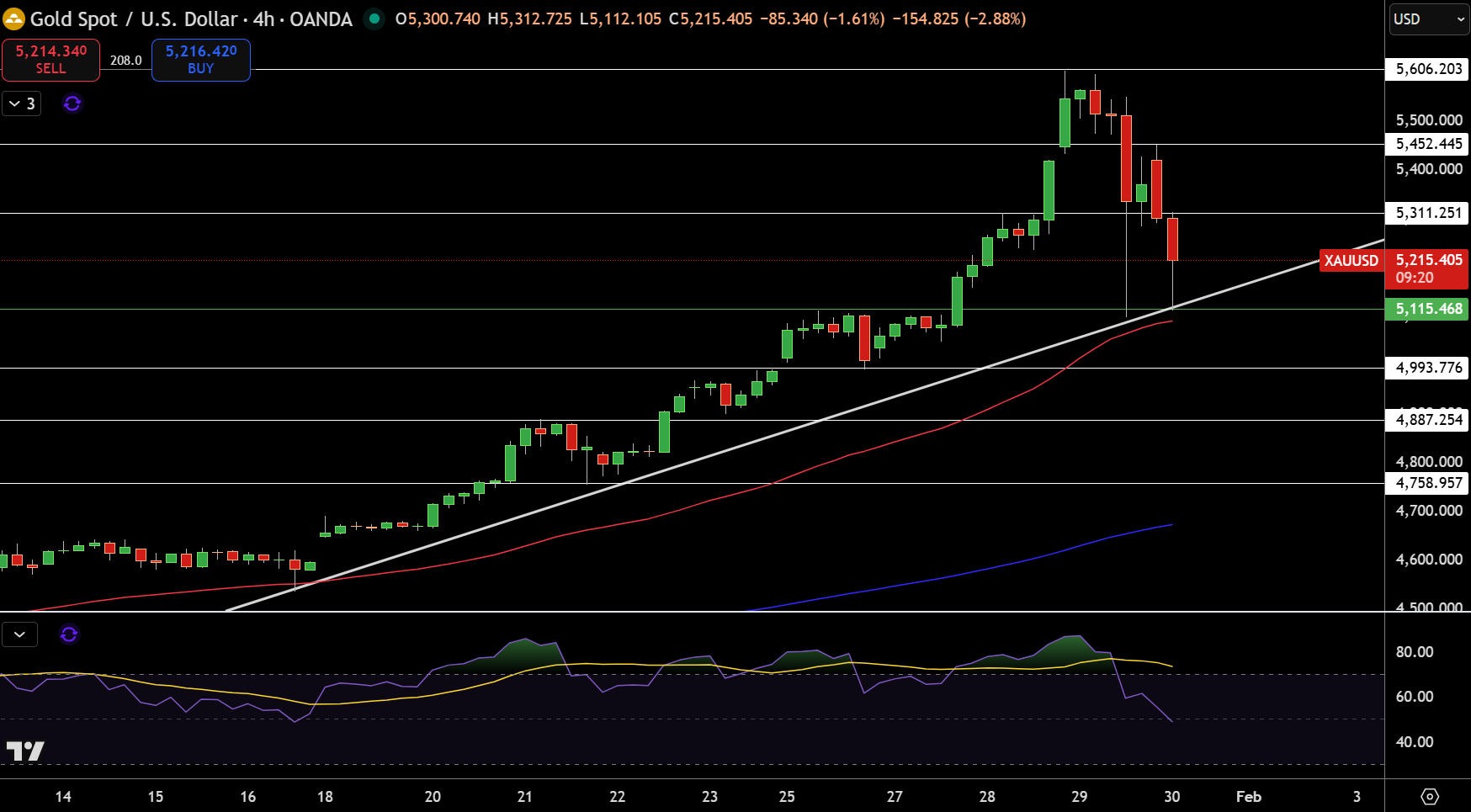
Gold (XAU/USD) is trading around $5,215, continuing its drop after it could not stay above $5,500. On the 4-hour chart, the price has fallen below the short-term rising trendline, which shows that upward momentum is fading. Recent candles have long bearish bodies, showing sellers stepped in after the price was rejected near resistance.
The overall trend remains positive, as the price is staying above the $5,115 to $5,000 support area and above the rising 50-period moving average.
RSI has fallen to the low 40s, which suggests momentum is slowing but there is no sign of panic selling. If the price moves back above $5,300, it could steady the trend, but if it drops below $5,115, a bigger pullback is possible.
Trade idea: Buy near $5,100, target $5,350, stop below $4,980.
Silver Price Forecast: XAG Holds $111 as Uptrend Pauses Near Key Support
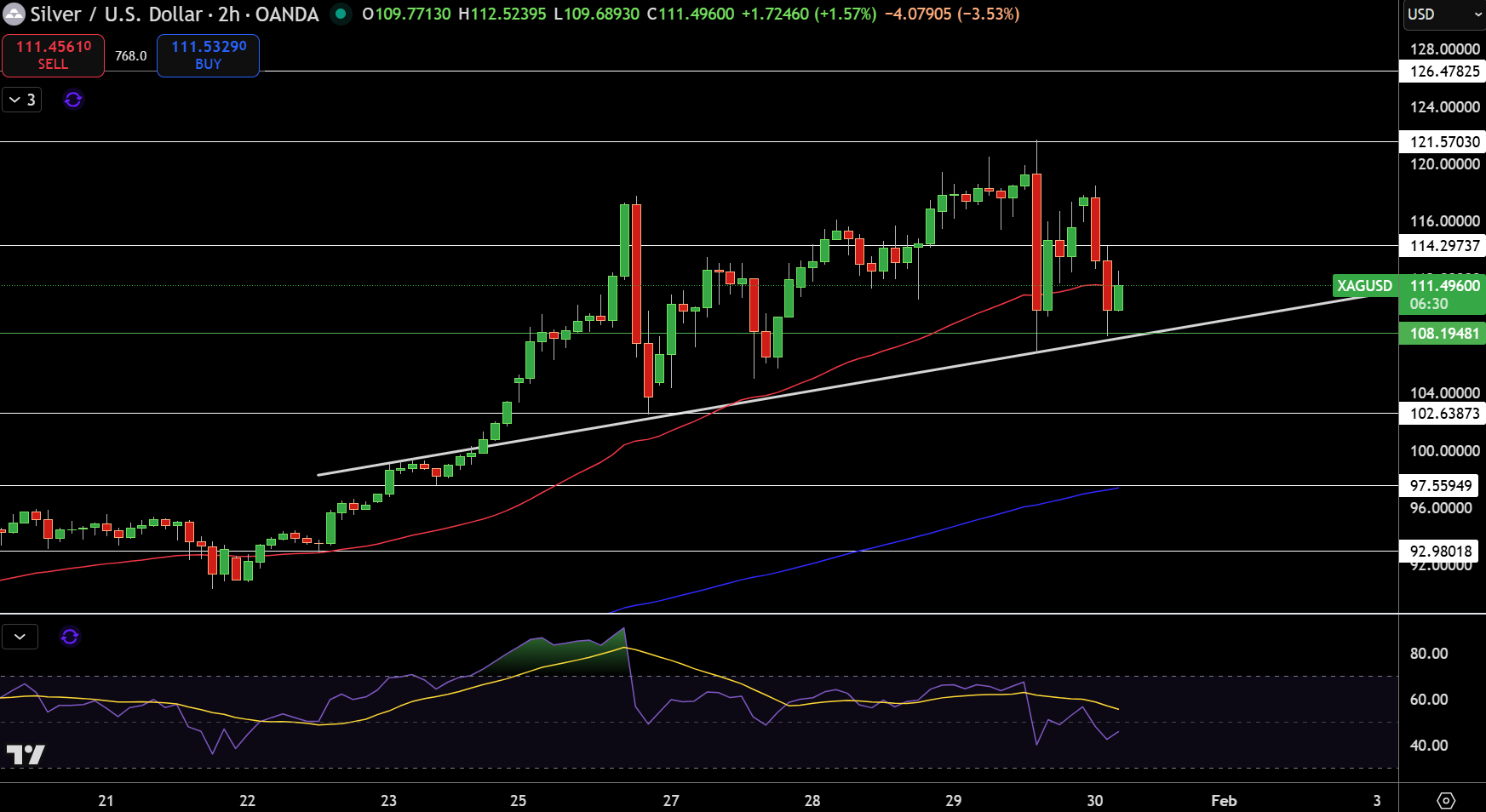
Silver (XAG/USD) is trading near $111.50, stabilizing after a sharp pullback from the $120 area. On the 2-hour chart, price remains above the rising trendline drawn from the late-January lows, keeping the broader structure intact.
Recent candles have long lower wicks near $108 to $109, which suggests buyers are stepping in on dips instead of heavy selling. The 50-period moving average is flattening just below the price, and the 200-period moving average is still well below at about $97, supporting the medium-term uptrend.
RSI has moved down to the low 40s, showing that momentum is cooling but not reversing. Resistance is at $114.30, followed by $120.50.
Trade idea: Consider buying near $109, with a target of $116 and a stop below $105.