Market Overview
Gold (XAU/USD) gained strong bullish traction, reaching an intraday high of $4,639. However, the upward trend can be attributed to expectations of further U.S. rate cuts and concerns over the Fed’s independence.
Investors are turning to precious metals like gold as bets on Federal Reserve rate cuts grow, following softer-than-expected US inflation data. Traders will look for additional cues from today’s U.S. Retail Sales and Producer Price Index (PPI) releases.
Meanwhile, Silver (XAG/USD) is trading at 91.09, showing +4.72% gains, supported by a weaker US dollar and growing expectations of Fed rate cuts.

Gold Gains as Weaker Dollar and Cooling US Inflation Boost Rate Cut Expectations
On the US front, the broad-based US dollar is showing some weakness after small gains in the previous session, trading around 99.10. This is helping gold, as a weaker dollar makes the metal cheaper for buyers using other currencies. These softer readings are supporting gold and silver while slightly weakening the US dollar, as markets price in a more dovish Fed outlook.
Gold is also getting support from growing expectations that the US Federal Reserve may cut interest rates later this year.
On the data front, the US Consumer Price Index (CPI) shows that inflation is cooling. Core CPI, which excludes food and energy, rose only 0.2% in December, below expectations, keeping annual core inflation at 2.6%, its lowest in four years. The headline CPI matched forecasts with a 0.3% monthly increase, bringing annual inflation to 2.7%. These softer readings are supporting gold and silver while slightly weakening the US dollar, as markets price in a more dovish Fed outlook.
Rising Geopolitical Tensions and Upcoming US Data Weigh on Market Sentiment
On the other hand, uncertainty is rising around the US central bank because of repeated threats from the Trump administration. Furthermore, in Iran, the situation is tense as security forces have cracked down on large protests, and hundreds of people have died, as per the latest report.
Gold Price Forecast
Every new Gold analysis as it publishes, today's technical signal and key levels, live price — on one page.
See all Gold forecastsMoreover, the government has also cut off Internet access, making it hard to know exactly what is happening in Iran. Trump has warned that the US might step in if protesters are killed. This increased the tension in the sentiment.
Meanwhile, investors are watching the US Retail Sales and Producer Price Index (PPI) reports due on Wednesday. If the data shows inflation is rising faster than expected, the US Dollar (USD) could strengthen.
Gold Prices Forecast: Technical Analysis
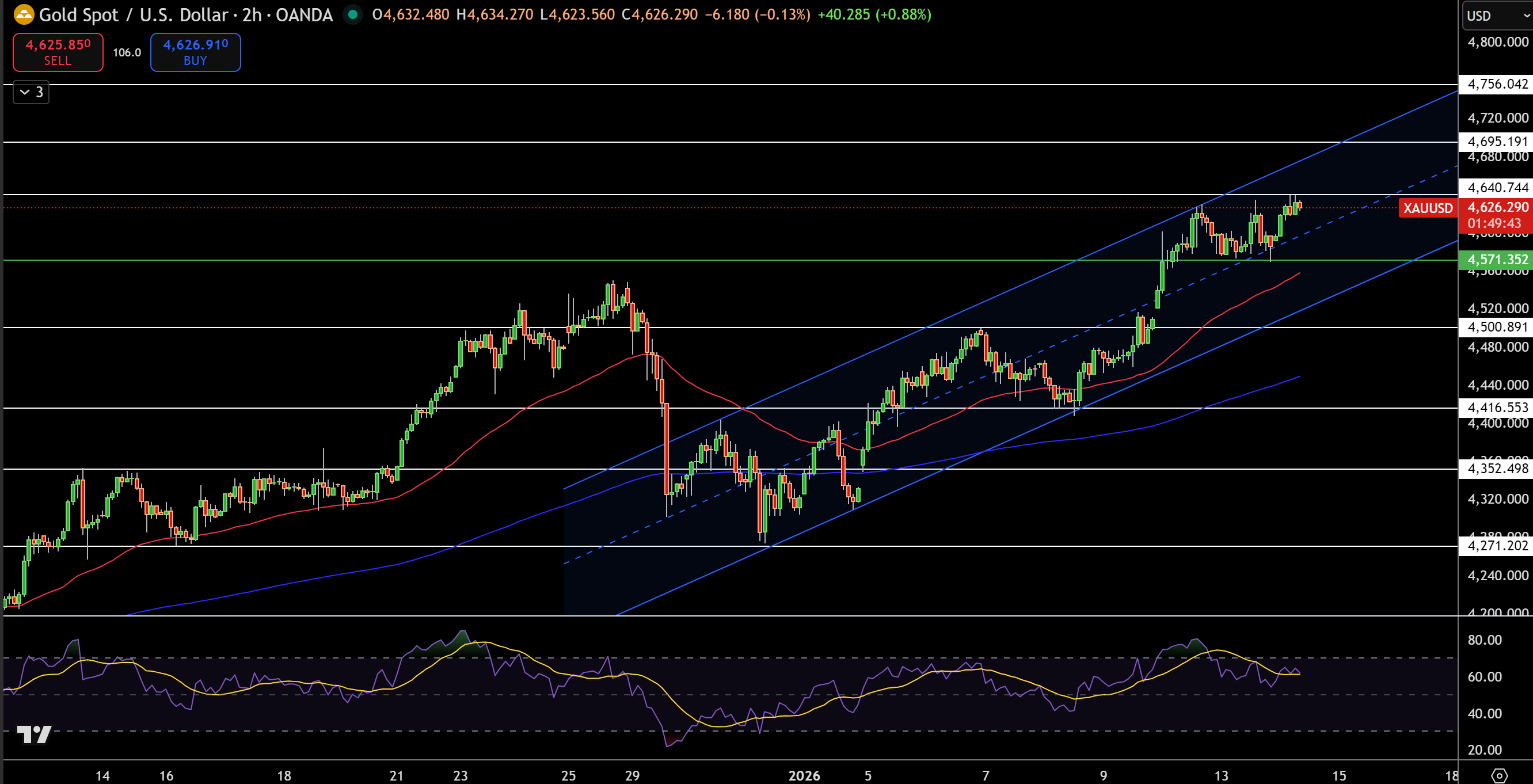
Gold trades near $4,626 on the 2-hour chart, consolidating just below the $4,640 resistance zone. The price of gold is respecting the upward channel, that with latest candlesticks signaling small bullish bodies and limited upper wicks. Typically, this indicates steady demand rather than aggressive selling.
The ascending trendline from late December remains intact, while the mid-channel support aligns near $4,570. A Fibonacci retracement from the $4,271 low shows price holding above the 38.2% level, keeping the structure constructive.
The leading indicator, RSI, is around 60 mark, is signaling momentum without overbought market conditions. No bearish engulfing pattern is visible yet. The trade idea is to buy near $4,580, set a stop below $4,520, and target $4,700.
Silver (XAG/USD) Price Forecast: Technical Outlook
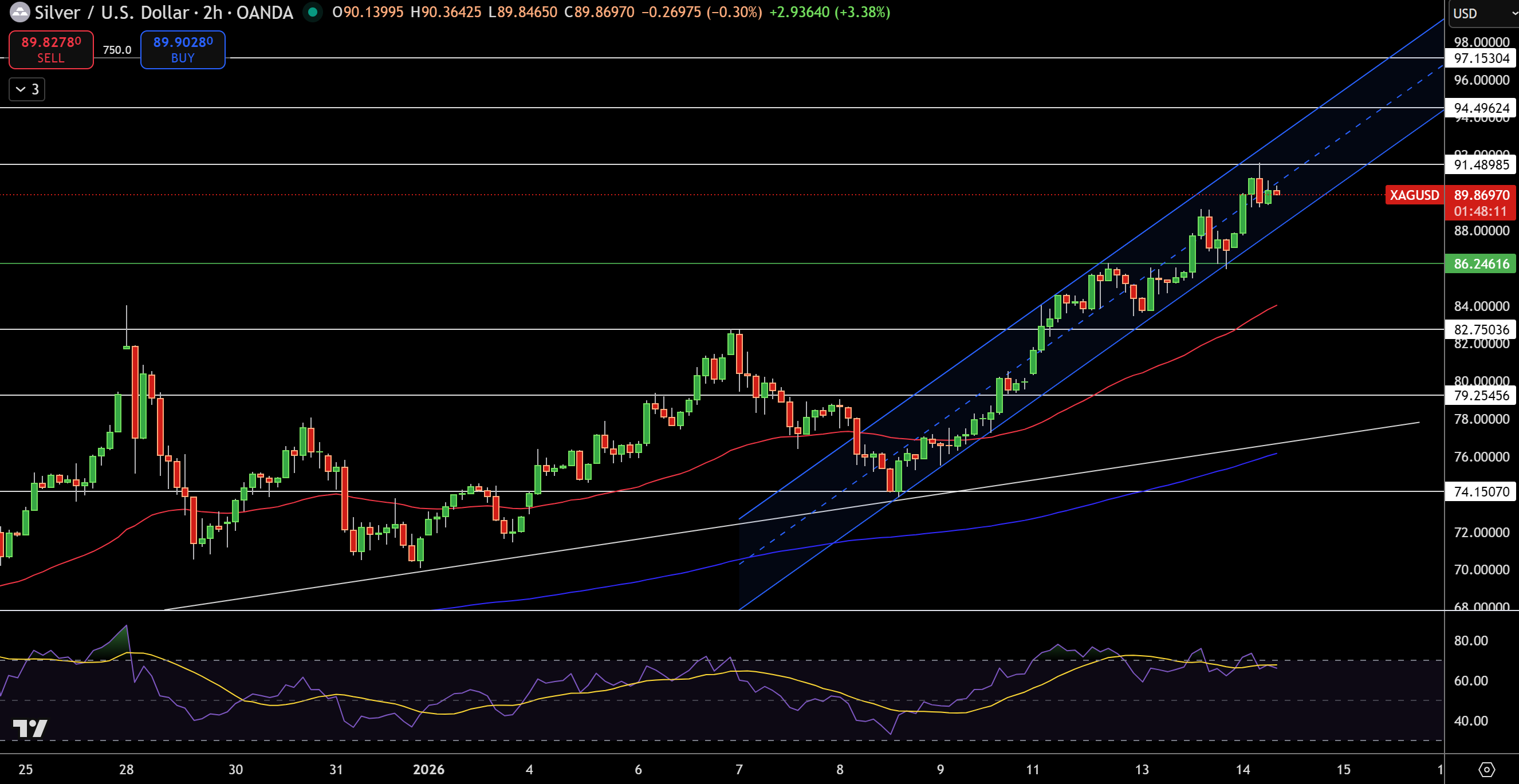
Silver is trading at around near $89.87 level on the 2-hour chart. It’s consolidating following a strong advance within a well-defined rising channel. Recent candlesticks show smaller bodies near the upper channel boundary, signaling a pause rather than a reversal. Price remains above the ascending trendline from early January, keeping the short-term structure bullish.
On the resistance front, it’s holding around $91.50 level, with immediate support at $86.25. Below this, the support is likely to be found around $82.75.
On the other hand, the 50-days moving average continues to slope higher and acting as dynamic support. The RSI indicator continues to hold near 60, signaling momentum is weakening but it’s still positive, with no bearish engulfing pattern visible yet.
The trade idea is to buy near $86.50, set a stop below $82.75, and target $94.50.