
Market Overview
Gold and silver strengthened as investors recalibrated expectations for US monetary policy following economic data that pointed to a slowing, though still stable, economy. Softer growth signals have weighed on the US dollar and reinforced demand for precious metals, which tend to benefit when interest rates are expected to remain lower for longer.
The Federal Reserve delivered its third 25-basis-point rate cut at the December meeting, but policymakers remain divided on the path ahead. While the median projection shows one additional cut in 2026, several officials see no need for further easing. That split has kept markets focused on incoming data rather than forward guidance.
Labor and Demand Show Signs of Cooling
Recent labor market data highlighted the shifting balance. Nonfarm payrolls rose by 64,000 in November, beating forecasts but marking a slower pace of hiring. The unemployment rate climbed to 4.6%, while average hourly earnings increased just 0.1% month on month, easing wage pressure.
Consumer demand also softened. US retail sales were flat in October, undershooting expectations and following a downward revision to September’s data. Together, the figures suggest that economic momentum is cooling without collapsing, a backdrop that strengthens the case for policy flexibility.
Inflation Data Takes Center Stage
Attention now turns to inflation indicators, with the Consumer Price Index due Thursday and the Personal Consumption Expenditures Price Index on Friday. These releases will shape expectations for further policy moves. Fed funds futures imply a 75.6% probability of rates holding steady at the January meeting, according to CME FedWatch data.
Why Silver Is Tracking Gold
Silver has moved in tandem with gold, supported by its role as both a monetary asset and an industrial input. Expectations of looser financial conditions support investment demand, while slower growth keeps risk appetite cautious. With inflation still under review and policy uncertainty elevated, fundamentals continue to favor gold and silver over yield-sensitive assets.
Gold Price Forecast
Every new Gold analysis as it publishes, today's technical signal and key levels, live price — on one page.
See all Gold forecastsShort-Term Forecast
Gold holds above $4,300, targeting $4,350–$4,390 short term, while silver near $66.20 eyes $66.90–$68.50 as momentum stays positive; dips toward $4,260 and $64.60 may attract buyers on pullbacks ahead week.
Gold Prices Forecast: Technical Analysis
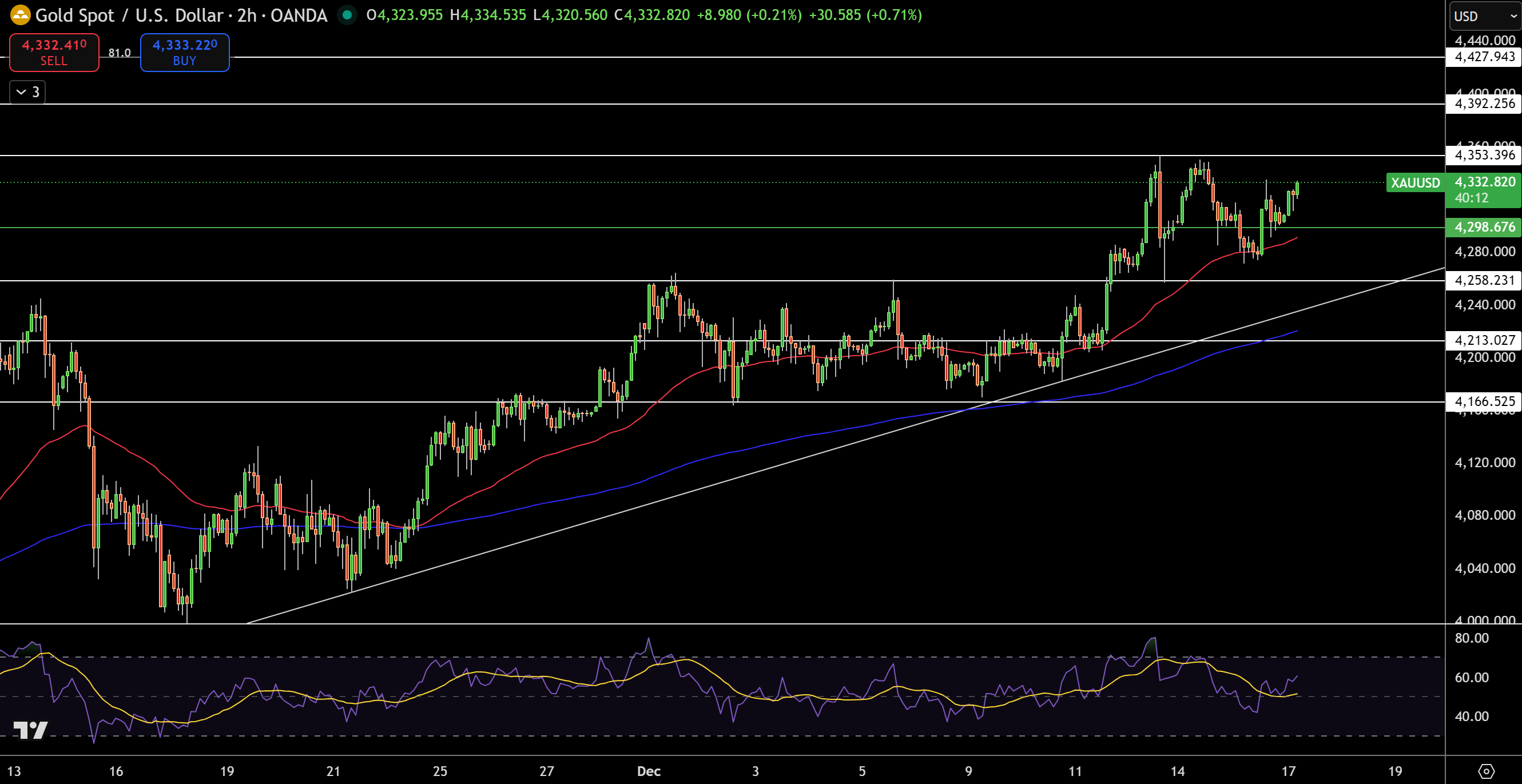
Gold is trading near $4,333 on the 2-hour chart after extending its advance above the former resistance at $4,300, which has now turned into short-term support. Recent candlesticks show higher lows with modest upper wicks, suggesting steady buying rather than exhaustion. Price continues to hold above the rising trendline from late November, keeping the broader structure constructive.
Gold remains supported above the 50-EMA near $4,285 and the 100-EMA around $4,240, reinforcing the bullish bias. Immediate resistance sits at $4,350, followed by $4,390. A sustained break above this zone could open room toward $4,425.
On the downside, support rests at $4,300, then $4,260. RSI is hovering near 60, indicating positive momentum without stretched conditions.
Silver (XAG/USD) Price Forecast: Technical Outlook
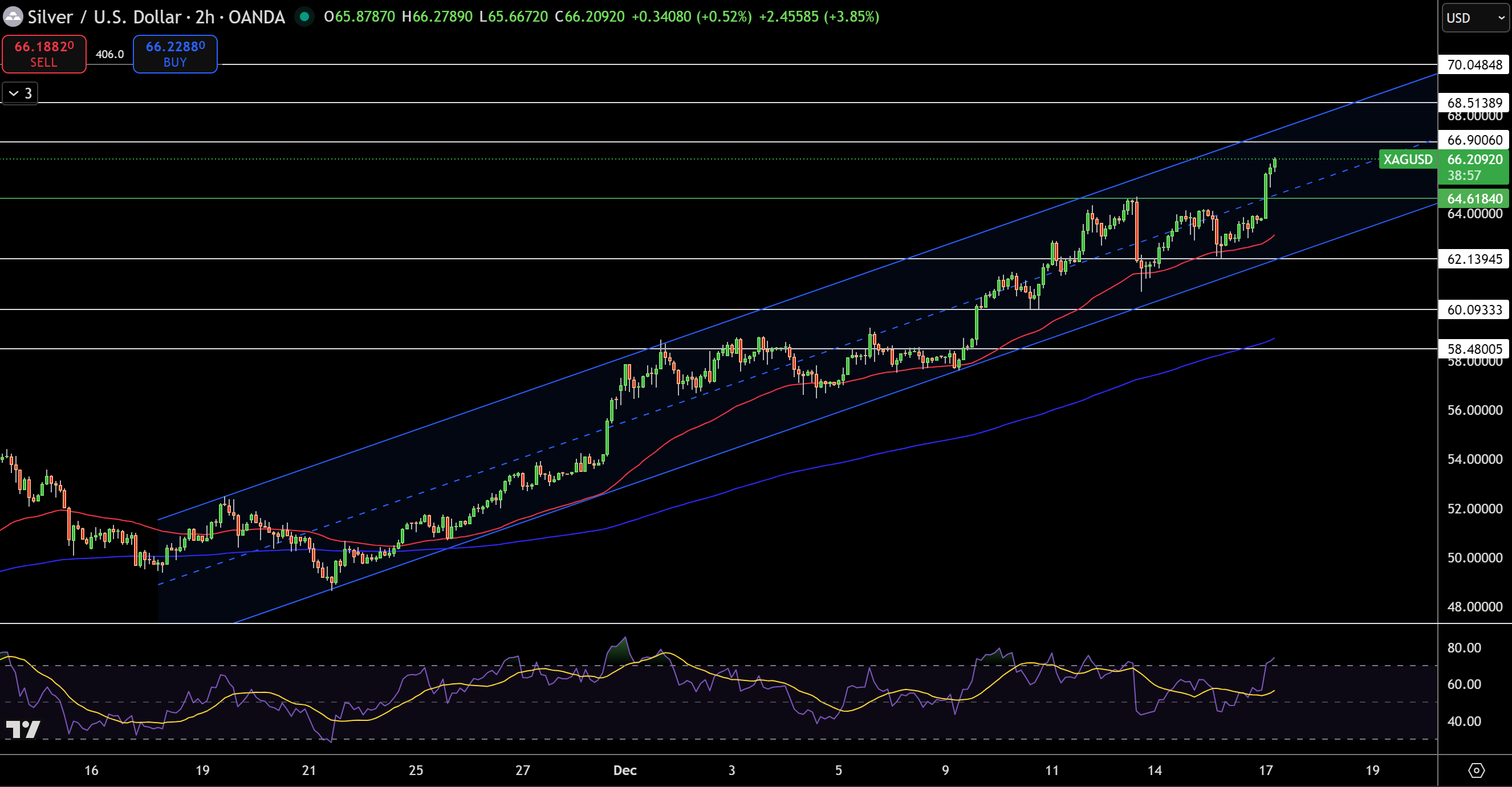
Silver is trading near $66.20 on the 2-hour chart after extending its rally within a well-defined ascending channel that has been in place since mid-November. Recent candlesticks show strong bullish bodies with limited upper wicks, suggesting buyers remain in control rather than chasing late moves. Price continues to track above the channel midline, keeping momentum constructive.
Silver is holding above the 50-EMA near $64.60, while the 100-EMA around $60.10 remains well below price, reinforcing the broader uptrend. Immediate resistance sits near $66.90, followed by $68.50, close to the upper channel boundary.
On the downside, support rests at $64.60, then $62.15. RSI is hovering around 62, showing strong momentum without overbought conditions.