
XRP saw its first two-day winning streak since January as the market focus shifted to the looming White House meeting on the Market Structure Bill.
Hopes that TradFi and DeFi would reach a consensus on stablecoin yields lifted demand for XRP on Monday, February 9. The White House will hold its second gathering of banking and crypto community representatives to discuss stablecoin yields, which have delayed the progress of the Market Structure Bill.
Meanwhile, robust demand for XRP-spot ETFs continued to contrast sharply with the BTC-spot ETF market’s outflows, another crucial tailwind for XRP.
While February’s losses support a bearish short-term outlook for XRP, the medium-term outlook remains bullish.
Below, I will explore the key drivers behind recent price trends, the medium-term (4-8 weeks) outlook, and the technical levels traders should watch.
White House Meeting on Stablecoin Yields Takes Center Stage
On Tuesday, February 10, the White House is slated to hold its second meeting for the banking and crypto communities to discuss stablecoin yields. The US administration is looking for US banks and crypto firms to reach an agreement by the end of the month on yields to schedule a spring Senate floor vote on the Market Structure Bill.
For context, the US House of Representatives passed the Market Structure Bill to the US Senate on July 17, 2025. However, the US Senate Banking Committee postponed its January 15 markup vote on draft text for the Market Structure Bill after Coinbase (COIN) withdrew its support for the Bill.
Coinbase CEO Brian Armstrong cited several reasons for pulling its support, including the draft text killing rewards on stablecoins and allowing banks to ban their competition.
An agreement on yields will likely be crucial for crypto legislation to pass before the looming midterm political wrangling begins. With the US Senate Agriculture Committee having advanced its draft text of the Market Structure Bill, the onus is on the Banking Committee to follow suit.
If US banks and crypto firms can find common ground on stablecoin yields, the Banking and Agriculture Committees must then merge their text to advance the complete Bill to the Senate floor.
Notably, the Agriculture Committee’s draft text advanced despite not a single Democrat voting in favor, fueling uncertainty about the outcome of a Senate floor vote. These dynamics underscore the significance of the February 10 meeting. Progress toward a compromise would raise hopes of a full Senate vote in the spring, a boon for XRP.
Bitcoin Price Forecast
Every new Bitcoin analysis as it publishes, today's technical signal and key levels, live price — on one page.
See all Bitcoin forecastsXRP Price Action Hinges on Crypto-Related Legislative Developments
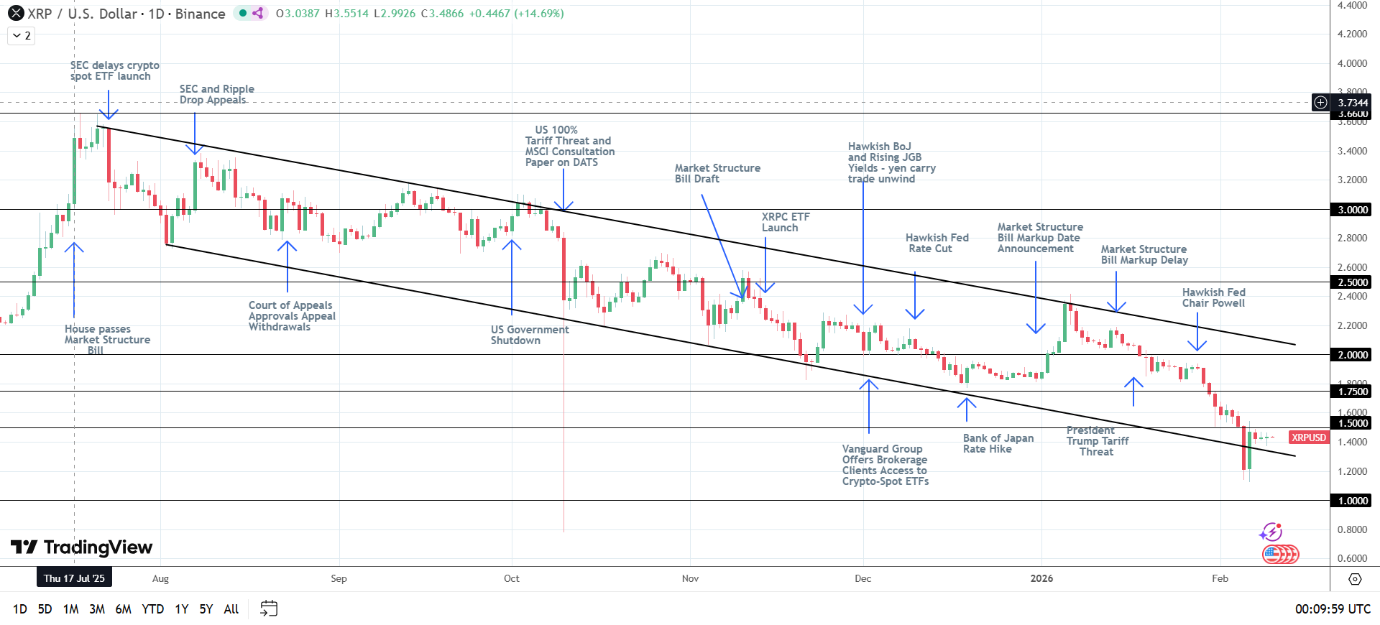
XRP remains highly sensitive to crypto-related regulatory developments. The token surged 14.69% on July 17, 2025, after the House passed the Market Structure Bill to the Senate.
In January 2026, XRP rallied from $1.8403 to a January 6 high of $2.4151 in reaction to the Banking Committee announcing its January 15 markup. However, the token plunged to a February 6 low of $1.1227, as investors reacted to delays to Senate Committee markup votes.
XRP Price Forecast: Short-, Medium-, and Long-Term Targets
February’s 12.5% loss affirmed the cautiously negative short-term outlook (1-4 weeks), with a target price of $1.0.
However, hopes that the Senate will eventually pass the Market Structure Bill and increased XRP utility continue to boost demand for XRP-spot ETFs, reinforcing the bullish medium- to long-term price projections:
- Medium-term (4-8 weeks): $2.5.
- Longer-term (8-12 weeks): $3.0.
Key Downside Risks to the Bullish Medium-Term Outlook
Several scenarios could challenge the constructive medium-term bias. These include:
- A hawkish Bank of Japan, with a higher neutral interest rate (potentially 1.5%-2.5%). Aggressive BoJ rate hikes could narrow US-Japan rate differentials in favor of the yen. Narrowing rate differentials may trigger a yen carry trade unwind, mirroring events in mid-2024. A yen carry trade unwind would validate the bearish trend reversal.
- Weak US economic indicators and rising risks of a US recession.
- Delays and/or partisan opposition to the Market Structure Bill.
- Extended periods of XRP-spot ETF net outflows.
These factors would weigh on buying interest in XRP, pushing XRP toward $1.0, reaffirming the bearish short-term outlook.
Technical Analysis: Levels to Watch
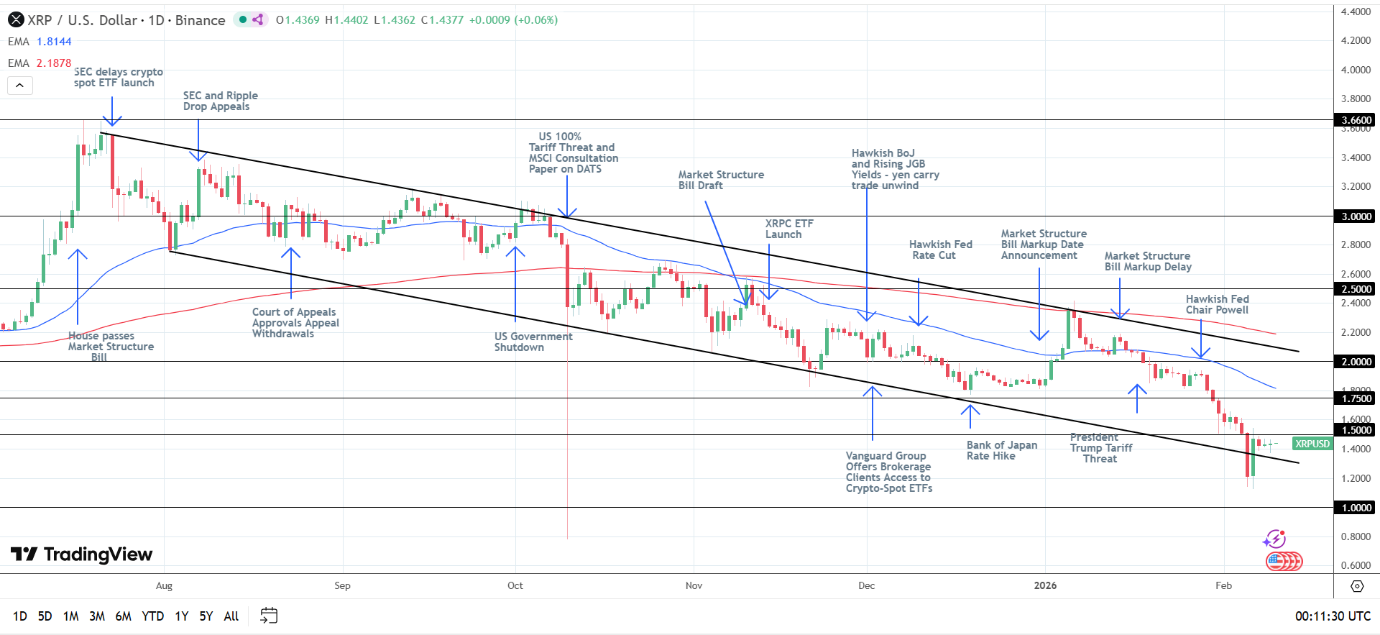
XRP rose 0.42% on Monday, February 9, following the previous day’s 0.57% gain, closing at $1.4368. The token outperformed the broader crypto market cap, which slipped 0.13%.
Despite the gains, XRP remained well below its 50-day and 200-day EMAs, indicating bearish momentum. However, several positive fundamentals continue to offset bearish technicals, supporting a bullish medium-term outlook.
Key technical levels to watch include:
- Support levels: $1.0 and then $0.7773.
- 50-day EMA resistance: $1.8144.
- 200-day EMA resistance: $2.1878.
- Resistance levels: $1.50, $2.0, $2.5, and $3.0.
On the daily chart, a breakout above $1.50 would enable the bulls to target the 50-day EMA and $2.0. Importantly, a sustained move through the 50-day EMA and $2.0 would signal a near-term bullish trend reversal. A bullish trend reversal would pave the way toward the 200-day EMA.
A sustained break above the EMAs would reaffirm the bullish medium-term price targets.
Fundamental Events Driving Near-Term Price Action
Near-term price drivers include:
- XRP-spot ETF flows.
- US economic data and the Fed’s policy stance. This week, US retail sales and the US jobs report will be key for the Fed.
- Crypto-related legislative developments.
- The Bank of Japan’s neutral rate and rate path.
- Increased geopolitical risks.
Bearish Structure Remains Intact with $1.0 as Critical Support
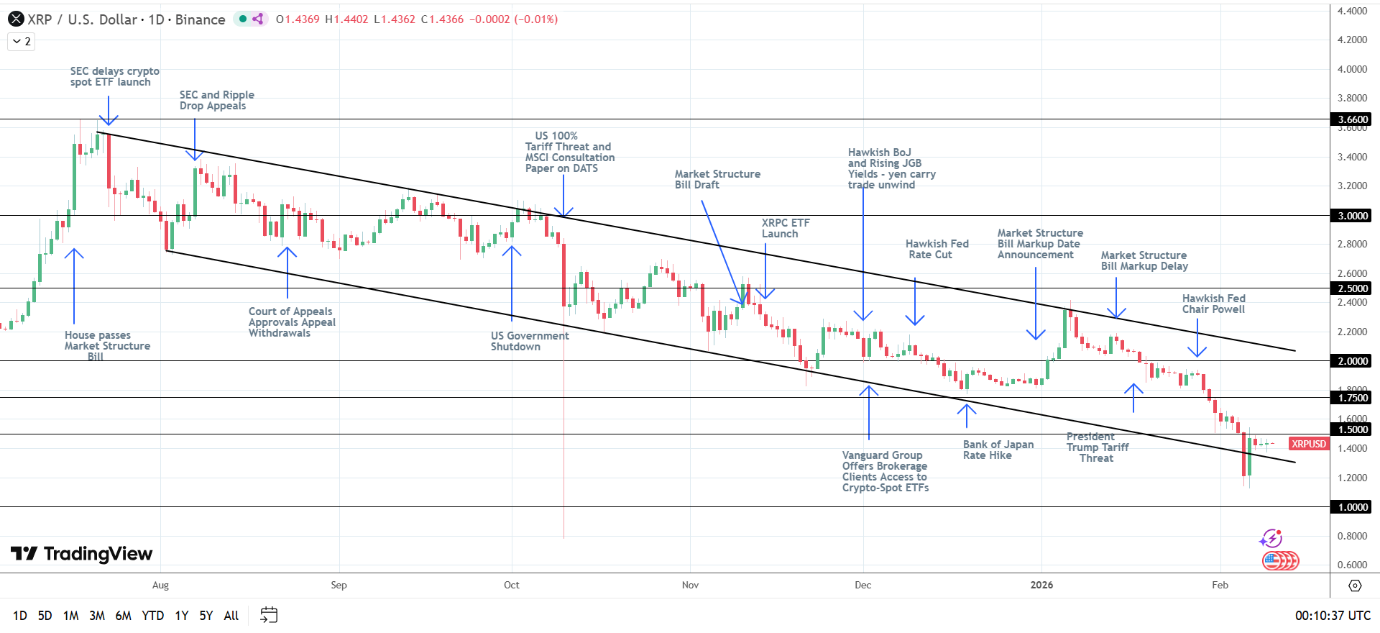
XRP’s 2026 reversal affirmed the existing bearish trend. A drop below the lower trendline would expose the February 6 low of $1.1227. If breached, $1.0 would be the next key support level. A fall through $1.0 would reaffirm the bearish short-term outlook and further validate the bearish structure.
Conversely, a breakout above $1.5 would open the door to testing $2.0 and the upper trendline. A sustained move through the upper trendline would invalidate the bearish structure and signal a bullish trend reversal, reinforcing the constructive medium-term bias.
- Short-term (1-4 weeks): $1.0.
- Medium-term (4-8 weeks): $2.5.
- Longer-term (8–12 weeks): target of $3.0.
XRP Outlook Hinged on Crypto Legislation, US Data, and ETF Flows
Looking ahead, the outcome of today’s White House meeting on crypto legislation will be key for XRP’s price trajectory. Reports of progress toward a common ground on stablecoin yields would likely boost XRP demand.
However, geopolitical risks, US economic data, central bank policy cues, and XRP-spot ETF flows will also influence near-term price trends.
A more dovish Fed rate path and a lower BoJ neutral rate (potentially 1%-1.25%) would lift sentiment. Strong inflows into US XRP-spot ETFs and the progress of the Market Structure Bill would support the positive medium-term outlook.
In summary, these scenarios suggest a medium-term (4–8 weeks) move to $2.5. The US Senate’s passing the Market Structure Bill would reaffirm the longer-term (8–12 weeks) price target of $3.0.
Beyond 12 weeks, these tailwinds are likely to send XRP to its all-time high of $3.66 (Binance). A break above $3.66 would affirm a 6- to 12-month price target of $5.