Market Overview
On Friday’s early European trading session, gold’s (XAU/USD) winning streak continued, touching an intraday high near $4,378. It’s been a solid bullish ride for the metal, and its strongest yearly performance since 1979 was a whopping 65% gain in 2025. All that momentum means one thing: people are betting on a softer US monetary policy and are clamoring for defensive assets as the world gets a little more uncertain.

Gold Rally Extends on Fed Rate-Cut Outlook
The Fed’s December decision to cut the Federal Reserve’s target rate by 25 basis points, to 3.50%–3.75%, followed by confirmation that they are indeed looking to ease further in 2026, has got everyone pretty convinced. While that decision was largely expected and the market had already priced it in, it was the icing on the cake for those betting on a more accommodative stance from the Fed.
Lower Rates Sustain Demand for Non-Yielding Assets
The FOMC meeting in December was clear: even though there were some internal disagreements, most of the Fed’s policymakers still think there’s room for further easing if inflation continues to slow. The upshot is lower interest rates, which make holding non-yielding assets like gold much less costly, keeping demand for them afloat.
Geopolitical Risks and Market Caution Shape Near-Term Outlook
The ongoing conflicts and tensions between nations have added a big layer of uncertainty to the mix, which in turn has led investors to stick with the tried and true safe haven assets that always seem to do well during times of uncertainty – and gold is no exception.
The big question is: will its price hold at record levels despite the inevitable pullbacks? That said, we do face some near-term headwinds.
Gold Price Forecast
Every new Gold analysis as it publishes, today's technical signal and key levels, live price — on one page.
See all Gold forecastsThe first is that after a gain as sharp as gold’s, some people will want to cash in their profits, which could lead to selling pressure. The CME Group has also decided to up the margin requirements for gold and other metals, which is likely to make it a little more expensive to speculate on the price of gold, and that could also dampen demand.
Looking ahead, gold is likely to remain well-supported as long as rate-cut expectations and geopolitical tensions continue to simmer. However, with US markets set to release a batch of important data, including the final Manufacturing PMI, traders are likely to keep a close eye on how it all plays out, especially its impact on the dollar and the Fed’s next move.
Short-Term Forecast
Gold may consolidate between $4,350–$4,450 in the near term, with dips attracting buyers above $4,300, while a break above $4,400 could reopen the path toward $4,475.
Gold Prices Forecast: Technical Analysis
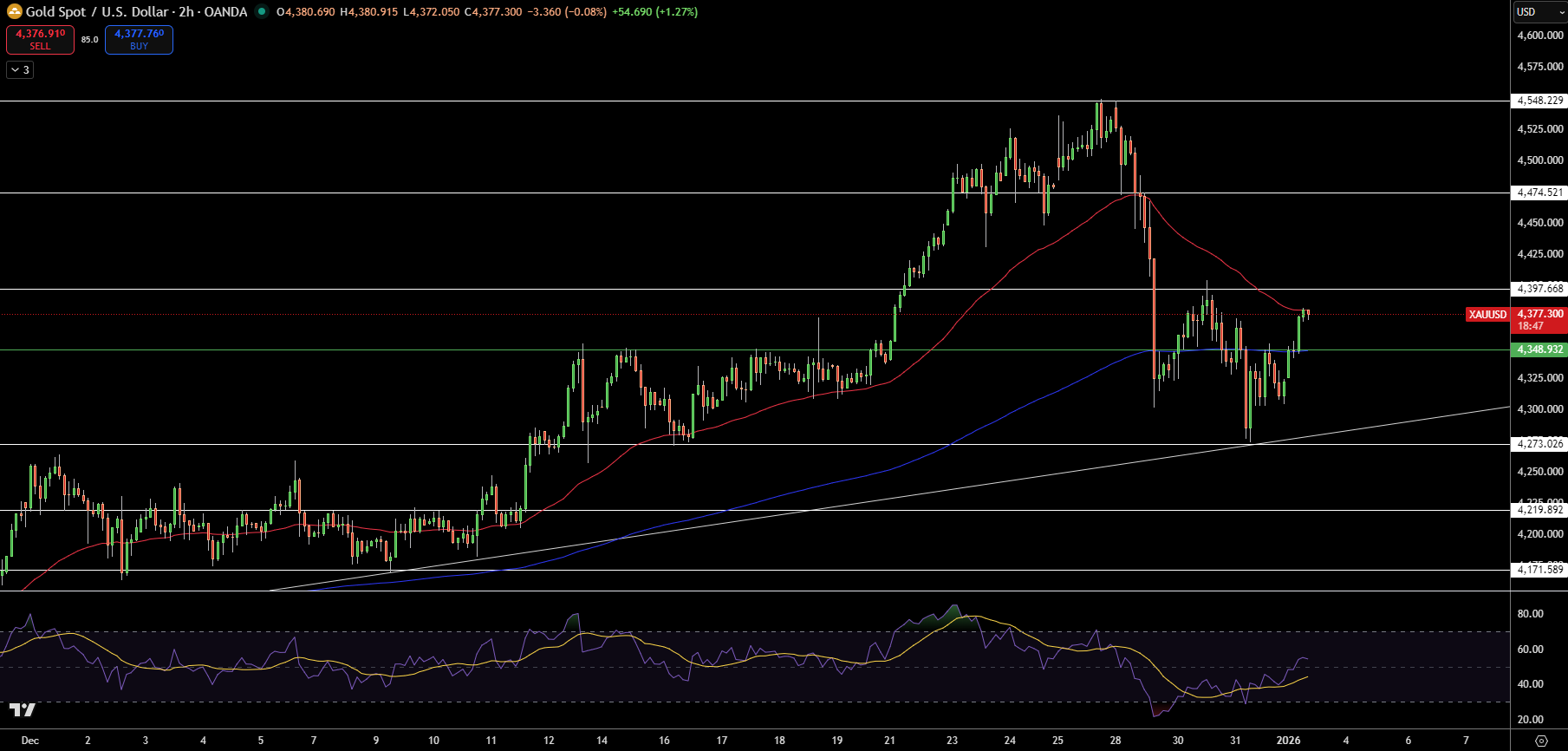
Gold (XAU/USD) is trading near $4,377, trying to stabilize after a sharp pullback from its $4,548 peak. On the 2-hour chart, price has reclaimed the $4,350–$4,360 zone, which looks a lot like a previous support level and a short-term consolidation area.
The leading indicator, RSI, has bounced back towards 50, which is a clear sign that the downward momentum is slowing. Looking at the price chart, the next resistance levels are $4,400 and $4,475. The trade idea today is to buy gold around $4,350, with a target at $4,450, and a stop-loss below $4,300.
Silver (XAG/USD) Price Forecast: Technical Outlook
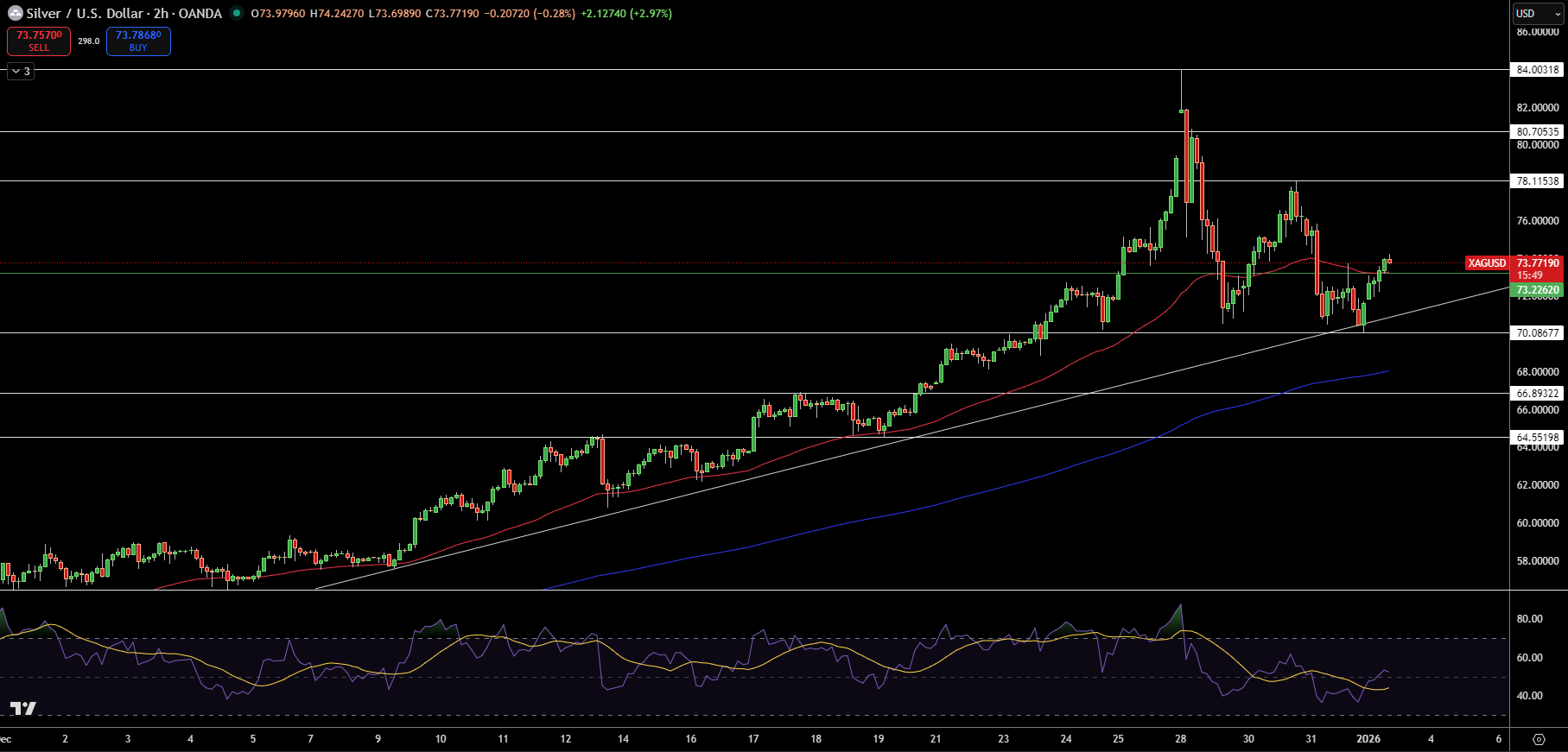
Silver (XAG/USD) is trading near $73.80, and it’s holding its ground above that rising trendline after a pretty sharp pullback from that $84.00 peak. On the 2-hour chart, price rebounded from the $70.10–$71.00 support zone, where trendline support and prior demand converged.
The candlestick chart shows a clear uptrend, suggesting that people are buying dips rather than selling at a loss. Silver’s consolidating around the 50-EMA near $73.20, while that 200-EMA is way down near $68.00 – which keeps the broader uptrend intact.
RSI has turned higher again, which is another sign that momentum is stabilizing. Looking at the price chart, the next resistance levels are $76.00 and $78.10.