
Market Overview
Despite the bullish US dollar, gold (XAU/USD) managed to maintain its bullish trend and remain strong above the $4,500 level. This rise is mainly due to ongoing tensions in the Middle East, which is increasing demand for safe assets like gold. However, the gains remain limited because these same geopolitical risks are also raising fears of higher inflation and possible interest rate hikes by the Federal Reserve, which supports the US dollar.
As a result, traders are being cautious and are not making strong buying or selling moves, choosing instead to wait for clearer updates on the situation in the Middle East.

Rising Middle East Tensions Support US Dollar and Limit Gold Gains
Despite talks of a ceasefire by US President Donald Trump, Iran has clearly rejected the idea and said there is no chance of a deal right now. Iran also refused a detailed ceasefire plan from the US and has set its own strong conditions to end the conflict.
At the same time, the US is sending more troops to the Middle East, which increases the risk of the situation getting worse.
As a result, the US dollar remain strong as a safe and trusted global currency. This limits gains in the Gold.
Meanwhile, Iran’s energy facilities are under pressure, and the closure of the Strait of Hormuz is pushing oil prices higher. Rising oil prices increase fears of inflation, which makes investors think that central banks, especially the Federal Reserve, will keep interest rates high or even raise them.
As a result, traders now expect fewer chances of rate cuts and are even betting on a rate hike by the end of the year.
Gold Price Forecast
Every new Gold analysis as it publishes, today's technical signal and key levels, live price — on one page.
See all Gold forecastsGold Crashes From $5,100 to $4,437 – Bears in Control Below the 200 MA
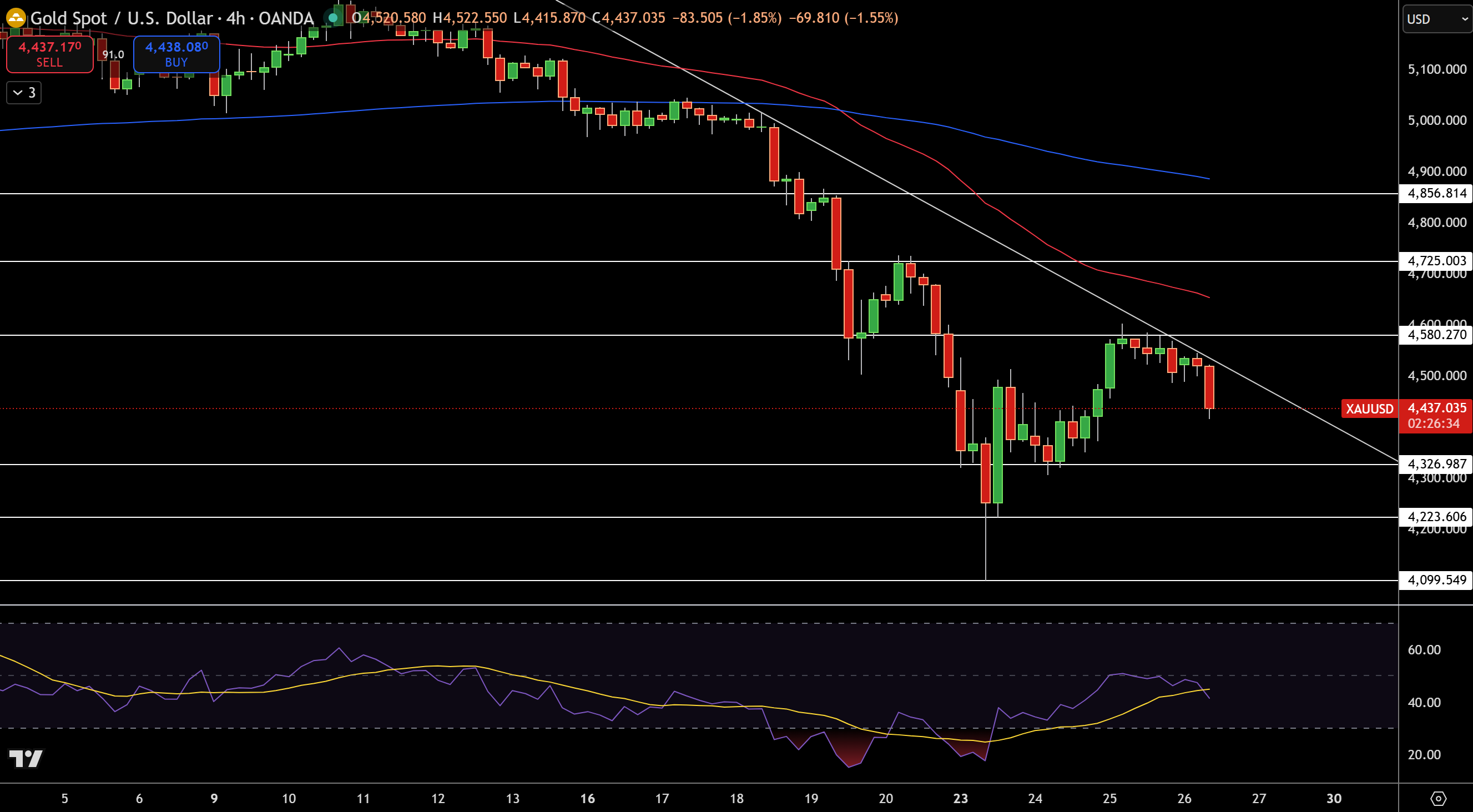
Gold (XAUUSD) is currently trading at $4437 on the 4 hour chart, off a whopping 1.85% today, after hitting a high of $4522 & promptly plummeting. The really big picture here is the massive selloff from $5100 in early March down to a swing low near $4099:a drop of over a grand in just 2 weeks.
That March 20th dip left behind a seriously ugly bearish engulfing candle, with a massive body and almost no lower wick, pure panicky selling. Since then, price has been recovering in a bit of a staircase pattern with higher lows at $4099, $4300 & $4400 but each rally has stalled out under that bearish trendline drawn from the highs.
The 200 period MA (that’s the blue one at $4725) & the shorter red MA around $4580 are both sloping downwards, sitting comfortably above current price, & that’s just bearish. The $4580 horizontal line aligns perfectly with the red MA, putting that level firmly in the ‘tough resistance’ category. Below, we’ve got a couple of key levels to watch: $4326 & $4223.
Trade idea: Short near $4520 if price retests that bearish trendline, setting your sights on $4326 with a stop loss above $4590.
Silver Rejected at the $74 Supply Zone – Descending Trendline Caps Every Rally
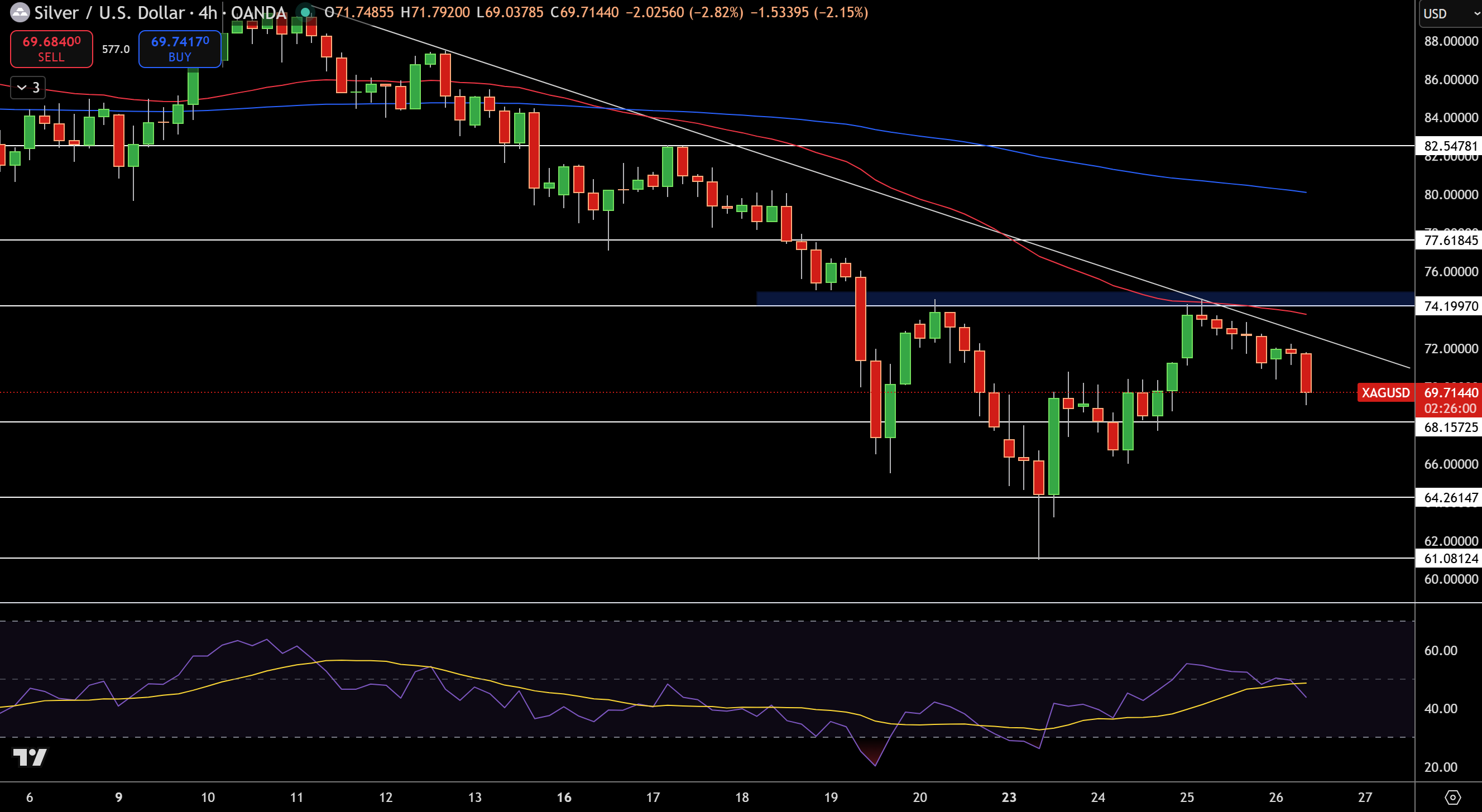
Silver (XAGUSD) is currently trading at $69.71 on its 4-hour chart, down a sizeable 2.82% from where it opened, and all because it just couldn’t keep up those gains that briefly put it above $71. That’s not the only thing thats going on here – the big clear picture is a downtrend thats been steadily pushing prices down since that peak near $88 back in early March.
That little blue highlighted area between $74 and $76 – thats just a hotbed of sellers. Theres been some quite aggressive selling going on there, don’t you think? Price tried to push into it on March 24 but got slapped back down with two red candles in a row – and that just about sealed the deal; it confirmed that zone as a pretty solid ceiling for now. The 200-period moving average (blue) is sitting pretty near $77, and it’s got a real downward bias going on – and it’s well above the price, just to drive the point home. Plus, it’s trending downwards really sharply.
And just to make things even more bearish, that shorter red moving average around $72 is also heading south and, guess what, it acted as a bit of resistance on the most recent bounce. Down below, we’ve got $68.15 as our nearest bit of support, but then comes the make-or-break level at $64.26.
Trade Idea: Take a short bet if price comes back to retest $72, and see if you can get all the way down to $64.26. Set your stop-loss above that $74.50 mark.