


US Markets Head North on Tariff Relief
US equity markets ended higher on a choppy session, on Friday, March 21, as investors reacted to tariff developments. President Trump provided much-needed market relief, signaling flexibility on reciprocal tariffs, which could take effect in early April. A softer tariff stance eased fears of a global trade war, inflationary pressure, and a potentially more hawkish Fed.
The Nasdaq Composite Index gained 0.52%, while the Dow and the S&P 500 rose 0.08%. However, the gains were modest amid Trump’s tariff flip-flopping and rising Middle East tensions.
Asian Market Implications: Despite Trump’s comments and the US market gains, the prospect of higher tariffs and geopolitical tensions signal a testy Asian session on Monday, March 24.
Japan PMI Data Weakens BoJ Hike Prospects
Japan’s private sector PMI numbers on March 24 potentially closed the door to an H1 2025 Bank of Japan rate hike. Japan’s Jibun Bank Services PMI tumbled from 53.7 in February to 49.5 in March, crucially dropping below the neutral 50 mark. The manufacturing sector contracted at a faster pace, with the PMI falling from 49.0 to 48.3.
With services contributing over 70% to Japan’s GDP, a softer growth outlook may force the BoJ to delay rate hikes. The Japanese Yen weakened, sending the USD/JPY up 0.40% to 149.878.
Annabel Fiddes, Economics Associate Director at S&P Global Market Intelligence, commented:
“Strong inflation, coupled with concerns over labour shortages, an ageing population, subdued client spending and increased uncertainty over the international trade environment dampened optimism around the outlook. Notably, overall confidence regarding future business activity dipped to the lowest since August 2020 at the end of the first quarter.”
Hang Seng Index and Mainland China Markets Drop on Tariff Concerns
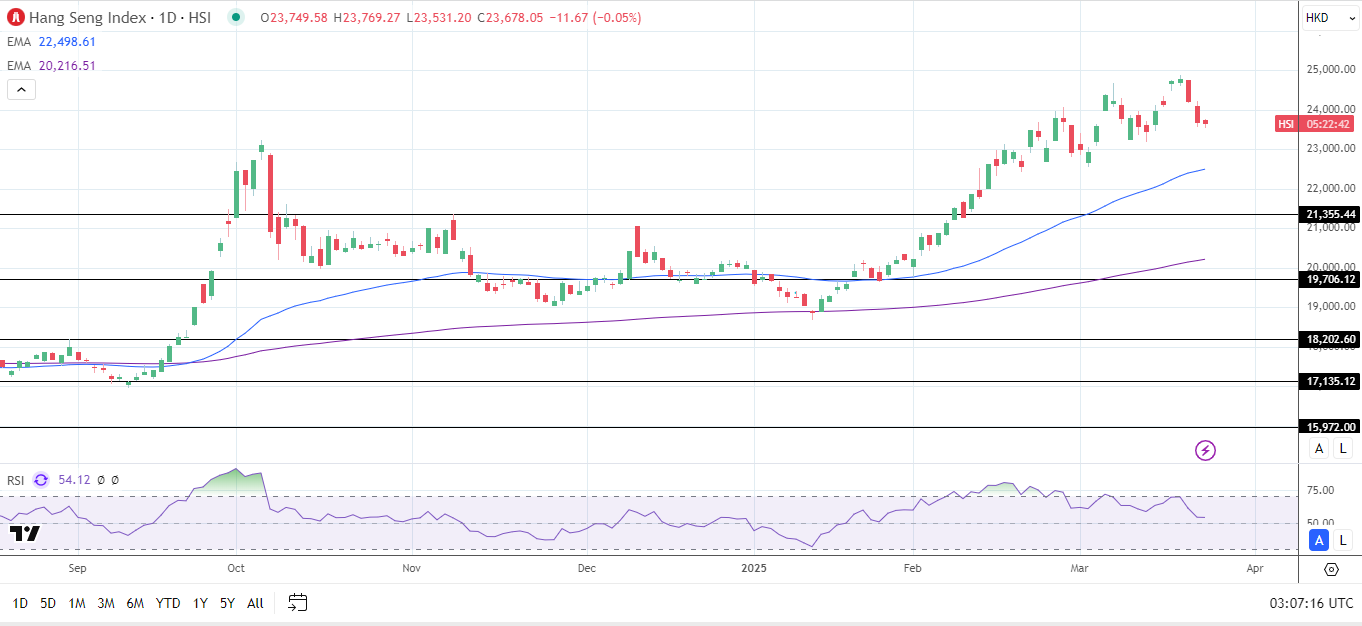
In Asia, the Hang Seng Index extended its losses from Friday, edging 0.05% lower on Monday morning. Real estate and tech stocks contributed to the morning losses.
Nikkei Price Forecast
Every new Nikkei analysis as it publishes, today's technical signal and key levels, live price — on one page.
See all Nikkei forecasts- The Hang Seng Technology Index slipped by 0.18%, while the Hang Seng Mainland Properties Index fell by 0.62%.
- Despite the broader tech sector decline, Tech giants Alibaba (09988.HK) and Baidu (09888.HK) gained 0.22% and 0.31%, respectively. News from Beijing contributed to the gains.
News of global executives attending an annual summit in Beijing underscored China’s growing position in the AI space. Brian Tycangco, editor/analyst at Stansberry Research, commented on the summit:
“This happened over the weekend and it’s incredible how practically ZERO of Western media outlets reported it. You have key US execs including Tim Cook, Stephen Schwarzman, Ken Griffin, and others looking to explore opportunities in China. Interviewing these US corporate leaders could increase awareness and appreciation for the economic interdependence of these two countries.”
Meanwhile, Mainland China’s equity markets had a mixed start to the week. The CSI 300 gained 0.33%, while the Shanghai Composite Index slipped by 0.09%.
Nikkei Index Flat as Yen Softens
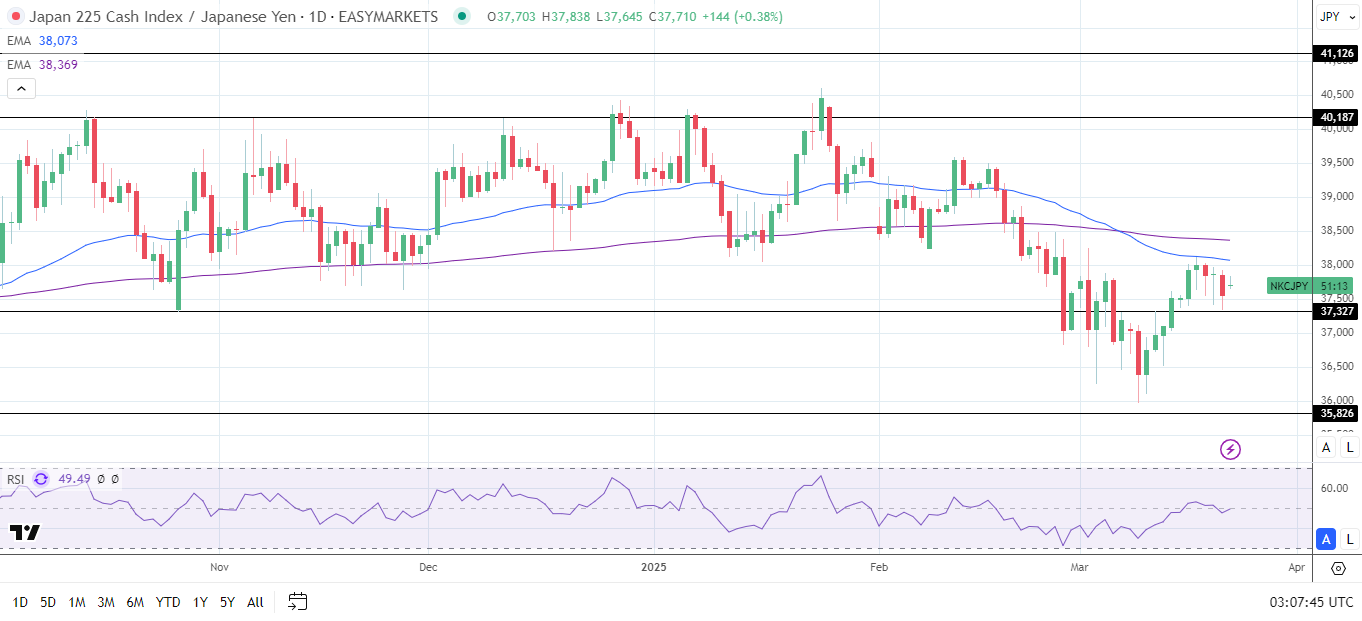
The Nikkei Index traded flat on Monday morning as tariff jitters and weak PMI data dampened sentiment. A softer Japanese Yen provided partial support. A weaker Yen improves the competitiveness of Japanese exports, improving corporate earnings prospects.
Softbank Group Ltd. (9984) rallied 2.91%, while Nissan Motor Corp. (7201) and Sony Corp. (6758) fell 1.58% and 0.40%, respectively, amid trade concerns.
ASX 200 Dips as Tariff Jitters Resurface
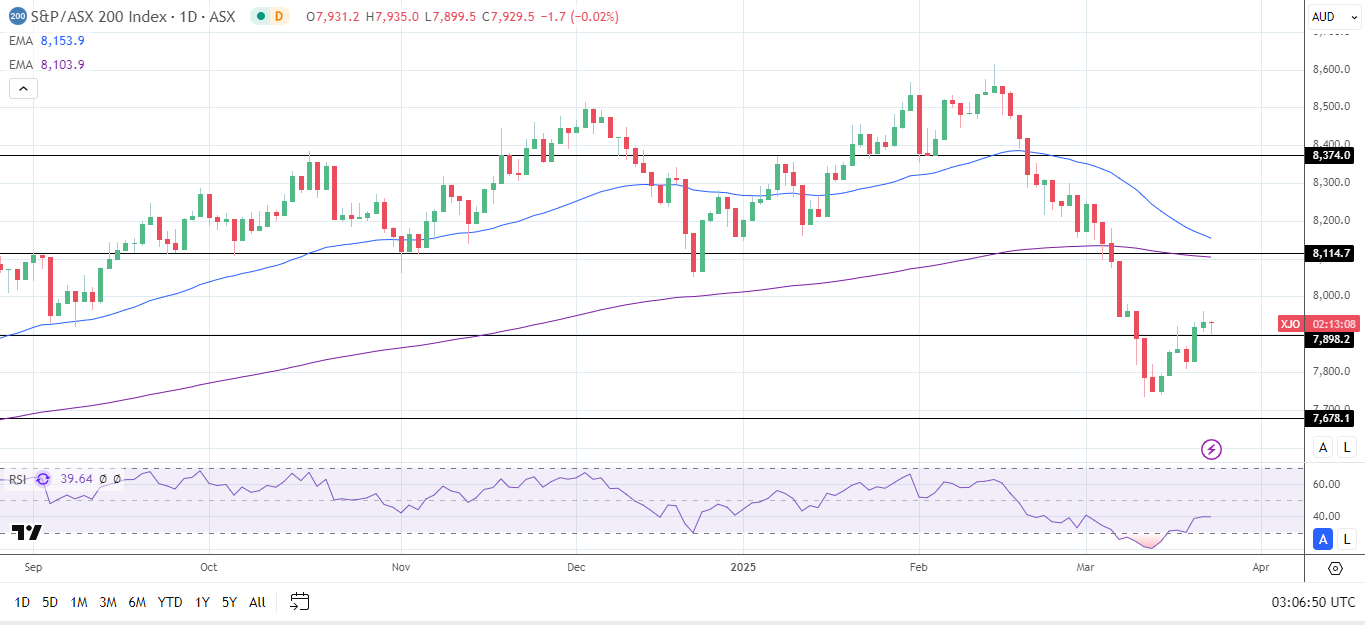
Australia’s ASX 200 also struggled on Monday morning, dipping 0.02%. Banking stocks advanced while gold and tech stocks declined.
- Banking stocks: The Commonwealth Bank of Australia (CBA) and Westpac Banking Corp. (WBC) rallied 1.13% and 1.04%, respectively. The recent drop in 10-year US Treasury yields fueled demand for high-yielding Aussie banks.
- Gold stocks: Northern Star Resources (NST) dropped 0.25% on weaker gold prices.
- The S&P/ASX All Technology Index fell 0.43%.
Outlook: Key Risks and Opportunities
Global markets remain sensitive to trade and policy signals:
- US-China Trade Tensions and Stimulus: Renewed US-China trade friction could hit sentiment but may also prompt fresh Chinese stimulus. Monetary support from Beijing would likely benefit Hong Kong and Mainland stocks.
- Central Bank Forward Guidance: Forward guidance remains key as policymakers navigate inflation and geopolitical uncertainty.
While geopolitical risks persist, China’s policy support and innovation push may underpin regional equities. Further consumer-oriented stimulus could offset US recession fears and bolster demand for Chinese and Hong Kong-listed stocks.
For in-depth analysis and expert insights, stay updated on market trends here to make informed investment decisions.