



Fed Fear Casts Shadows Over the Asian Equity Markets
Market angst over reducing investor bets on a September Fed rate cut continued to plague investor confidence across the Asian equity markets on Thursday (May 30).
The Chinese equity markets kickstarted the Thursday session in an unconvincing fashion. Beyond concerns about the Fed rate path, the increasing risk of a lengthy trade war with the US and the EU remained a headwind. Initial buzz around measures to bolster the Chinese real estate market has also faded, testing buyer demand for China and Hong Kong-listed stocks.
Furthermore, tech stocks remain another focal point, as AI providers cut prices to protect existing market share and attempt to knock out the competition.
The US futures signaled another testy session ahead following losses in the Wednesday session. On Thursday (May 30), the Dow mini tumbled 255 points. The Nasdaq mini and S&P 500 mini were down 83 and 19 points, respectively. US 10-year Treasury yields trended higher after jumping 1.36% on Wednesday.
On Wednesday, the Nasdaq Composite Index and the S&P 500 saw losses of 0.58% and 0.74%, respectively. The Dow slid by 1.06%.
China Equity Markets See a Mixed Open
On Thursday, the CSI 300 and the Shenzhen Composite Index saw gains of 0.13% and 0.08%, respectively.
News of the IMF revising its growth forecast for China and aligning with the Beijing projection of 5% supported early gains. The IMF previously expected the Chinese economy to expand by 4.6%. The IMF attributed the better outlook to a strong Q1 2024 and policy measures from Beijing.
However, the Hang Seng Index continued its downward trajectory, falling by 0.38%.
The real estate sector faced a third consecutive daily loss, with the Hang Seng Mainland Properties Index (HSMPI) down 1.34%. The Hang Seng Mainland Properties Index (HSMPI) slid by 2.02% on Wednesday.
Tech stocks found much-needed support, with the Hang Seng Tech Index (HSTECH) up 0.39% in the morning session. On Wednesday, the Index tumbled 2.32%.
Baidu (9888) and Tencent Holdings (0700) advanced by 0.89% and 0.14%, respectively, with Alibaba (9988) gaining 0.78%.
Nikkei Price Forecast
Every new Nikkei analysis as it publishes, today's technical signal and key levels, live price — on one page.
See all Nikkei forecasts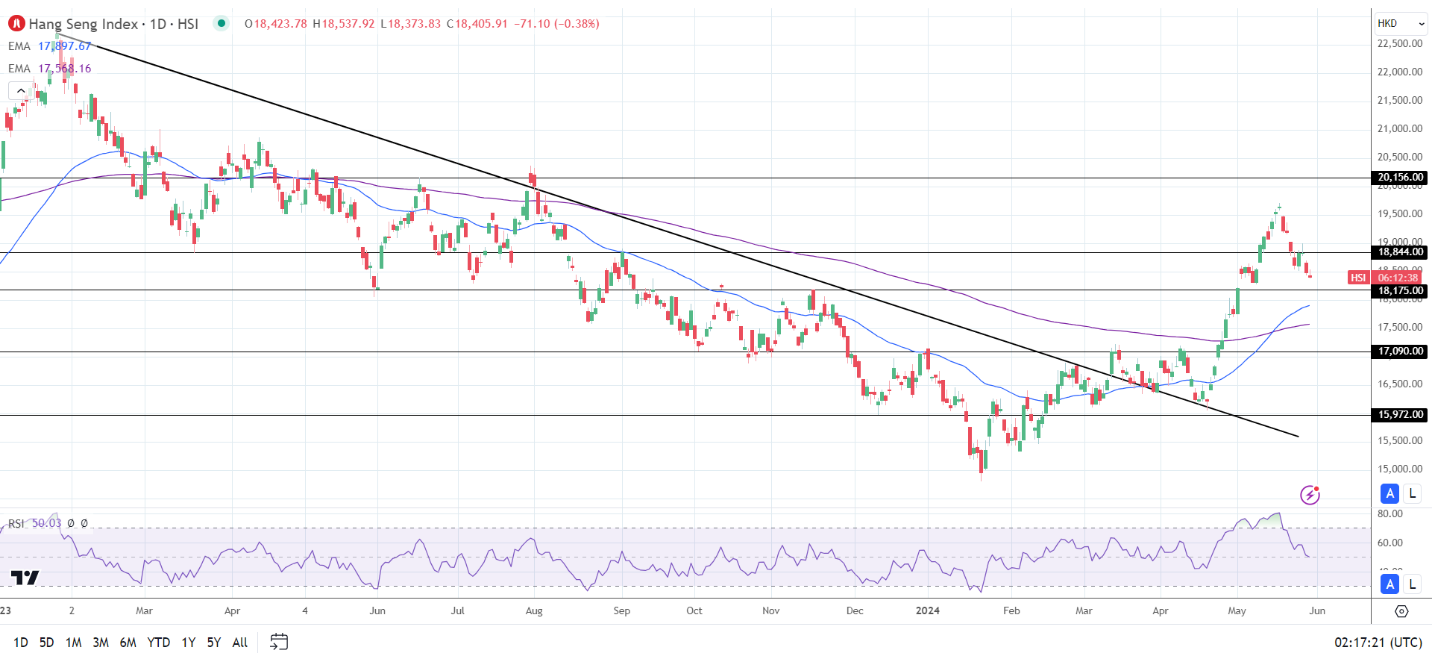
Japanese Equity Markets Trend Lower Despite a Weaker Yen
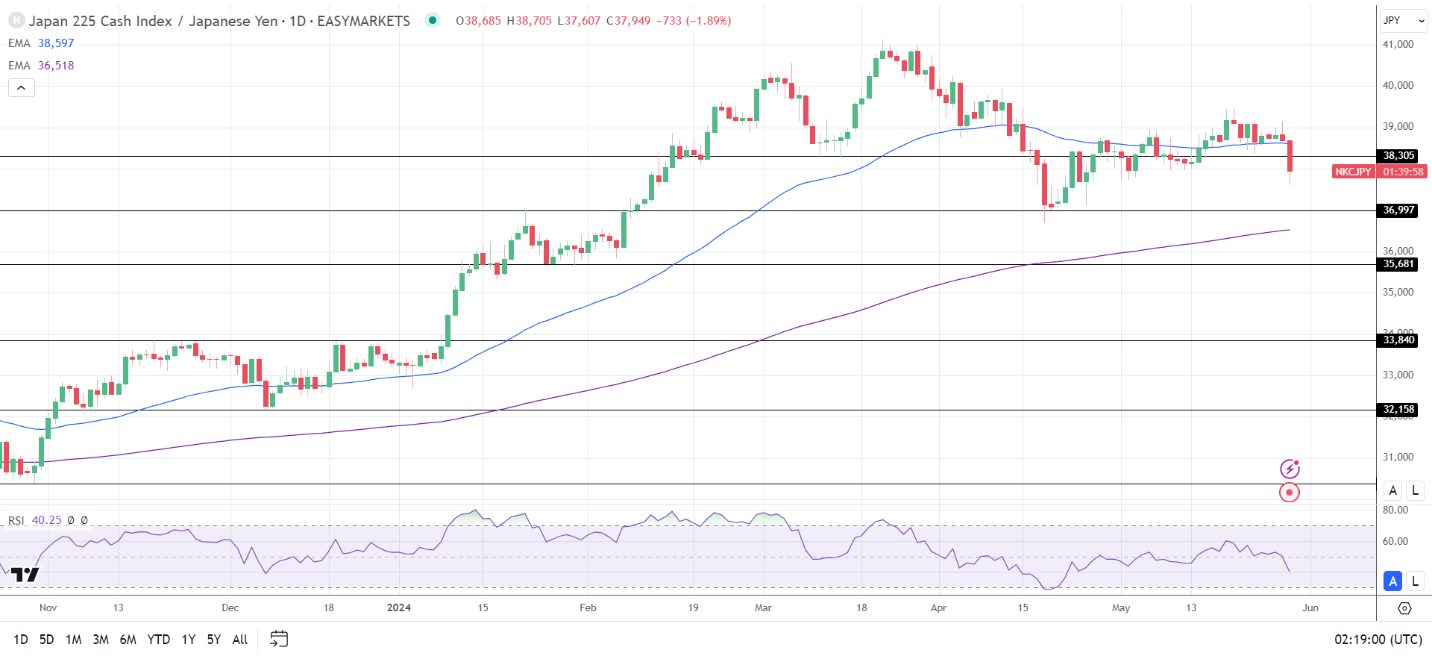
The Nikkei Index slid by 1.56% through the early Thursday session, with the USD/JPY declining by 0.14% to 157.416. Rising threats of a Bank of Japan interest rate hike, a stronger Japanese Yen, and intervention risks impacted buyer demand for Nikkei-listed stocks. Tech stocks led the way down.
Tokyo Electron Ltd. (8035) tumbled 2.85%. Softbank Group Corp. (9984) slid by 2.68%, with Fast Retailing Co. Ltd. (9983) falling by 2.57%.
Gold, Oil, and Mining Stocks Send the ASX 200 South
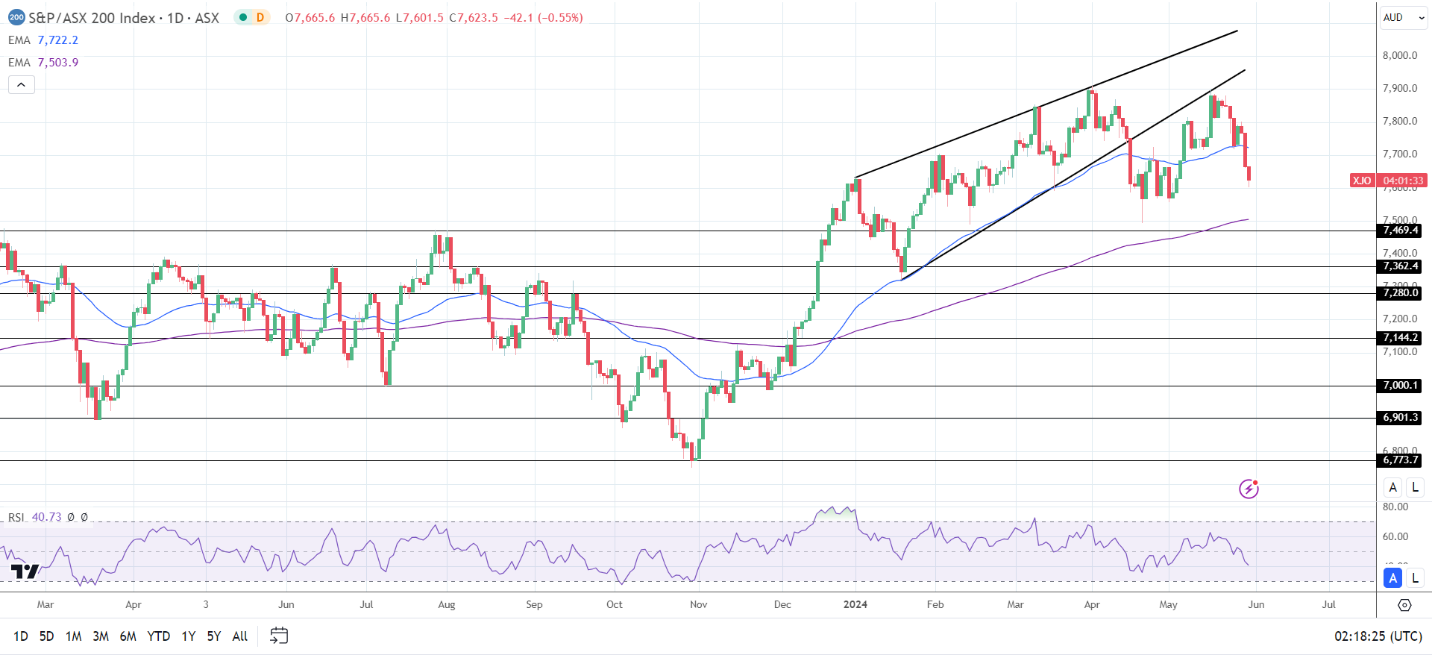
The ASX 200 was down 0.55% through the Thursday morning session. Gold, oil, and mining were the main protagonists of the sell-off.
BHP Group Ltd (BHP) and Rio Tinto Group Ltd. (RIO) slid by 1.73% and 1.43%, respectively. Fortescue Metals Group Ltd. (FMG) was down 2.19%. On Thursday, iron ore spot reversed gains from Wednesday, impacting mining stocks.
Investors also responded to commodity price trends from Wednesday. A pullback in gold spot (XAU/USD) and WTI crude oil also dragged the ASX 200 into negative territory. On Wednesday, Gold spot fell by 0.98% to $2,337.95, with WTI crude declining by 0.75% to $79.23.
Woodside Energy Group Ltd (WDS) fell by 1.09% on Thursday morning, with Santos Ltd (STO) declining by 1.11%.
Gold-related stocks Northern Star Resources Ltd. (NST) and Evolution Mining Ltd (EVN) were down 1.67% and 1.78%, respectively.
For upcoming economic events, refer to our economic calendar.