US Markets Slammed by Trump’s Tariff Shocks
Global markets slumped this week after President Trump announced sweeping tariffs, igniting a full-scale global trade war. Governments responded swiftly, launching retaliatory measures that triggered a flight to safety. The Nasdaq Composite Index plunged 10.02% in the week ending April 4, while the S&P 500 and the Dow lost 7.86% and 9.09%, respectively.
In the bond markets, 10-year US Treasury yields tumbled to 3.86% before settling at 4%, a 25 bps drop for the week.

Tariffs, Retaliations, and Downgrades Rattle Investors
Tuesday’s tariff announcement set off a chain reaction in global markets. Key US tariff measures included:
- China: 34%, bringing total US tariffs to 64%.
- Taiwan: 32%.
- South Korea: 30%.
- Japan: 24%.
Fitch Ratings responded by downgrading China from A+ to A, with a stable outlook. The rating agency also forecast GDP growth of 4.4% in 2025, down from 5.0% in 2024, citing the unexpectedly high tariffs and a likely global slowdown.
On Friday, April 4, China announced a series of countermeasures, including:
- Canceling a deal to sell TikTok to the US.
- Imposing 34% tariffs on US goods, effective April 10.
- Export controls on select rare earth items.
- Suspension of import licenses for six US companies’ products.
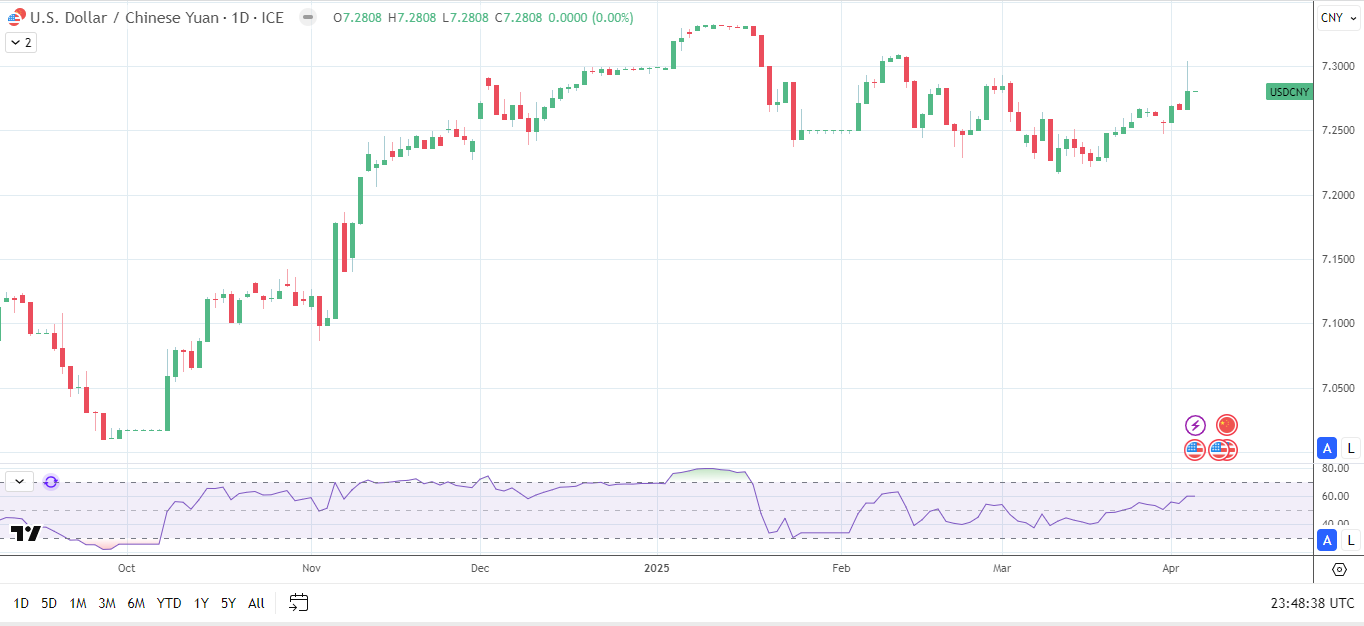
Despite the retaliatory measures, China has not devalued the Yuan, suggesting a willingness to negotiate. The USD/CNY gained 0.25% in the week ending April 4, closing at $7.2808. In February, we noted China’s similar refrain from devaluing the Yuan in response to earlier US tariffs, contrasting with its strategy during Trump’s first term.
Market Commentary: The Kobeissi Letter: The Kobeissi Letter commented on China’s tariffs on US goods:
“Here’s the real question: President Trump says China was charging the US 67% tariffs before his reciprocal tariffs were announced. Then, President Trump charged China a 34% tariff rate on Wednesday. Today, China tariffs all US goods by 34%, and assuming this is on top of the 67% claimed by Trump, that’s a total of 101%. What does Trump do now?”
If China has raised tariffs on the US to 101%, Trump may counter with additional reciprocal tariffs on reciprocal tariffs, risking another market shock.
Headlines on tariffs overshadowed key US economic indicators, including labor market and services data.
Hang Seng Index Falls as Trade War Escalates
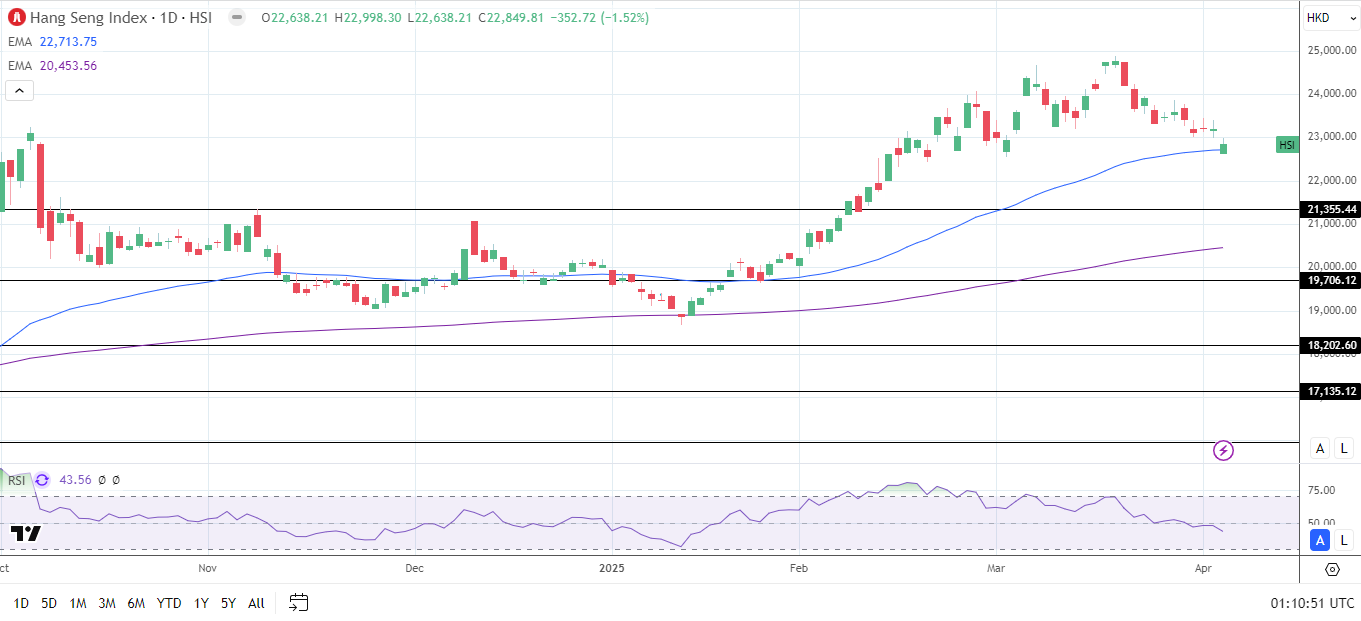
The Hang Seng Index declined for the fourth consecutive week, falling 2.46% amid fears of a global recession. However, the Hong Kong and Mainland China markets were closed on Friday, April 4, for the Ching Ming Festival, tempering the week’s losses.
- The Hang Seng Technologies Index slid 3.51%, with heavy losses in the EV and tech sectors.
- BYD Electronic (00285.HK) plunged 10.71%, BYD Company Ltd. (01211.HK) slid 7.87%, NIO Inc. (09866.HK) fell 4.96%, and Li Auto (02015.HK) declined 2.11% in the shortened week.
- Tech giants Alibaba (09988.HK) and Baidu (09888.HK) posted weekly losses of 5.73% and 5.95%, respectively.
However, these names could face a tumultuous Monday if weekend trade talks or policy measures fail to boost risk sentiment.
Brian Tycangco, editor/analyst at Stansberry Research, commented:
“Chinese ADRs very much on the defensive rn (right now) without guidance from Asia since markets were closed for the Qing Ming Festival. Beijing has in the past announced market moving policies over the weekend.”
Chinese ADR moves on April 4 included BABA (-10.45%), Bidu (-9.37%), and JD.com (-9.45%).
Meanwhile, Mainland China’s equity markets saw relatively modest losses. The CSI 300 fell 1.37%, while the Shanghai Composite Index dropped 0.28%. Upbeat Manufacturing and Services PMI data and stimulus hopes helped cushion declines.
For more analysis on the Hang Seng Index and global market trends, click here.
Commodities: Gold, Iron Ore, and Oil Sink
Commodities were hit hard by tariff concerns, central bank rhetoric, and OPEC developments.
- Gold ended a four-week winning streak, falling 1.52% to $3,037. Trump’s tariffs drove gold to a record high of $3,168. However, a hawkish Fed Chair Powell and upbeat US labor market data triggered a Friday reversal.
- WTI crude oil prices tumbled 9.81%, closing at $62.48. Demand concerns and OPEC’s plans to raise output triggered the sell-off.
- Iron ore spot prices declined 0.33% in the week.
ASX 200 Sinks Amid Recession Fears
The ASX 200 slid 3.94% in the week, with mining, oil, and tech stocks dragging the Index into the red.
- Mining sector: BHP Group Ltd. (BHP) and Rio Tinto Ltd. (RIO) tumbled 7.23% and 7.06%, respectively.
- Energy sector: Woodside Energy Group Ltd. (WDS) plunged 14.2%.
- Tech Sector: The S&P/ASX All Technology Index dropped 7.5%.
Nikkei Index Slumps on Yen Strength and Tariffs
The Nikkei Index dropped 7.30% in the week as investors reacted to Trump’s tariffs, retaliations, and surge in Japanese Yen demand. The USD/JPY fell 1.94% to 146.904 in the week. A combination of higher tariffs and a stronger Yen could significantly impact demand for Japanese goods and corporate earnings.
- Auto Sector: Nissan Motor Corp. (7201) slumped 13.46%, while Honda Motor Co. (7267) slid 9.24%. Japanese automakers face an uncertain outlook as Japan is the second largest exporter of cars to the US.
- Tech sector: Tokyo Electron (8035) and Softbank Group (9984) dropped 11.92% and 15.96%, respectively.
Looking Ahead: Key Events on the Radar
Investors should closely monitor policy announcements from Beijing, tariff headlines, economic data, and central bank developments. Key events include:
- Tariffs negotiations: Progress could improve sentiment.
- Beijing Stimulus: Stimulus measures targeting consumption and domestic demand could mitigate tariff risks.
- Key Economic Data: China inflation and trade figures, the US CPI Report, and Fed commentary.
Amid market turbulence, traders should remain alert to global macro shifts and policy responses. Get in-depth insights on Hang Seng movers here.