



That is The Gold & Silver Club’s conviction as 2026 exposes a regime change. The asset driving inflation is increasingly behaving like protection against the crisis itself.
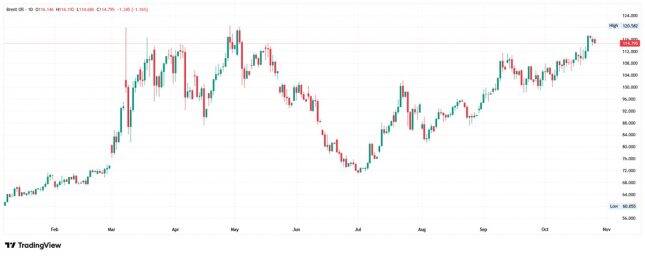
Brent Crude’s benchmark price has surged 91.8% so far in 2026. On 23 October, Brent settled at $116.72 a barrel, capping a 6.2% weekly advance. While Gold and the S&P 500 fell sharply.
Oil is forcing its way into the safe haven debate with numbers traders cannot ignore. If sustained through year-end, that would represent Brent’s strongest annual performance since 1999.
For The Gold & Silver Club, the divergence illustrates an increasingly urgent investment theme: The Era of Scarcity is changing where protection can be found.
Oil Is Becoming the Hedge Against Scarcity
Oil and stocks often rise together when growth lifts demand. A supply shock reverses that logic. Missing barrels increase energy costs while squeezing corporate margins and household spending. The same headline can lift crude and sink equities.
Federal Reserve research published in October identified Oil’s recent inverse relationship with equities as consistent with its potential to hedge near-term market risk.
“The assumption that Oil belongs only in a growth trade is breaking down,” says Lars Hansen, Head of Research at The Gold & Silver Club. “In a supply crisis, the asset transmitting the inflation shock can also help hedge it.”
The Fed faces inflation and weaker growth simultaneously. Households confront dearer fuel and falling portfolios. Interest-rate cuts cannot replace missing barrels.
Gold Price Forecast
Every new Gold analysis as it publishes, today's technical signal and key levels, live price — on one page.
See all Gold forecastsGold’s Reputation Faces a Market Test
Gold retains its monetary role. But in today’s macro environment, The Gold & Silver Club views the precious metal’s week-to-week, macro-driven swings as an opportunity for tactical trading. The short-term playbook can be summarized simply: “Buy low, sell high. Rinse, repeat and do it all over again,” says Hansen.
509 Million Barrels of Protection Have Gone
The International Energy Agency estimates global observed inventories ended September 509 million barrels below end-February levels. On-land stocks were at their lowest since at least 2016.
The agency forecasts supply falling by 5.8 million barrels a day in 2026, against a 2.6 million decline in demand. It still expects deficits through year-end.
Weaker growth alone cannot resolve a shortage when supply contracts faster than consumption.
When the IEA report was prepared, physical North Sea Dated crude traded around $134 against Brent futures near $107.
“Scarcity becomes financially powerful when the system loses its margin for error,” Hansen says. “Another interruption could hit a market with fewer reserves available to soften the impact.”
Fifteen Years of Calling the Big Moves
Over the past 15 years, The Gold & Silver Club has built a reputation as one of the industry’s most accurate forecasters of major Commodity price trends, a record well documented across leading financial publications and institutional research reports.
The firm’s proprietary models have consistently pinpointed major turning points across the metals, energies and agricultural sectors – earning GSC recognition as a trusted authority among institutional investors and private wealth clients alike.
On 4 September, The Gold & Silver Club outlined a path towards $130 before year-end, following Brent’s rebound from $84.20 on 26 August. The forecast identified $120 and $126 as milestones towards $130.
From the late-August low to last week’s high, Brent has advanced approximately 39.5%. That is the scale of the repricing already under way.
Last week’s $117.45 high left Brent roughly $13 short. From the $116.72 settlement, another 11.4 per cent would reach the target. Q4 still has more than two months to run.
For GSC, depleted inventories and persistent infrastructure threats strengthen the case for $130.
$120. $126. $130.
A sustained break above $120 would bring a reclaim of the $126 area into focus. Beyond that, $130 becomes the fourth-quarter objective.
With the quarter unfinished, a sustained advance through those milestones would shift attention towards how far energy scarcity can carry prices before the year ends.
“Oil does not need every bullish catalyst to occur simultaneously,” Hansen says. A supply recovery that disappoints expectations could be sufficient to force another upward repricing.
$150 Oil Could Reprice Protection Again
Recovering exports have brought limited reassurance. Data compiled by GSC Commodity Intelligence shows Hormuz Oil flows averaging 11.7 million barrels daily in October to date, up from 9.75 million in September.
The most powerful and influential voices in the global oil market agree that extensive damage to critical infrastructure could push crude towards $150. A trading executive warned diesel, already around $200 a barrel, could reach $250 or more under renewed escalation.
At $150, Brent would stand another 28.5% above its 23 October settlement, showing how sharply escalation could reprice protection.
These conditional scenarios expose the stakes. Diesel transmits scarcity into freight, farming and manufacturing. Another supply shock would reach far beyond the petrol pump.
Hard Assets Consume Other Hard Assets
The fertilizer disruption makes that principle tangible. In September, data tracked by GSC Commodity Intelligence revealed shipments through Hormuz near zero after renewed hostilities. GSC estimates the strait normally carries 29% of global urea trade and 47% of sulphur trade.
Natural gas helps produce nitrogen fertilizers. Sulphur supports phosphate production. Diesel powers farm machinery and freight. Hard Assets consume other Hard Assets: shortages can spread through the resources required to produce other essentials.
Farmers squeezed by fuel costs and disrupted nutrient supplies may reduce planting or fertilizer use, threatening future harvests. The energy shock can become a food shock.
“The Era of Scarcity is about the cost of securing essentials,” Hansen says.
The Year of Hard Assets May Be Saving Its Biggest Move for Last
At the start of the year, analysts at The Gold & Silver Club declared 2026 “The Year of Hard Assets.”
The firm’s longer-term thesis is straightforward: fiscal strain, geopolitical fragmentation, strategic competition and constrained physical supply could drive a sustained repricing of scarce resources – opening significant wealth creation opportunities well beyond a single year.
“This is no longer simply the Year of Hard Assets,” Hansen says. “We believe we are transitioning into The Hard Asset Decade. In a world increasingly defined by scarcity, Oil is becoming one of the smartest strategic places for capital to be positioned.”
Exposure to those scarce essentials, the firm argues, can help offset the inflationary damage their shortages create.
In this supply-shock regime, Oil is the new Gold – and it may be saving its biggest move of the year for last.
The implications extend far beyond 2026. The world spent decades pricing abundance. It may now be entering a decade forced to price scarcity.
That is the foundation of The Gold & Silver Club’s Hard Asset Decade thesis and the conviction behind one increasingly urgent conclusion:
“None of Us Own Enough Hard Assets.”
Where are prices heading next? Watch The Commodity Report now, for my latest price forecasts and predictions: