


Henry Hub kicks off the trading week on Monday with a weather forecast that could delay a stronger heating-demand narrative. NOAA’s Climate Prediction Center discussion, issued October 25, favors above-normal temperatures across much of the central and eastern United States into early November. The window between November 2 and November 8 has probabilities exceeding 70% in parts of the Upper Mississippi Valley, Great Lakes, Ohio and Tennessee Valleys, and Southeast.
These forecasts, therefore, are weighing upon the market. For Henry Hub, the timing will matter. Warmer conditions across heating-sensitive regions could reduce residential and commercial demand relative to the normal seasonal transition, leaving more supply available for storage or other uses. The effect depends on actual temperatures, obviously, population exposure, and how much cooling demand remains elsewhere from warmer temperatures.
The latest storage report provides a modest national buffer. The EIA’s October 22 release estimated Lower 48 working gas at 3,644 billion cubic feet for October 16. Following a 77 billion cubic feet weekly injection, stocks were 35 billion cubic feet above the five-year moving average of 3,609 billion cubic feet, but 152 billion cubic feet below last year’s level at this time.
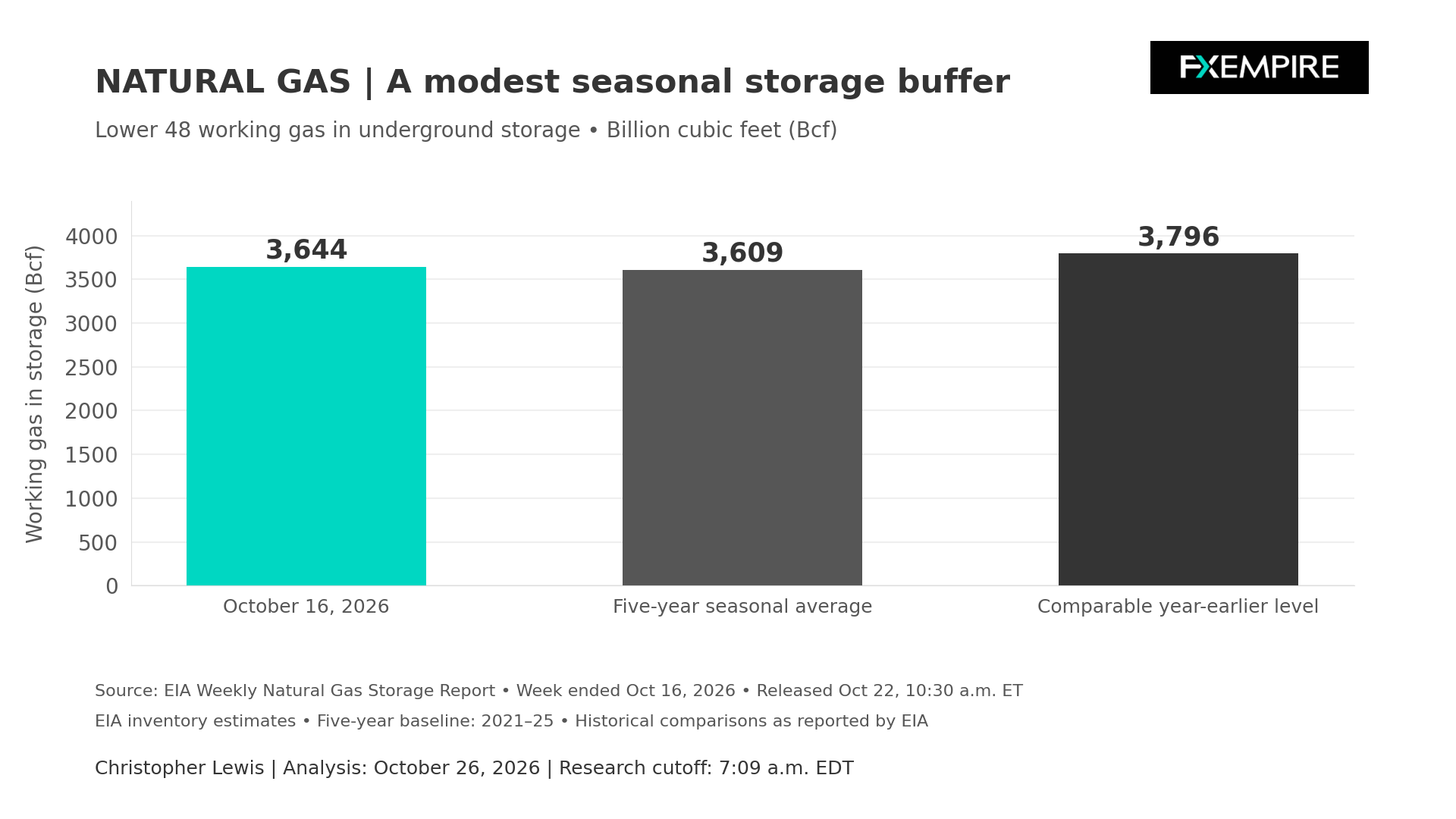
South Central working stocks were 3.4% below their five-year average, while salt cavern stocks there were 14.9% above benchmark. These are overlapping categories and should not be added together. The relevance is that national inventories do not necessarily show every available unit of gas and where it sits.
The modest national surplus gives the market some flexibility if warmth persists, but not an unlimited cushion, to say the least. The balance should be judged against the idea of subsequent injections and withdrawals rather than through a calendar assumption that storage must stop rising on a particular day. Weather, production, and export demand all come into the picture, changing the transmission to Henry Hub.
EIA October Energy Outlook Supply
The EIA’s October Energy Outlook Supply is a longer-term reference. Released October 6 and completed October 1, it forecasts end-October inventories near 3,850 billion cubic feet, about 2% above the five-year moving average. This is a model projection rather than a storage observation, but it has weighed upon the market overall, as seen on the chart.
The same outlook forecasts annual average dry production of 112.2 billion cubic feet per day in 2026 and 116.13 billion cubic feet per day in 2027, while LNG exports of 17.6 and 18.6 billion cubic feet per day are expected. LNG demand can support domestic gas consumption when terminals are operating, while an interruption can leave more gas available to the domestic market. Production disruptions can work in the opposite direction.
The replacement EIA weekly supplement did not expose dated operating figures in its accessible report. The immediate scheduled checkpoint is the next EIA storage report, released this Thursday, October 29, at 10:30 a.m. Eastern. The October 22 report is the most recent information that we have to work with, which does not compel the market to look for scarcity. That missing scarcity is part of what has driven so much selling pressure.
Natural Gas Price Forecast
Every new Natural Gas analysis as it publishes, today's technical signal and key levels, live price — on one page.
See all Natural Gas forecastsThe Market Has Collapsed to April Lows
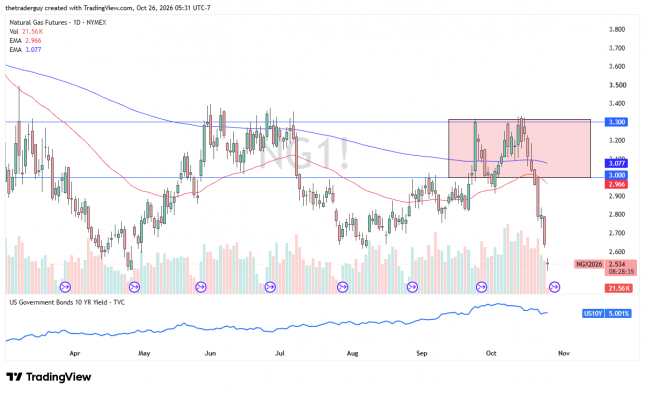
This leads to the question in my mind of exactly who would be left to sell this contract. That being said, I’m not willing to jump in and try to catch a falling knife, but at the first signs of weather deterioration in the United States or a less-than-expected injection report, I am willing to get long.
As things stand right now, the market still needs to find its base, which it clearly has not. Shorting from this low level is simply chasing at this point.