


Henry Hub natural gas enters the Tuesday session with inventories above seasonal averages, while the latest official weather outlook offers limited evidence of widespread northern heating pressures. NOAA favors warmth across several major northern areas, but cooler conditions in parts of the Southeast. This is a forecast of temperature probabilities, not measured consumption.
Warm Weather Is Expected Next Week as Well
The Climate Prediction Center’s November 2 outlook, issued at 3 p.m. EST, covers November 8–12. It favors above-normal temperatures across the West and north-central United States, as well as the Northeast and Great Lakes. Below-normal temperatures are favored in parts of the Southeast.
My interpretation of the weather reports is that geographic distribution matters more than a single nationwide warm or cold label. A cool pocket of weather could increase local heating requirements, while warmth elsewhere limits the aggregate draw on supply. The relevant question for the market is how this forecast will translate into population-weighted demand and how long that weather lasts.
Storage Remains Abundant
The latest published EIA storage report, released October 29, puts Lower 48 working gas at 3,724 Bcf for the week ending October 23, following an 80 Bcf injection. Stocks were 38 Bcf above the five-year average, but 147 Bcf below the level last year. Both comparisons matter. Inventories can be seasonally adequate while still being lower than an unusually well-supplied previous year.
The chart below presents those three comparable stock levels using a zero-base scale. It will avoid exaggerating the relatively moderate surplus over the seasonal norm. For the market, the outlook is that a buffer rather than immunity from tighter conditions is what’s going on. A prolonged change in weather could change everything we see on the chart, but as things look at the moment, we are not there yet.
Natural Gas Price Forecast
Every new Natural Gas analysis as it publishes, today's technical signal and key levels, live price — on one page.
See all Natural Gas forecasts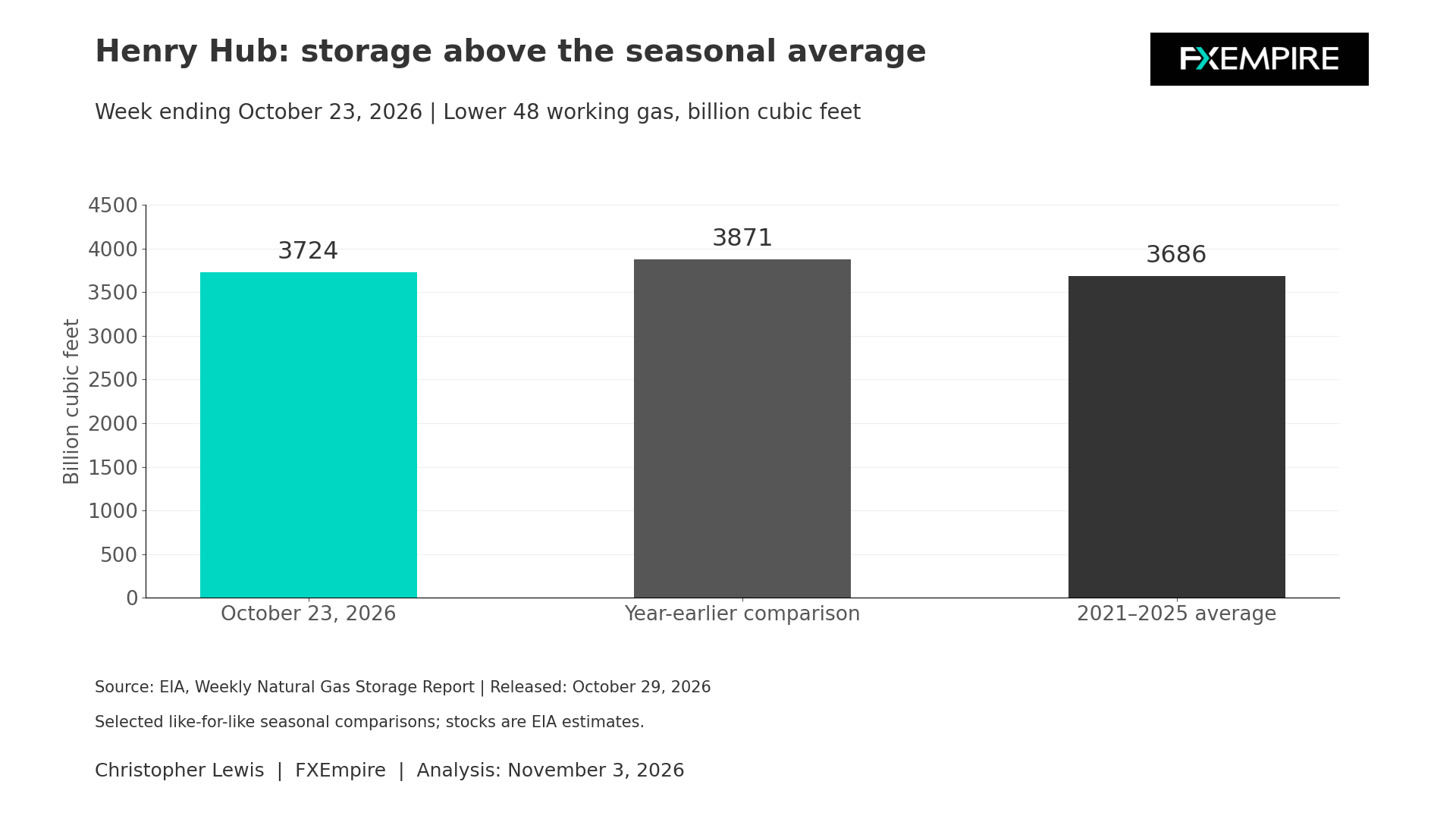
Regional figures also qualify the national picture. South Central stocks were 1,168 Bcf against the five-year average of 1,196 Bcf. Its salt-storage component stood at 274 Bcf versus a seasonal average of 310 Bcf. These are components of the same October 23 report, not new measurements.
Analytically, a national surplus does not necessarily establish that every consuming region has the same flexibility. The location of storage and the ability to move gas can influence regional pricing and the speed at which supply responds to changing weather-related requirements.
Supply Outlook Remains in Focus
The broader supply outlook remains constructive in the EIA’s dated forecast. The October Short-Term Energy Outlook projected average dry gas production of 112.2 Bcf per day this year and 116.13 Bcf per day next year, alongside LNG exports of 17.6 and 18.6 Bcf per day, respectively. These are annual forecasts, not measured daily production or current terminal feedgas. This outlook was completed on October 1. The timing limits how much the forecast can carry its weight into a daily assessment, as it predates subsequent operational developments and weather revisions.
This is good background information and suggests whether additional production can accommodate export growth while maintaining sufficient domestic availability. The catch here, of course, is that Europeans may need to buy more natural gas exports as the cost of gas on the continent skyrockets.
Thursday Storage Report
The next storage release is scheduled for this Thursday. It will provide the most recent inventory observation and a better test of whether the seasonal surplus is expanding or narrowing. The EIA’s next Short-Term Energy Outlook is scheduled for November 10.
For now, stronger heating demand and a shrinking storage cushion would reinforce a tighter interpretation as far as the market is concerned, with persistent warmth and further inventory accumulation reinforcing looser supply. Forecast revisions deserve attention, but confirmation should come from the actual observed balances.
The Technical Analysis for Natural Gas Is Still Fairly Weak
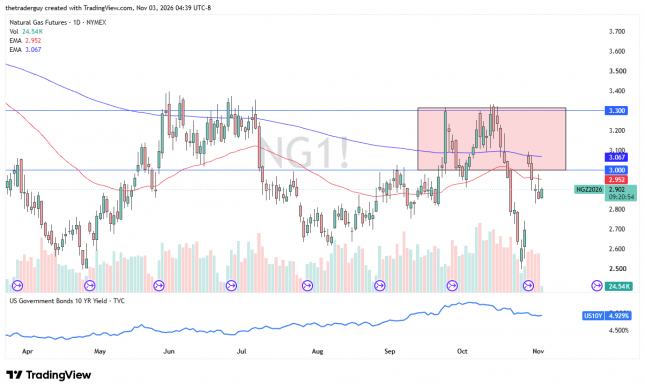
Although it is worth noting that we gapped very high and aggressively when we rolled over into the December contract, we have since started to fall back, which is typical after a gap like that. The question now is: where will we find the buyers?
I anticipate that this remains a buy-the-dip market, but that dip could fall all the way to $2.70 before finding the bottom. I’m cautiously optimistic for natural gas, but weather reports so far are a bit of a drag.