
Japan’s Stock Investment by Foreigners: An Economic Bellwether
The USD/JPY pair was in the spotlight on Thursday, November 28. Japan’s stock investment by foreigners drew interest amid uncertainty about the timing of a Bank of Japan rate hike.
Foreign investment in Japanese stocks tumbled by ¥446 billion (the week ending November 23) after investments of ¥127.6 billion (the week ending November 16).
Foreign capital outflows can materially impact the USD/JPY pair by reducing demand for the Japanese Yen, altering the supply-demand balance in favor of Yen weakness. Economists consider foreign investment trends a barometer of overseas sentiment toward Japan’s economy.
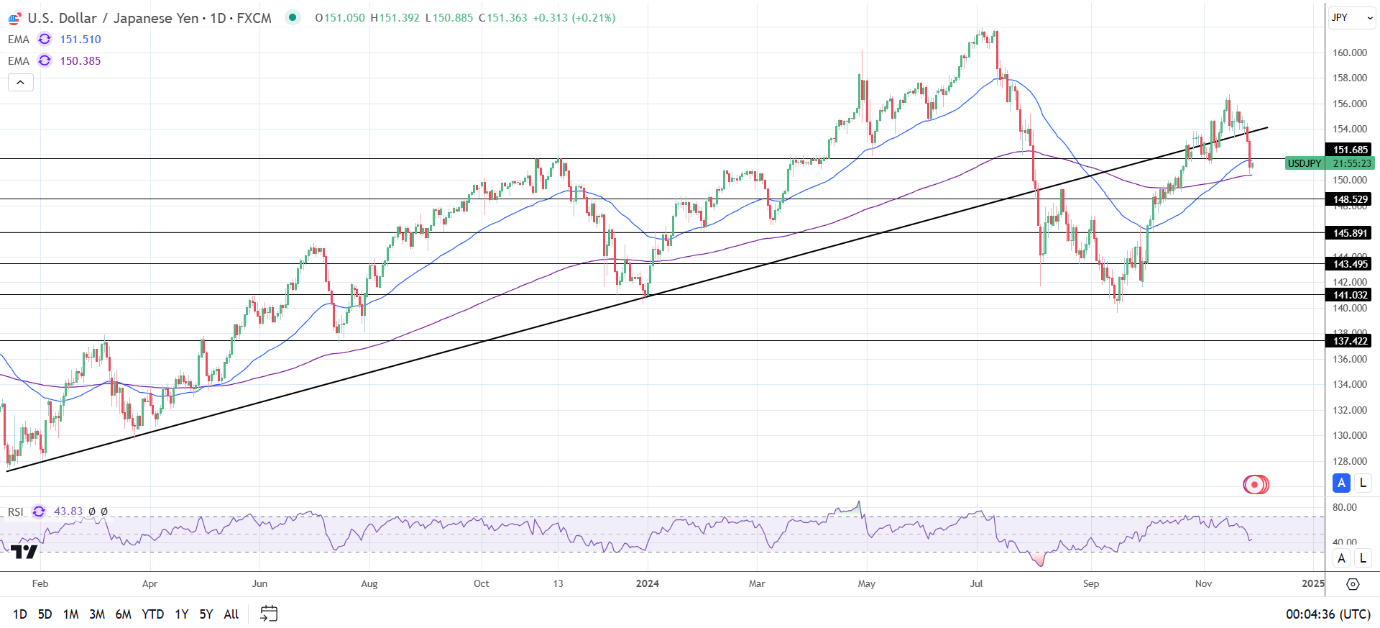
Beyond the economic data, investors should monitor BoJ comments throughout the Thursday session. Recent economic indicators have fueled bets on a December BoJ rate hike, dragging the USD/JPY to 150. BoJ support for a December rate hike and further tightening in Q1 2025 may send the pair below the key 150 level.

BoJ’s December Rate Hike: Will It Break USD/JPY’s 150 Level?
CLSA Strategist Nicholas Smith recently predicted a 25-basis point December BoJ rate hike and two additional rate hikes in 2025. Smith suggested that rate hikes could benefit Japan’s households by strengthening the Yen. A stronger Japanese Yen may lower import costs, potentially lowering living costs.
Smith’s views align with a recent Reuters poll, where 56% of respondents predicted a December hike, up from 49% in October.
AUD/USD Price Forecast
Every new AUD/USD analysis as it publishes, today's technical signal and key levels, live price — on one page.
See all AUD/USD forecastsJapanese Yen Daily Chart
In today’s US session, investors should consider FOMC member speeches. October’s US Personal Income and Outlays Report suggested inflation remains under control, boosting bets on a December Fed rate cut.
Support for a December Fed rate cut could drive the USD/JPY below 150. Conversely, calls to delay rate cuts until Q1 2025 may move the pair toward 153.5.
AUD/USD: Private Capex and RBA Governor Bullock in Focus
Turning to the AUD/USD, private capital expenditure (CAPEX) data will garner interest on Thursday. Economists forecast private CAPEX to increase by 0.9% quarter-on-quarter in Q3 2024 after falling 2.2% in Q2 2024.
Higher-than-expected private CAPEX may signal an improving economy, supporting job creation and wage growth. Higher wages could fuel consumer spending and demand-driven inflation.
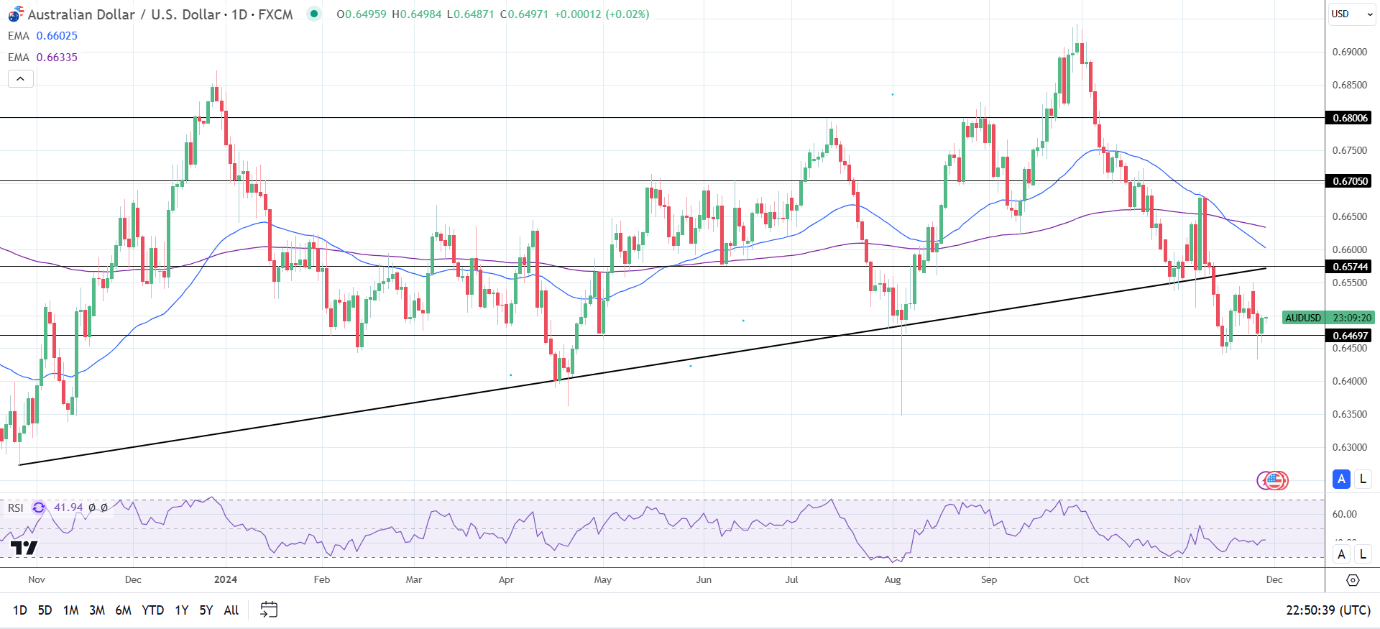
Rising inflation expectations might temper bets on a Q1 2025 RBA rate cut, pushing the AUD/USD toward $0.65500. Conversely, weak private CAPEX could raise expectations of a Q1 2025 rate cut, potentially dragging the pair toward $0.64500.
Will RBA Governor Michele Bullock address potential timelines for an RBA rate cut?
Later in the Thursday session, RBA Governor Michelle Bullock is on the calendar to speak. Her insights into inflation, the labor market, and the RBA rate path could move the dial.
Expert Insights Into Aussie Inflation and the RBA Rate Path
AMP Head of Investment Strategy and Chief Economist Shane Oliver remarked on October’s Aussie inflation report, stating,
“Aust Oct CPI 2.1%yoy,
While the trimmed mean inflation rate remains above the RBA’s 2-3% target range, the downward trend offers room for discussions on rate cuts.
Australian Dollar Daily Chart
FOMC commentary later in the US session could further influence the AUD/USD pair after Wednesday’s data dump. Support for a December Fed rate cut may drive the AUD/USD pair toward $0.65500 on a potential narrowing in the interest rate differential between the US and Australia.
Conversely, calls for a delay to rate cuts until Q1 2025 may pull the pair below $0.64500.
Vigilance Amid Volatile Markets
Market volatility underscores the importance of tracking key economic indicators and central bank commentary. With shifting rate expectations driving sentiment, traders must remain informed to navigate USD/JPY and AUD/USD price movements effectively.