
USD/JPY briefly dipped below 156 on Friday, November 28, before closing the session at 156.128. Strong Japanese retail sales and sticky Tokyo inflation numbers fueled speculation about a Bank of Japan rate hike, boosting demand for the yen.
Rising expectations of a BoJ rate hike have clashed with bets on a December Fed rate cut, increasing the risk of a yen carry trade unwind, potentially sending USD/JPY sharply lower. In my view, the prospect of a narrowing US-Japan rate differential sets the stage for a drop toward 140 through December.
On Monday, December 1, Japanese economic indicators and BoJ Governor Kazuo Ueda will set the tone for another pivotal week as the BoJ’s December interest rate decision fast approaches.
Below, I’ll outline the macro backdrop, the near-term price catalysts, and technical levels traders should closely watch.

Capital Spending Weakens in Q3
Japanese capital spending rose 2.9% year-on-year in the third quarter, down from 7.6% in the previous quarter. Capital spending trends provide insights into business sentiment, the economic outlook, and labor market trends.
Typically, softer spending would suggest a weaker economic outlook, job cuts, and falling wages. These scenarios favor a more dovish BoJ policy stance. However, last week’s data, including October’s retail sales and November inflation numbers for Tokyo, signaled a pickup in demand and sticky national inflation.
Strong domestic consumption and sticky inflation support a more hawkish BoJ rate path, discounting Q3 data. The USD/JPY reaction to last week’s data and the capital spending figures aligned with my view that markets are focused more on the Q4 numbers, key for the BoJ’s upcoming policy decision.
Looking at the USD/JPY pair’s five-minute chart, USD/JPY briefly climbed to a post-data release high of 156.584 before sliding to a low of 156.094 on Friday, November 28. Price action aligned with increasing speculation about a December BoJ rate hike. Meanwhile, USD/JPY dropped from 156.128 to 155.808 in morning trading on December 1.
USD/JPY Price Forecast
Every new USD/JPY analysis as it publishes, today's technical signal and key levels, live price — on one page.
See all USD/JPY forecasts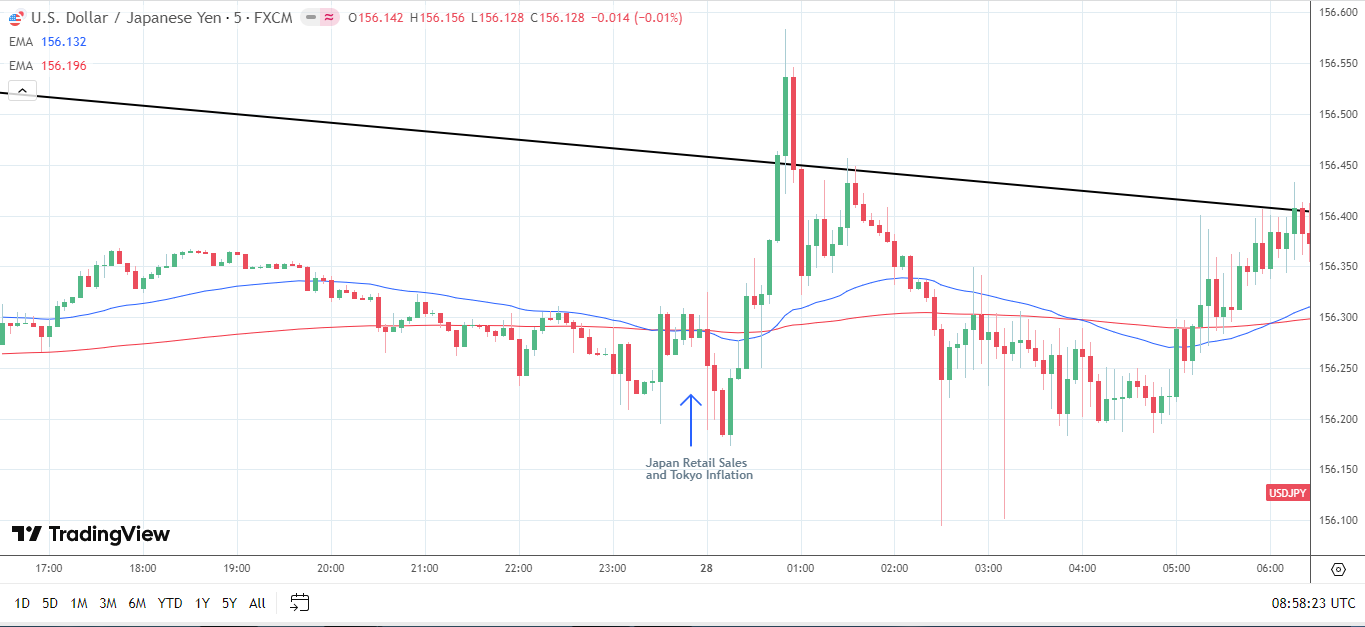
Will BoJ Governor Ueda Greenlight a Hike?
Later this morning, BoJ Governor Kazuo Ueda could greenlight a December hike, potentially kick-starting a USD/JPY bearish-trend reversal.
USD/JPY has soared 5.63% in the fourth quarter, fueled by Prime Minister Sanae Takaichi’s support for ultra-loose monetary policy and fiscal stimulus policies. Previously fading bets on a December rate cut contributed to the fourth quarter rally.
However, growing concerns about the weaker yen pushing import prices higher and eroding Japanese households’ purchasing power have added to the chances of a BoJ hike.
I expect USD/JPY to drop sharply if Governor Ueda focuses on elevated import prices while talking optimistically about wage growth. Markets would likely view such comments as a green light for a rate hike at the December meeting.
Economists continue to flag the weaker yen as a BoJ focal point, aligning with my bearish stance on USD/JPY.
East Asia Econ commented on October’s national inflation figures, stating:
“Headline SPPI inflation was stable in October, but weak for high labor-intensive sectors, while part-time wages were strong, likely on the back of the minimum wage hike. That’s an unclear picture. But right now, with JPY so weak, the BoJ will focus more on headline CPI than these messy details.”
US PMI Data and Fed Speakers to Impact US Dollar Demand
While BoJ Governor Ueda will take center stage in the Asian session, US data and Fed speakers are in focus later on Monday.
Economists forecast the ISM Manufacturing PMI to fall from 48.7 in October to 48.6 in November. A more marked contraction across the manufacturing sector and softer prices would raise expectations of a December Fed rate cut.
November’s data will come ahead of a Fed Chair Powell speech after the market close on Monday, December 1.
Powell’s support for a December rate cut, coupled with a hawkish BoJ Governor, would likely send USD/JPY toward 150, setting up a sharper fall to 140 later in the month.
According to the CME FedWatch Tool, the probability of a December cut jumped from 39.1% on November 20 to 86.4% on November 28. Meanwhile, November’s Reuters poll showed a majority of economists predicting a December BoJ rate hike. All panelists expecting a policy adjustment by March 2026.
Technical Outlook: USD/JPY Faces Three-Day Losing Streak
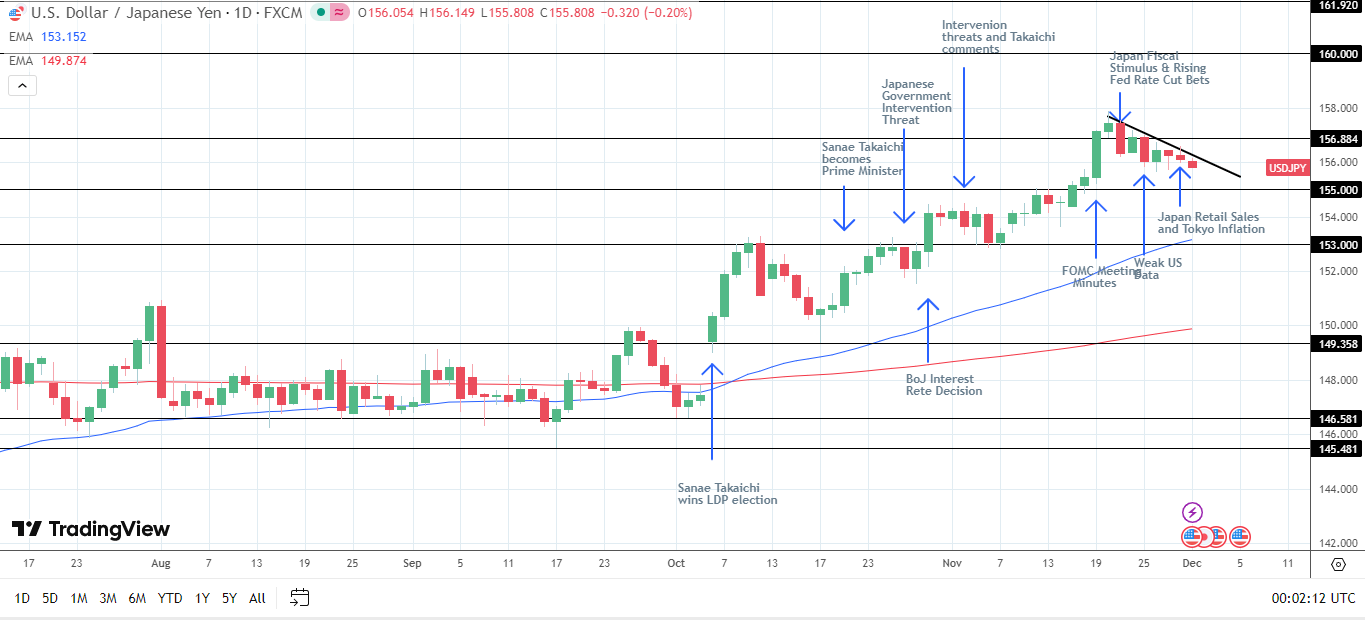
Looking at the daily chart, USD/JPY remained above the 50-day and 200-day Exponential Moving Averages (EMAs), affirming a bullish bias. However, fundamentals have started to shift from the technical trend, supporting a bearish outlook.
A break below the 155 support level would pave the way to the 50-day EMA and the 153 support level. If breached, the 200-day EMA and 150 would be the next key support levels. Crucially, a break below the 50-day EMA would indicate a bearish trend reversal, signaling a drop toward 140.
Position and Upside Risk
In my view, fundamentals and this morning’s reaction to weaker Japanese data support a bearish short- to medium-term outlook. A BoJ and Fed-driven drop below the 50-day EMA, and the 153 level will likely strengthen the case for a sharper fall toward 150 and the 200-day EMA, bringing 140 into view.
However, upside risks linger, including:
- Dovish BoJ commentary.
- Weak Q4 Japanese data.
- Stronger US inflation.
- Solid US services sector activity.
- Robust US jobs data.
- Hawkish Fed rhetoric.
Despite the upside risks, yen intervention warnings will likely cap upside around the 157.893 November 20 high.
Read the full USD/JPY forecast, including chart setups and trade ideas.
Conclusion: Longer-Term Trajectory to 130 in Play
To summarize, BoJ monetary policy normalization and Fed monetary policy easing set the stage for a reversal of gains since 2022. In my view, USD/JPY will likely drop to the 2023 low of 127.215 in the next 6-12 months.
For more in-depth analysis, review today’s USD/JPY trading setups in our latest reports and consult the economic calendar.