
USD/JPY eyes 160 for the first time since the July 2024 yen carry trade unwind as political uncertainty and concerns over monetary and fiscal policy weaken the yen.
The USD/JPY pair gained momentum in the first half of the week despite rising beyond the 157 level, a previous yen intervention threat zone. Japan’s finance minister previously warned of yen intervention in the forex markets in the 157-158 range.
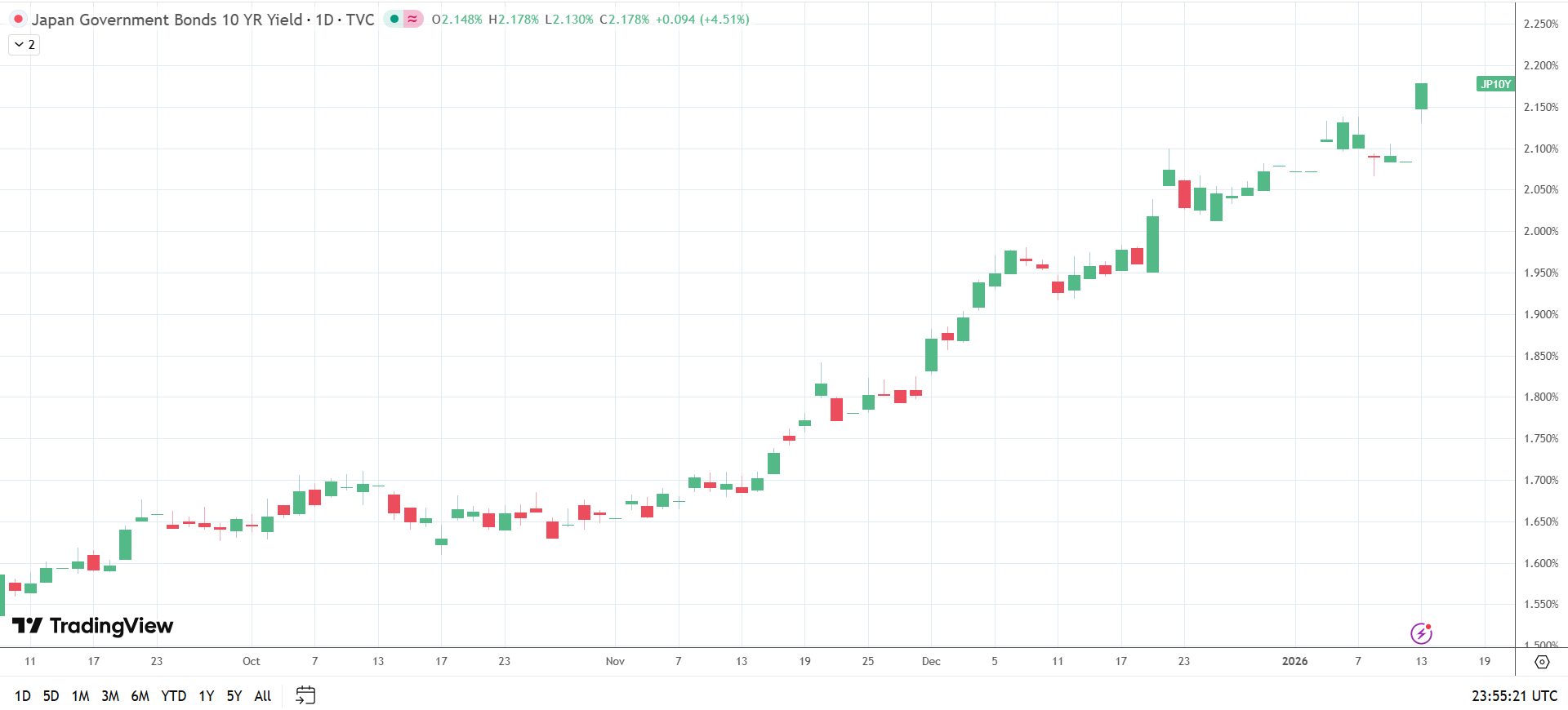
This week, 10-year Japanese Government Bond (JGB) yields surged to 2.178%. The weaker yen and soaring yields reflected market sentiment toward Prime Minister Sanae Takaichi’s plans for a snap election. Fading bets on a March Fed rate cut have added to USD/JPY momentum.
Below, I’ll discuss the macro backdrop, the near-term price catalysts, and technical levels traders should closely watch.

Snap Election and Fiscal Policy Concerns Sink the Yen
News outlets reported that Japan’s Prime Minister Takaichi may call for a snap election in February over the weekend, her first time facing national voters. Speculation about a snap election intensified as Takaichi’s approval rating jumped to 78.1% in January, according to a JNN public opinion survey.
Meanwhile, the Liberal Democratic Party’s approval rating remains below 30%, fueling uncertainty over how voters will side in a national election. A strong election win would enable Takaichi to push through fiscal stimulus plans, weighing on demand for the yen. Takaichi’s fiscal stimulus plans and Japan’s debt-to-GDP ratio have led to a surge in risk premiums for holding JGBs, sending yields to decade highs.
Robin Brooks, Senior Fellow at the Brookings Institution, commented:
“Japan is trapped in a very bad place and is the G10 country that’s closest to a full-blown debt crisis. Japan’s only choice is to accept higher interest rates and a debt crisis or – if it caps yields – a depreciating yen, which is nearing its 2024 lows…”
Notably, USD/JPY has surged 8.25% since Takaichi’s election win to become the LDP leader in early October. USD/JPY trends underscored market concerns about her stance on fiscal stimulus and monetary policy.
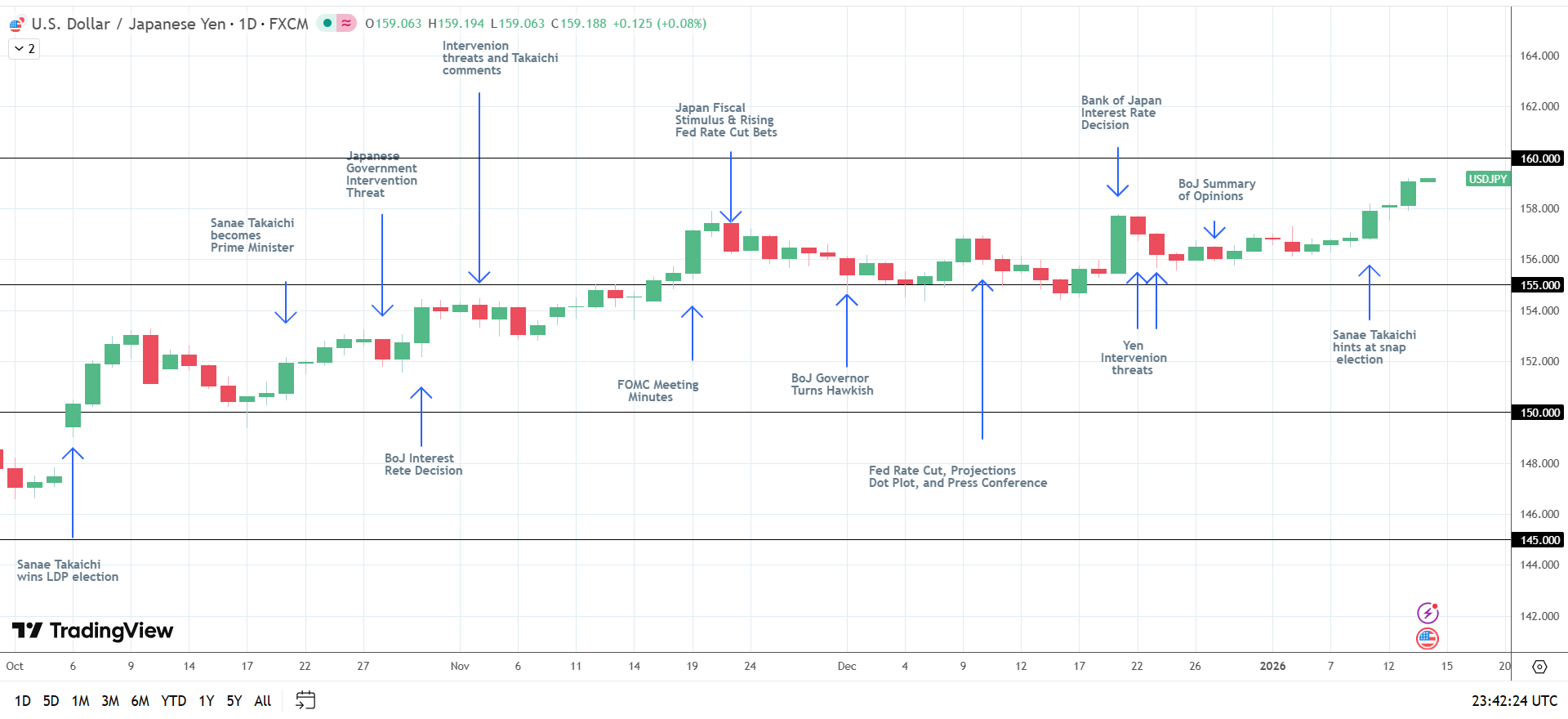
The political uncertainty supports a cautiously bullish short-term price outlook for USD/JPY. However, potential yen interventions and the prospect of Bank of Japan rate hikes affirm the bearish medium-term projection.
Crucially, the weaker yen would increase import prices, eroding households’ purchasing power. These scenarios may force the BoJ to signal further policy tightening to strengthen the yen.
USD/JPY Price Forecast
Every new USD/JPY analysis as it publishes, today's technical signal and key levels, live price — on one page.
See all USD/JPY forecastsUS Producer Prices and Retail Sales to Drive Dollar Demand
Later on Wednesday, US retail sales and producer prices are likely to influence market bets on a March Fed rate cut.
Economists forecast retail sales to rise 3.0% year-on-year (YoY) in November, down from 3.5% in October. Weaker consumer spending would signal a softer demand-driven outlook, supporting a more dovish Fed rate path.
Meanwhile, economists expect producer prices to increase 2.7% YoY in November, mirroring October’s rise. Softer-than-expected producer prices would raise expectations of a March Fed rate cut, weighing on demand for the US Dollar. Increased bets on a March cut would support the bearish medium-term outlook for USD/JPY.
According to the CME FedWatch Tool, the probability of a March Fed rate cut fell from 48.5% on January 6 to 25.7% on January 13. Stronger-than-expected US labor market and Services PMI data cooled expectations of a March cut.
Today’s US economic data will be key for the near-term USD/JPY price outlook. Stronger US data would signal a more hawkish Fed policy stance, strengthening the US dollar, and challenging the bearish medium-term outlook.
Nevertheless, expectations of multiple BoJ rate hikes and a new Fed Chair potentially favoring lower interest rates remain key considerations. These factors reinforce the bearish medium-term outlook for USD/JPY.
Technical Outlook: Key Levels to Watch
For USD/JPY price trends, traders should consider technicals and closely monitor the fundamentals.
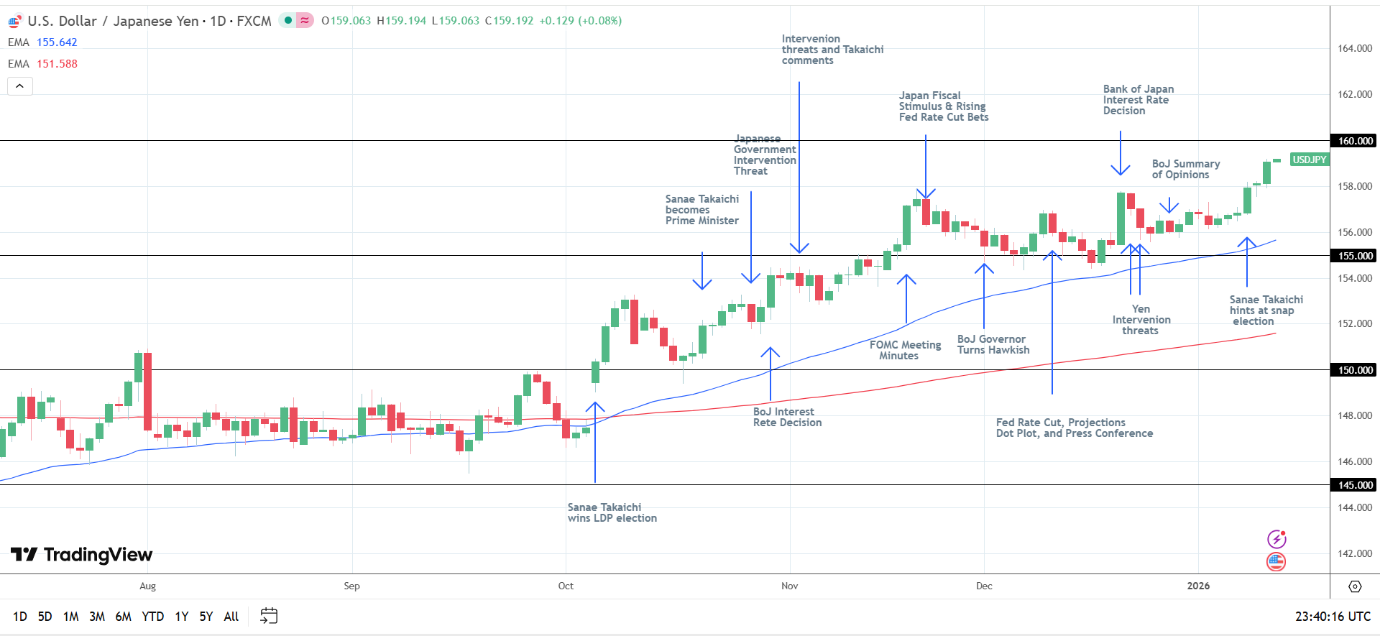
Viewing the daily chart, USD/JPY trades well above its 50-day and 200-day Exponential Moving Averages (EMAs), indicating bullish momentum. While technicals remain bullish, bearish fundamentals are evolving, countering the technicals.
A drop below 157 would bring the 50-day EMA and the 155 support level into play. A sustained fall below the 50-day EMA would signal a bearish near-term trend reversal, exposing the 200-day EMA. If breached, 150 would be the next key support level.
Crucially, a sustained fall below the 50-day and 200-day EMAs would reinforce the bearish medium-term price outlook.
Position and Upside Risk
In my view, expectations for BoJ rate hikes, potential warnings of yen intervention, and bets on Fed rate cuts support a negative price outlook. However, the BoJ neutral interest rate and upcoming US data will be pivotal, given the focus on US-Japan rate differentials.
A hawkish BoJ neutral interest rate level (potentially 1.5%-2.5%) would signal multiple BoJ rate hikes and a narrower US-Japan interest rate differential. A narrower-than-expected rate differential may trigger a yen carry unwind, sending USD/JPY toward 140 over the longer term.
However, upside risks to the bearish outlook include:
- Dovish BoJ chatter and a dovish neutral interest rate (potentially 1%-1.25%).
- Strong US economic data.
- Hawkish Fed chatter.
These events would send USD/JPY higher. However, the threat of yen interventions is likely to cap the upside at the 160 level, based on the latest communication.
Read the full USD/JPY forecast, including chart setups and trade ideas.
Conclusion: Politics, Neutral Rate, and US Data in the Spotlight
In summary, the USD/JPY trends will hinge on Prime Minister Takaichi’s election and policy goals, the BoJ’s neutral rate, and the Fed rate path.
While a comfortable Takaichi election win would be USD/JPY bullish, a hawkish neutral rate (1.5%-2.5%) would indicate an aggressive BoJ rate path, delivering yen strength. Additionally, dovish Fed chatter would raise expectations of narrower rate differentials, reaffirming the bearish outlook for USD/JPY.
Notably, a sharply stronger yen could trigger the unwinding of yen carry trades, which would likely send USD/JPY toward 140 over the longer 6-12 month timeline.
For more in-depth analysis, review today’s USD/JPY trading setups in our latest reports and consult the economic calendar.