USD/JPY takes center stage on Friday, January 23, as markets await the Bank of Japan’s monetary policy decision and quarterly outlook report.
Economists expect the BoJ to leave interest rates at 0.75%. However, the weaker Japanese yen has fueled uncertainty about the timing of further rate hikes, exposing the USD/JPY pair to potential volatility.
Ahead of the monetary policy decision, inflation and private sector PMI data gave insights into Japan’s economy and price trends. Softer-than-expected inflation and a hotter Services PMI numbers increased fueled speculation about an H1 2026 BoJ rate hike.
While inflation cooled, Japan’s Services PMI supported a bearish medium-term outlook for USD/JPY.
Below, I’ll discuss the macro backdrop, the near-term price catalysts, and technical levels traders should closely watch.

Inflation Softens Sharply, Signaling Weak Demand
Japan’s annual inflation rate dropped from 2.9% in November to 2.1% in December, while ‘core-core’ inflation eased from 3% to 2.9%.
On the face of it, the December numbers are likely to reduce pressure on the BoJ to raise interest rates. However, the BoJ’s concerns about a weaker yen driving import prices higher and the resulting erosion of household purchasing power remain a key factor.
Furthermore, economists expect Prime Minister Sanae Takaichi’s fiscal policies to also push inflation higher, supporting a more hawkish BoJ rate path. The BoJ may indicate the need for multiple rate hikes to counter the risk of elevated inflation.
According to January’s Reuters poll, conducted between January 6-13, 43% of economists expected a July rate hike, 27% a June hike, and just 8% an April hike.
Since the poll, speculation has intensified about an April hike, raising the prospect of multiple monetary policy adjustments in 2026. The BoJ’s Quarterly Outlook Report and Governor Kazuo Ueda’s press conference will reveal the Bank’s policy stance. BoJ Governor Kazuo Ueda previously stated that rate hikes would continue if the economy and prices aligned with the Bank’s projections.
A more aggressive BoJ rate path would support the bearish short- to medium-term outlook for USD/JPY. Despite the potential for a hawkish BoJ policy stance, the yen weakened against the dollar in response to the inflation data. USD/JPY briefly dropped to 158.385 before climbing to a high of 158.532 as the market’s focus shifted to the private sector PMIs.
USD/JPY Price Forecast
Every new USD/JPY analysis as it publishes, today's technical signal and key levels, live price — on one page.
See all USD/JPY forecasts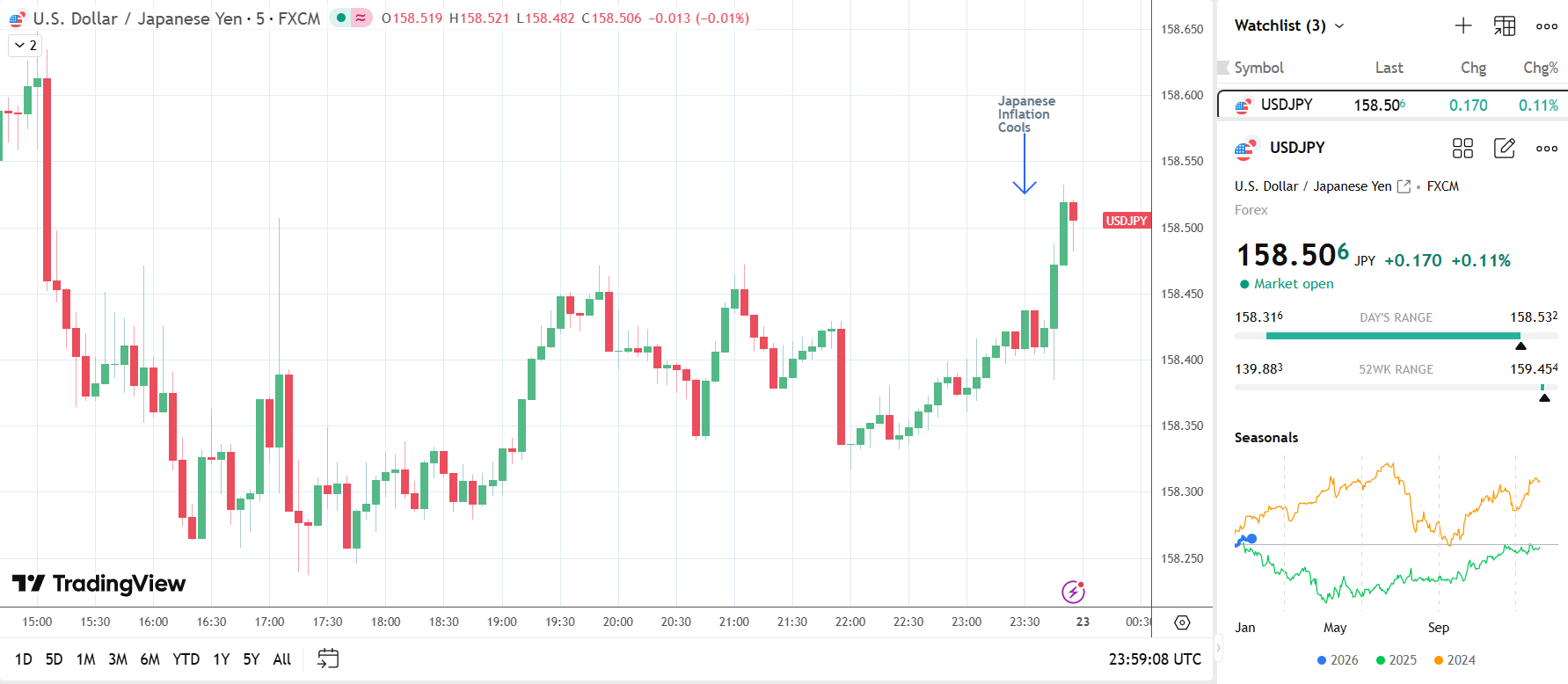
Japan Services PMI Boosts Rate Hike Bets
The all-important S&P Global Japan Services PMI increased from 51.6 in December to 53.4 in January. Notably, the rate of job creation was the most marked since April 2019, while service providers increased their charges, suggesting higher consumer prices. The January PMI data will draw the BoJ’s attention, supporting a more hawkish stance, contrasting with the Fed’s dovish rate path.
Expectations of BoJ rate hikes and Fed rate cuts reaffirm the bearish medium- to longer-term price projections.
US Private Sector PMIs Put the Fed in Focus
While the yen faces a potentially choppy session awaiting the BoJ’s monetary policy decision and press conference, US economic data will influence bets on a June Fed rate cut.
Economists forecast the S&P Global US Services PMI to increase from 52.5 in December to 52.9 in January.
A higher headline PMI would indicate a pickup in economic momentum. The services sector contributes around 80% to the US GDP. However, traders should consider the employment and prices sub-components. Crucially, falling prices would support a more dovish Fed rate path, given that services sector inflation remains the key driver for headline and underlying inflation. A more dovish Fed rate path would weaken the US dollar, sending USD/JPY lower.
Other economic indicators include finalized consumer sentiment numbers. Barring a marked deviation from the preliminary figures, the Services PMI figures are likely to be key for USD/JPY.
Despite ongoing concerns about Japan’s fiscal spending and debt-to-GDP, the expectation of multiple BoJ rate hikes and a new Fed Chair in favor of lower interest rates suggests a narrower US-Japan rate differential. These scenarios reaffirm the bearish medium-term outlook for USD/JPY.
Technical Outlook: Key Levels to Watch
For USD/JPY price trends, traders should consider technicals and monitor central bank and political headlines.
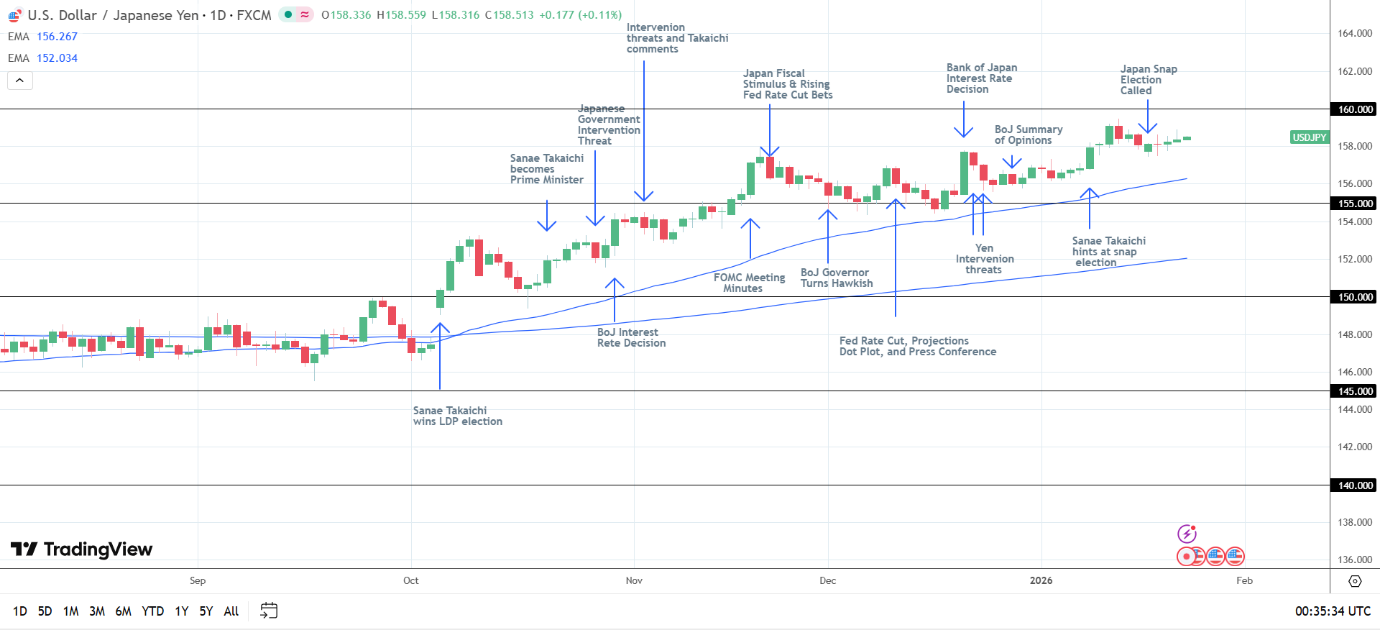
On the daily chart, USD/JPY trades comfortably above its 50-day and 200-day Exponential Moving Averages (EMAs), signaling bullish momentum. While technicals remain bullish, bearish fundamentals remain, countering the technicals. Despite recent gains, the pair sits below the January 14 high of 159.453.
A break below 157 would expose the 50-day EMA and the 155 support level. A sustained fall through the 50-day EMA would indicate a bearish near-term trend reversal, bringing the 200-day EMA into play. If breached, 150 would be the next key support level.
Significantly, a sustained fall through the EMAs would reaffirm the bearish medium-term price outlook.
Positioning and Risk Outlook
In my view, expectations for hawkish BoJ policy outlook, potential yen intervention warnings, and expectations of Fed rate cuts support a negative price outlook. However, Japan’s February election and US economic data will be key, given recent movements in the USD/JPY pair.
Furthermore, a hawkish BoJ neutral interest rate level (potentially 1.5%-2.5%) would signal multiple BoJ rate hikes and a narrower US-Japan interest rate differential. A narrower rate differential may trigger a yen carry unwind, as seen in mid-2024. A yen carry trade unwind would likely push USD/JPY toward 140 over the longer term.
However, upside risks to the bearish outlook include:
- Dovish BoJ rhetoric and a neutral interest rate (potentially 1%-1.25%).
- Upbeat US economic data cools Fed rate cut expectations in H1 2026.
- US Supreme Court rules tariffs legal, suggesting more levies.
These factors would drive USD/JPY higher. However, the potential threat of yen interventions is likely to continue limiting the upside at the 160 level.
Read the full USD/JPY forecast, including chart setups and trade ideas.
Conclusion: Politics, the BoJ, and the Fed in the Spotlight
In summary, the USD/JPY trends will hinge on Prime Minister Takaichi’s election and fiscal spending goals, the BoJ’s monetary policy outlook, and the Fed’s rate path.
A higher neutral rate (1.5%-2.5%) would indicate a hawkish BoJ rate path, which would strengthen the yen. Meanwhile, Japan’s upcoming election will be key for the near-term USD/JPY trends. The yen has weakened sharply since October, given Prime Minister Takaichi’s fiscal and monetary policy stances. Additionally, a dovish Fed would signal narrower rate differentials, reinforcing the bearish medium-term outlook for USD/JPY.
A sharply stronger yen, triggering the unwinding of yen carry trades. A carry trade unwind would likely push USD/JPY toward 140 over the longer 6-12 month timeline.
For more in-depth analysis, review today’s USD/JPY trading setups in our latest reports and consult the economic calendar.