USD/JPY took the spotlight early in the Monday, December 8, session, as crucial Japanese economic data fueled speculation about a Bank of Japan rate hike.
Wage growth and finalized Q3 GDP numbers supported market bets on a December BoJ hike, boosting demand for the Japanese yen. The USD/JPY pair retreated on the stronger yen.
Rising expectations of a BoJ rate hike have coincided with bets on a December Fed rate cut, opening the door to heightened volatility as key data rolls out. This morning’s data supported a bearish short- to medium-term outlook for USD/JPY, hinging on dovish Fed and hawkish BoJ rate paths.
Below, I’ll discuss the macro backdrop, the near-term price catalysts, and technical levels traders should closely watch.

Japanese Average Cash Earnings
Average cash earnings increased 2.6% year-on-year (YoY) in October, up from 2.1% in September. Overtime pay rose from 1% YoY to 1.5% in October. A pickup in wages is crucial for the BoJ hawks, looking to advance monetary policy normalization.
Higher wages increase household purchasing power, boost consumer spending, and fuel demand-driven inflation. Furthermore, an upswing in household spending would bolster the economy, given that private consumption accounts for roughly 55% of Japan’s GDP.
Last week, BoJ Governor Kazuo Ueda signaled an imminent rate hike, citing wage growth, underscoring the importance of household purchasing power on the Bank’s policy stance.
USD/JPY responded, briefly falling from 155.285 to 155.240 after the data.
USD/JPY Price Forecast
Every new USD/JPY analysis as it publishes, today's technical signal and key levels, live price — on one page.
See all USD/JPY forecastsJapan’s Economy Contracts in Q3
While wage growth lifted bets on a December BoJ rate hike, finalized Q3 GDP data offered the BoJ doves an argument to delay a policy adjustment until January. The economy contracted by 0.6% quarter-on-quarter in the third quarter, revised from a preliminary 0.5% contraction. However, the downward revision to headline GDP stemmed from a 0.2% QoQ fall in capital expenditure. According to the preliminary report, capital expenditure had risen 0.4% QoQ.
Two components drew significant interest, given BoJ Governor Ueda’s recent comments on easing tariff risk and rising wages:
- External demand fell 0.2% QoQ, unchanged from the preliminary report.
- Private consumption rose 0.2% QoQ, up from a preliminary 0.1% increase.
Markets will likely discount the drop in external demand (though unchanged), given that the US administration lowered tariffs on Japanese goods from 25% to 15% in the quarter and BoJ Governor Ueda’s recent comments.
Looking at the one-minute chart, the pair briefly rose to a high of 155.381 before sliding to a low of 155.165 after the finalized GDP report. USD/JPY price action showed market sentiment toward higher wages and the upward revision to private consumption.
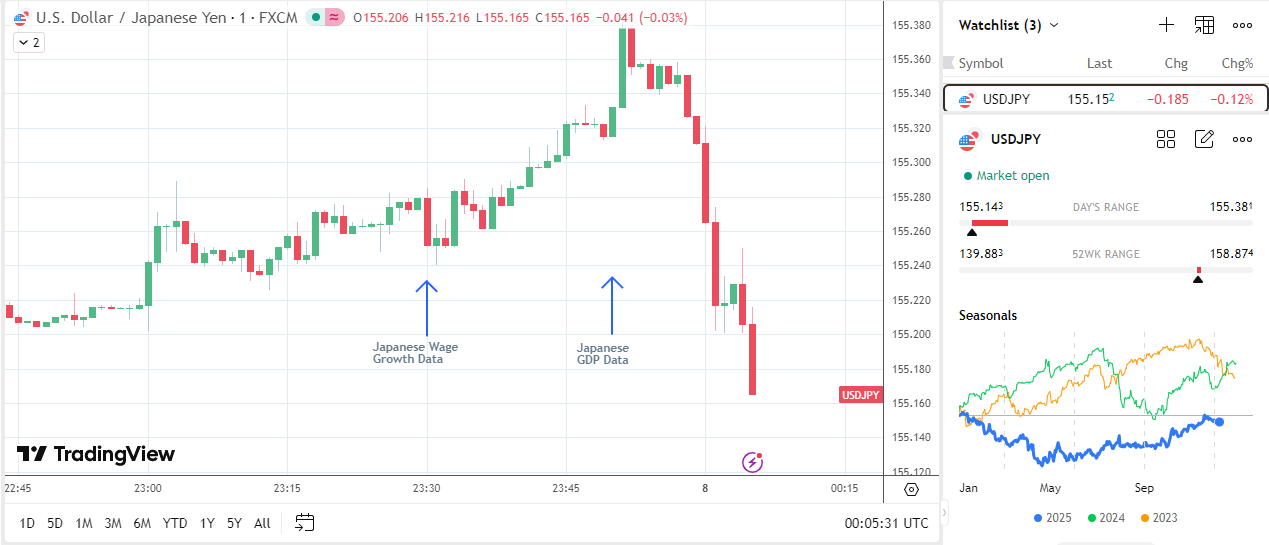
While expectations of a BoJ rate hike are strengthening yen demand, key US data will fuel speculation about multiple Fed rate cuts.
US Inflation in Focus as the Fed Decision Looms
Later on Monday, US economic data will influence USD/JPY trends as the FOMC interest rate decision and projections loom. Economists expect Consumer Inflation Expectations to soften from 3.2% in October to 3.1% in November.
A drop in the NY Fed 1-Year Consumer Inflation Expectations would align with last week’s inflation data, supporting bets on a Fed rate cut. A more dovish Fed rate path would weaken demand for the US dollar, sending USD/JPY lower, aligning with my bearish short- to medium-term outlook.
For context, the US Core PCE Price Index rose 2.8% YoY in September, down from 2.9%, while Michigan Inflation Expectations fell from 4.5% in November to 4.1% in December.
The prospect of a December Fed rate cut, further easing in H1 2026, and BoJ rate hikes are key for USD/JPY trends.
According to the CME FedWatch Tool, the probability of a December cut stood at 88.4% on December 8, up from 86.2% on December 5. Meanwhile, the chances of a March rate cut slipped from 46.5% to 46.1%.
With markets already pricing in a December cut, traders should closely monitor the chances of a March cut.
While key US inflation data will influence US dollar demand, there are no FOMC member speeches to overshadow the reports. The Fed’s Blackout Period is in effect until December 11, limiting Fed-driven volatility.
Technical Outlook: USD/JPY on a Downward Trajectory
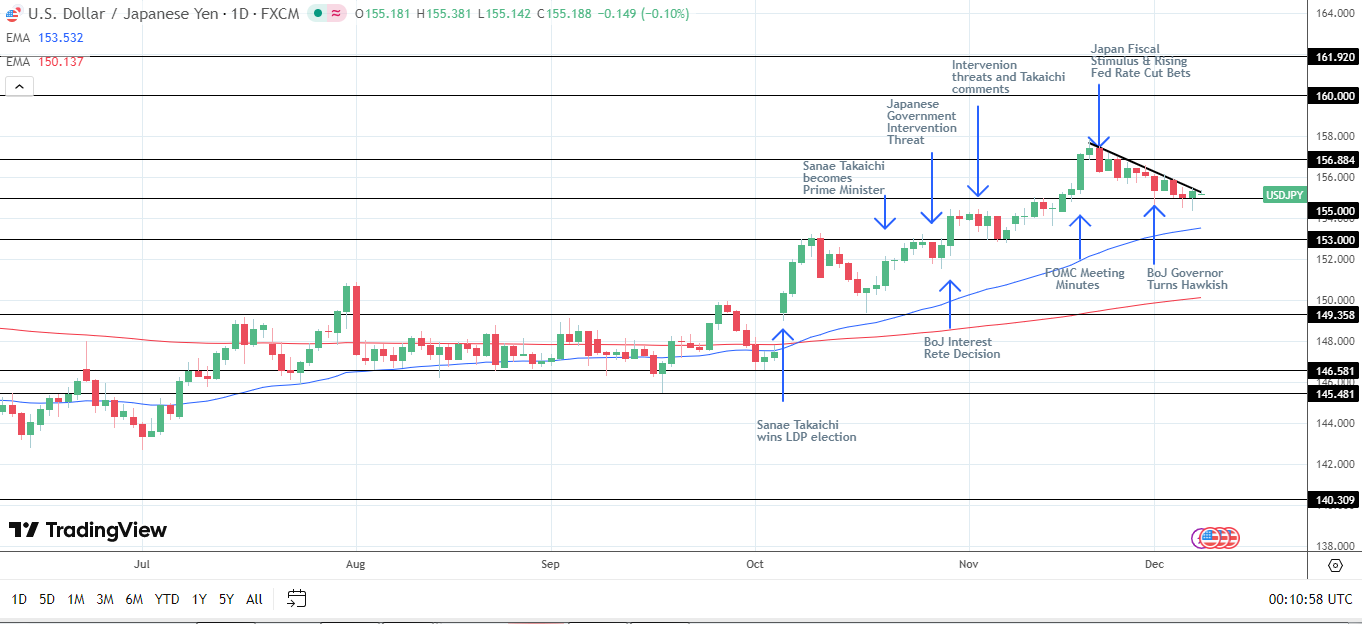
Looking at the daily chart, USD/JPY remained above the 50-day and 200-day Exponential Moving Averages (EMAs), indicating a bullish bias. However, fundamentals have begun to shift from the technical trend, supporting a bearish outlook.
A drop below the 155 support level would pave the way toward the 50-day EMA. If breached, the 153 support level would be the next key support. Significantly, a break below the 50-day EMA would signal a bearish trend reversal, signaling a near-term drop toward 150.
Position and Upside Risk
In my view, the wage growth and private consumption data support a bearish short- to medium-term outlook. A sustained USD/JPY break below the 50-day EMA would signal a fall toward 150 and the 200-day EMA. A drop below the 200-day EMA would affirm a bearish trend reversal.
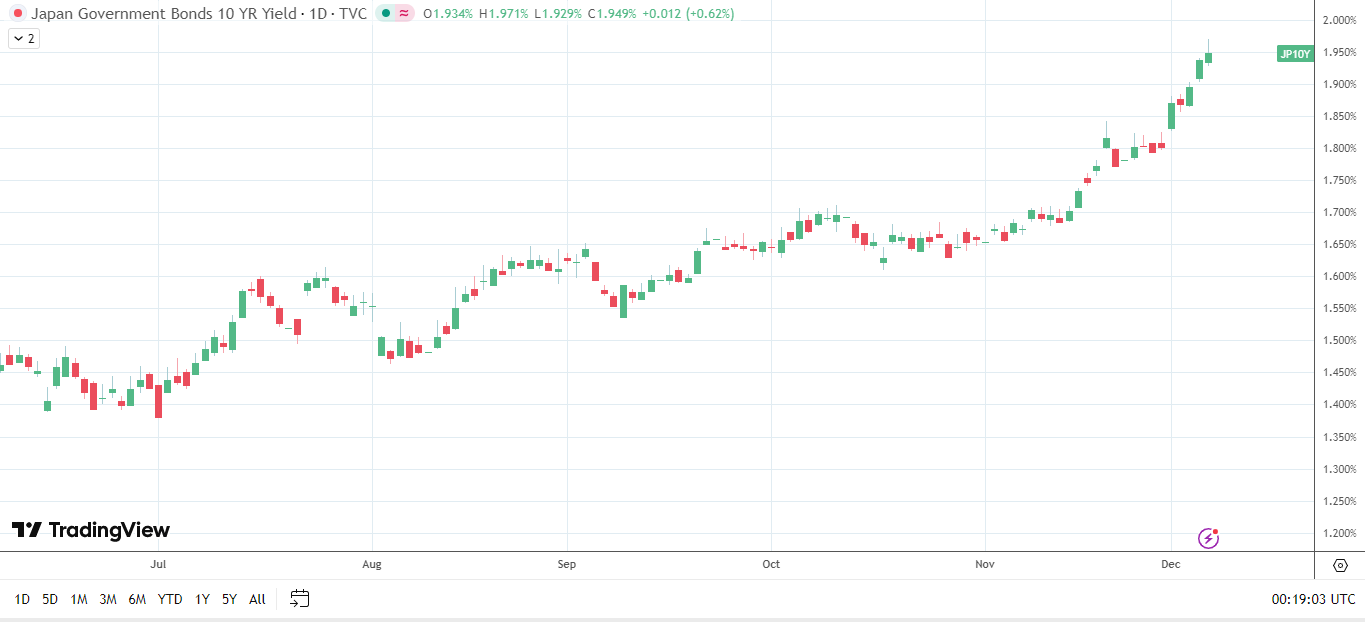
Narrowing rate differentials are likely to accelerate the pullback from the November 20 high of 157.893. Traders should closely monitor 10-year JGB and 10-year US Treasury yields, given the upcoming interest rate decisions.
For context, 10-year JGB yields soared to 1.971% on Friday, December 5, their highest since 2007.
However, upside risks could derail the bearish momentum. These risks include:
- Dovish BoJ chatter.
- Hotter US inflation.
While traders should consider the upside risks, yen intervention threats will likely cap upside around the November 20 high of 157.893, based on past communication.
Read the full USD/JPY forecast, including chart setups and trade ideas.
Conclusion: Longer-Term Fall to 140 in Play
In summary, BoJ rate hikes and multiple Fed rate cuts are likely to send USD/JPY lower on narrowing rate differentials. Barring upside risk developments, USD/JPY will likely drop toward 140 in the 3-6 month timeframe. A drop to 140 would bring the 2023 low of 127.215 into play over a longer 6-12 month timeframe.
For more in-depth analysis, review today’s USD/JPY trading setups in our latest reports and consult the economic calendar.