
USD/JPY took center stage in morning trading on Friday, December 19. The Bank of Japan raised interest rates by 25 basis points to 0.75%, the highest level since 1995. The yen weakened after the widely anticipated monetary policy decision. Market focus will now turn to the upcoming BoJ Governor Kazuo Ueda’s press conference.
A more hawkish BoJ policy stance and a more dovish Fed rate path would narrow US-Japan interest rate differentials, making yen-denominated investments more attractive and fueling yen demand. Given the potential for a further narrowing in rate differentials, the outlook for USD/JPY remains bearish.
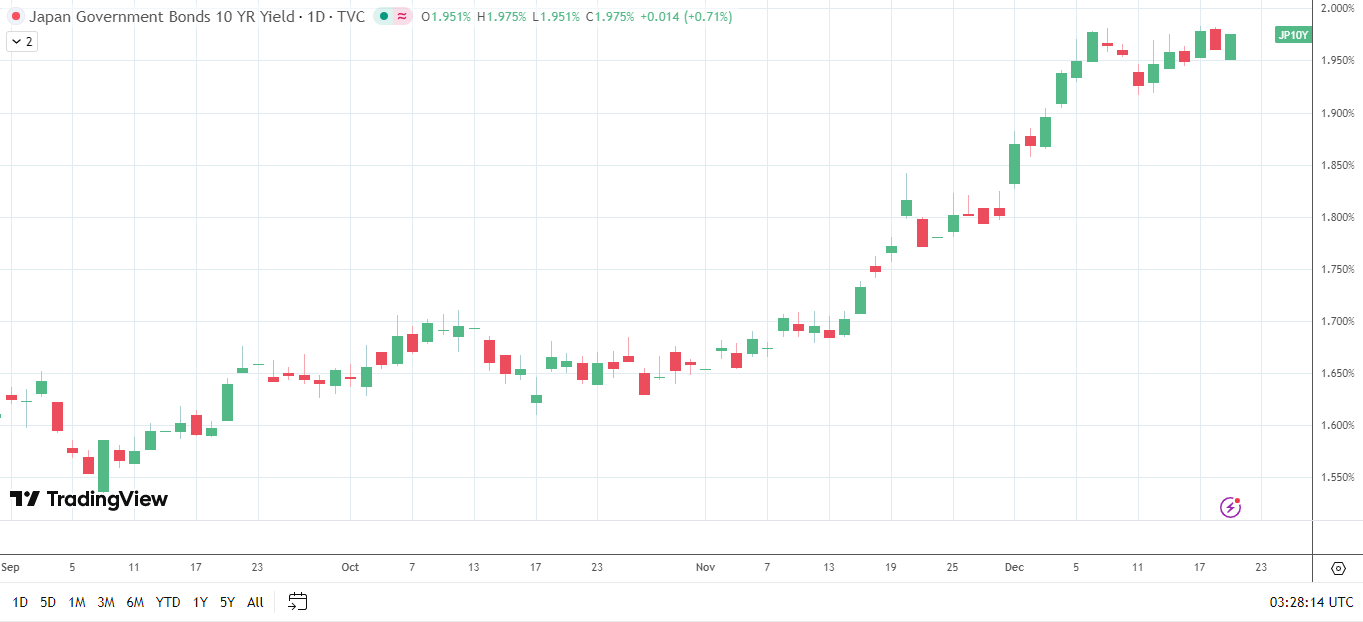
Ahead of the BoJ’s monetary policy decision, Japanese inflation figures had signaled a mild cooling in core inflation, but remained well above the 2% inflation target. Notably, 10-year Japanese Government Bond (JGB) yields were higher in morning trading, signaling a hawkish BoJ policy outlook.
Below, I’ll discuss the macro backdrop, the near-term price catalysts, and technical levels traders should closely watch.
Japanese Core Inflation Holds Ahead of BoJ Decision
Japanese inflation figures came under scrutiny in early trading on Friday, December 19, as the BoJ’s monetary policy decision loomed. The so-called core-core inflation rate unexpectedly cooled from 3.1% in October to 3.0% in November.
The softer core-core inflation rate eased expectations of a hawkish BoJ monetary policy outlook, weighing on the yen. USD/JPY rose from 155.570 to 155.795 following the release of the data, reflecting shifting sentiment toward the BoJ rate path. However, the reaction was mild, given that the BoJ’s monetary policy decision was imminent.
USD/JPY Price Forecast
Every new USD/JPY analysis as it publishes, today's technical signal and key levels, live price — on one page.
See all USD/JPY forecasts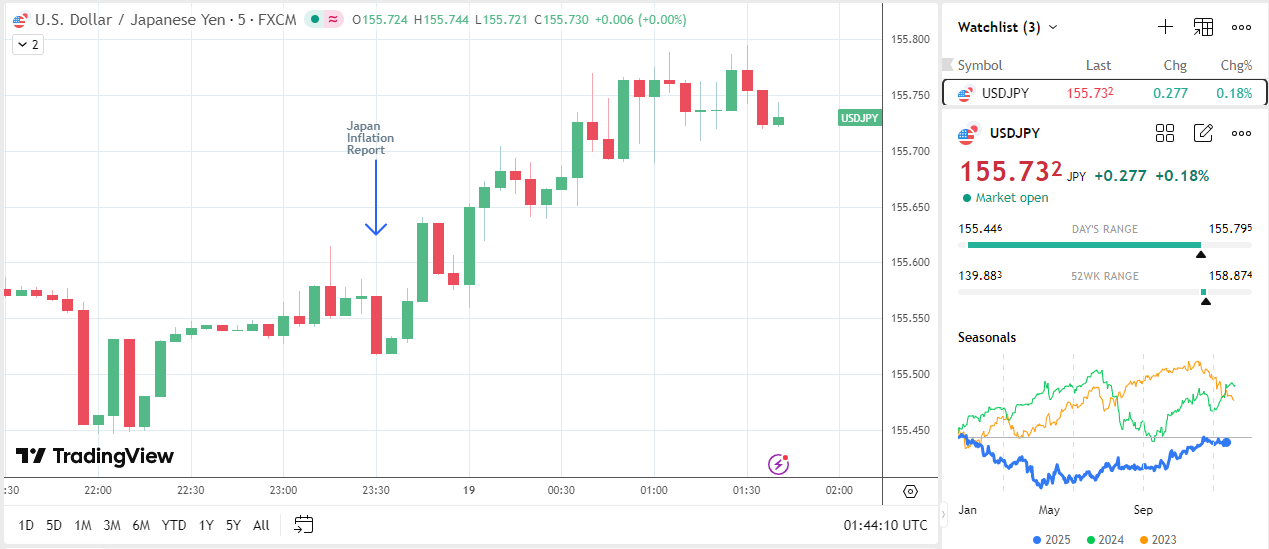
Bank of Japan Raises Interest Rates
While November’s inflation figures drew market attention, the BoJ’s monetary policy decision was the main event of the Asian session on Friday, December 19.
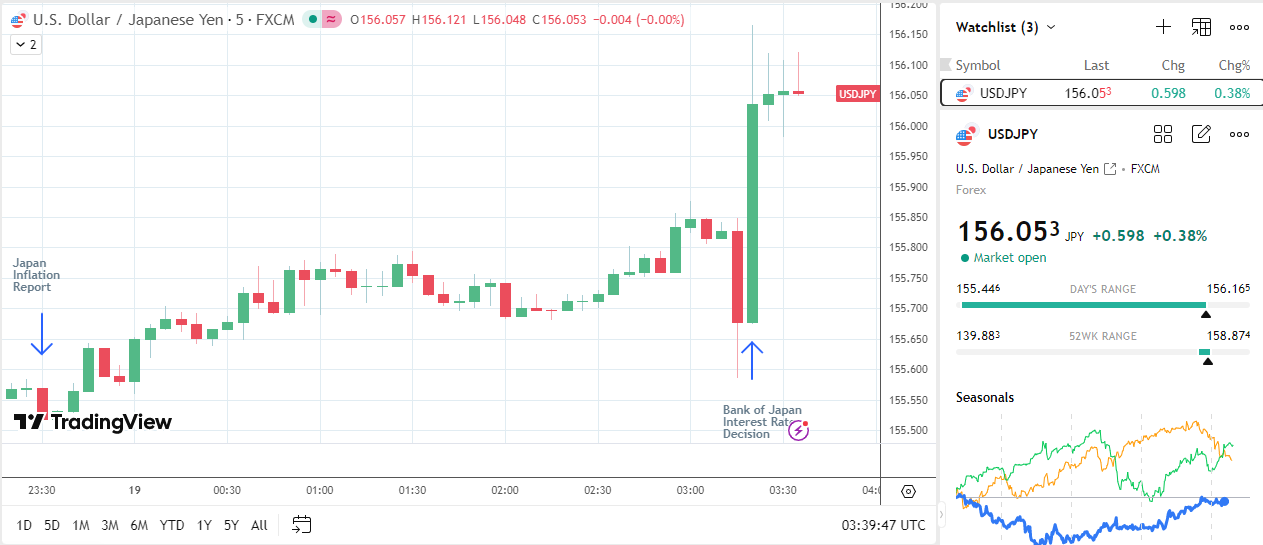
The BoJ raised interest rates by 25 basis points, aligned with market expectations. The 25-basis point rate hike shifted market focus to the BoJ Statement on Monetary Policy. Key comments from the Statement included:
- Policymakers unanimously voted for a 25 basis-point rate hike.
- Labor market conditions have continued to be tight.
- Corporate profits are expected to remain at high levels on the whole, even after taking into account the impact of tariff policies.
- It is highly likely that firms will continue to raise wages steadily next year, following the solid wage increase this year.
- While uncertainties remain regarding the US economy and the impact of trade policy in each jurisdiction, these uncertainties have declined.
- Underlying CPI inflation has continued to rise moderately, with moves to pass on wage increases to selling prices continuing.
- The likelihood of realizing the baseline scenario that underlying CPI inflation will be at a level that is generally consistent with the price stability target of 2 percent has been rising.
- If the outlook for economic activity and prices presented in the October Outlook Report will be realized, the Bank, in accordance with improvement in economic activity and prices, will continue to raise the policy interest rate and adjust the degree of monetary accommodation.
Notably, there were no references to the Bank’s neutral interest rate, sending USD/JPY higher after the Statement.
Bank of Japan Governor Ueda in the Spotlight
As markets react to the BoJ’s monetary policy decision and rate statement, the market focus will begin shifting to the upcoming BoJ Governor Kazuo Ueda’s press conference. Governor Ueda may provide more insights into the BoJ’s neutral interest rate and timeline for rate hikes in 2026.
A 1.5% to 2.0% neutral rate would indicate multiple rate hikes, sharply narrowing US-Japan rate differentials. A higher neutral rate would support the bearish short- to medium-term outlook for USD/JPY.
University of Michigan Survey of Consumers in Focus
Later on Friday, the finalized Consumer Sentiment figures will influence US dollar demand. According to the Preliminary Report, the Michigan Consumer Sentiment Index rose from 51.0 in November to 53.4 in December.
Typically, a higher Consumer Sentiment reading would signal a pickup in private consumption. A pickup in consumer spending fuels demand-driven inflation, supporting a more hawkish Fed policy stance.
However, consumers’ views on inflation also require consideration. A softer inflation outlook may indicate a delay in spending due to the expectation of lower prices in the future. A pullback in spending would dampen demand-driven inflation, suggesting a more dovish Fed rate path.
Given these dynamics, sentiment toward inflation is likely to be key for the Greenback and USD/JPY trends. The Michigan 1-Year Inflation Expectations fell from 4.5% in November to 4.1% in December. A downward revision, combined with November’s softer-than-expected US CPI Report, would raise bets on a March Fed rate cut, weighing on US dollar demand.
According to the CME FedWatch Tool, the chances of a March Fed rate cut increased from 53.9% on December 17 to 59.5% on December 18, boosted by US headline inflation falling from 3% in September to 2.7% in November. The October report was canceled because of the US government shutdown.
Beyond the data, traders should monitor FOMC members’ speeches for views on the labor market, inflation, and calls for a March rate cut. Dovish rhetoric would signal a sharper narrowing in US-Japan interest rate differentials, supporting the bearish short- to medium-term outlook for USD/JPY.
Technical Outlook: USD/JPY on a Downward Trajectory
With markets focused on technical indicators and fundamentals, they will offer key insights into potential USD/JPY price trends.
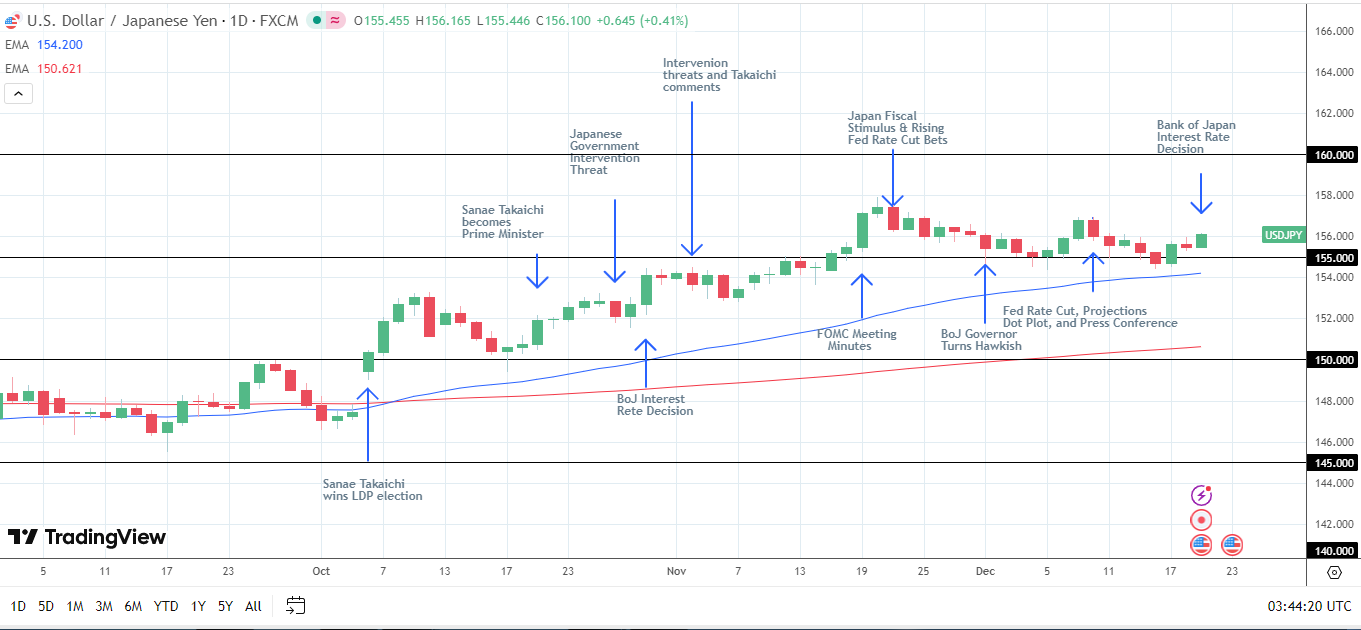
Looking at the daily chart, USD/JPY traded above the 50-day and 200-day Exponential Moving Averages (EMAs), indicating a bullish bias. While technicals remained bullish, fundamentals are increasingly outweighing the technical structure, indicating a bearish outlook.
A break below the 155 support level would expose the 50-day EMA. If breached, 150 would be the next key support level. Importantly, a sustained drop below the 50-day EMA would indicate a bearish near-term trend reversal, bringing the 200-day EMA and 150 into play. A break below the 200-day EMA would reinforce the bearish medium- to longer-term USD/JPY price outlook.
Position and Upside Risk
In my view, a more hawkish BoJ policy stance and increasing bets on a March Fed rate cut support a bearish short- to medium-term outlook. However, the BoJ’s neutral interest rate will be pivotal for the USD/JPY pair’s price outlook. A more aggressive monetary policy outlook for 2026 could trigger a yen carry trade unwind, sending USD/JPY toward 130 in the medium-term.
However, upside risks to the bearish outlook include:
- A dovish BoJ Governor Ueda and a 1% neutral rate.
- Upbeat US data.
- Hawkish Fed rhetoric.
These events would boost US dollar demand and send USD/JPY higher. However, yen intervention warnings are likely to cap the upside at around the November 20 high of 157.893, based on past communication.
Read the full USD/JPY forecast, including chart setups and trade ideas.
Conclusion: Longer-Term Fall to 130 Hinges on Hawkish BoJ Policy Outlook
In summary, with USD/JPY trends reflecting market bets on narrowing rate differentials, market focus will be on BoJ Governor Ueda’s outlook and views on the neutral rate.
A higher neutral rate would signal multiple rate hikes, supporting the bearish short- to medium-term outlook for USD/JPY. Furthermore, a more dovish Fed policy stance clashing with a hawkish BoJ will likely drag USD/JPY toward 130 in the 6-12 month time horizon.
For more in-depth analysis, review today’s USD/JPY trading setups in our latest reports and consult the economic calendar.