The Bank of Japan’s Summary of Opinions put USD/JPY under the spotlight on Monday, December 29, amid shifting sentiment toward the rate path. This month, the BoJ raised interest rates to 0.75% but signaled a cautious policy stance, sending USD/JPY into the yen intervention zone (157-160). Since raising interest rates, Tokyo inflation cooled sharply, supporting a more dovish BoJ rate path.
Despite softer inflation, USD/JPY has given up the lion’s share of its BoJ-driven gains. Yen intervention warnings and speculation about an incoming Fed Chair supporting lower rates have pushed the pair lower.
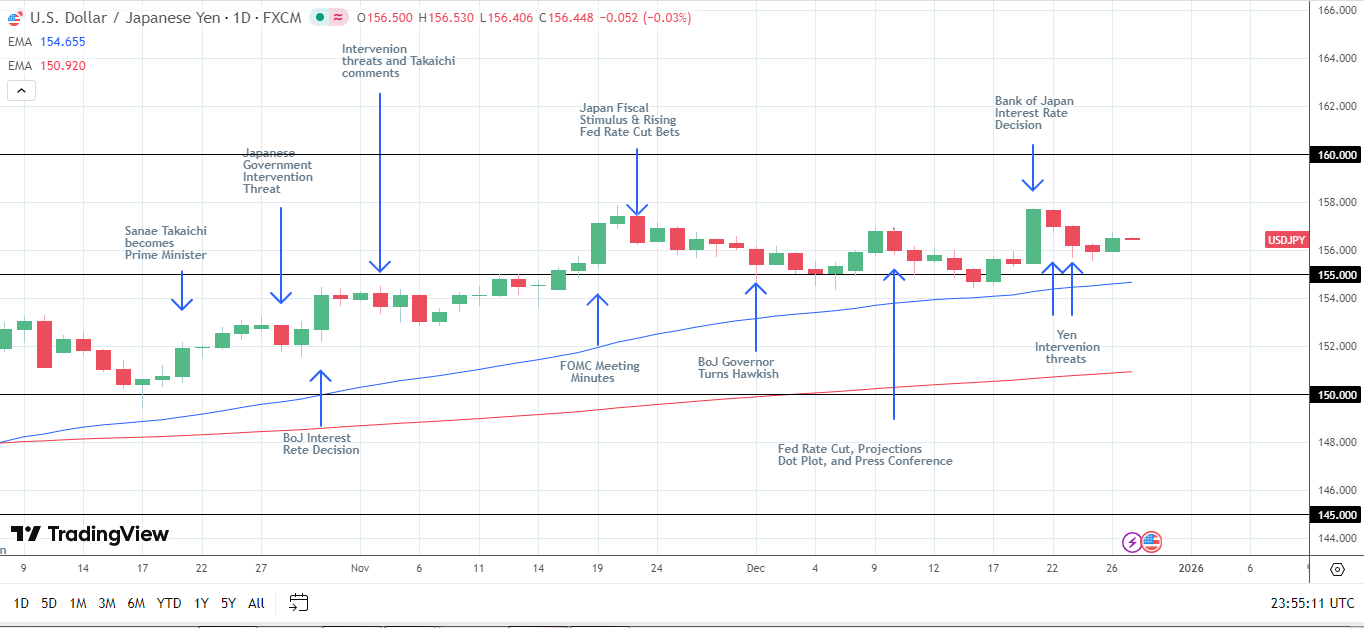
The BoJ’s Summary of Opinions pointed to a more hawkish stance, while the markets are betting on a March Fed rate cut, suggesting a bearish short- to medium-term outlook for USD/JPY.
Below, I’ll discuss the macro backdrop, the near-term price catalysts, and technical levels traders should closely watch.

Bank of Japan Summary of Opinions – A Hawkish Spin
The Bank of Japan’s December interest rate decision and Tokyo inflation numbers tempered expectations of aggressive rate hikes to achieve monetary policy normalization. Meanwhile, the BoJ’s Summary of Opinions shed more light on policymakers’ views on the economy, wage growth, inflation, and rate hikes. Policymakers’ opinions included:
- Easing concerns about US tariffs affecting the Japanese economy, corporate profits remain high, wage growth to continue, and inflation is expected to cool before increasing. (Hawkish)
- Increased likelihood of the economy and prices moving in line with the BoJ’s outlook. (Hawkish).
- Corporate profits are robust enough to support wage hikes, with inflationary pressure likely to persist. (Hawkish).
- Japan’s real policy interest rate is the lowest globally, making it appropriate to adjust policy support. (Hawkish).
- A 25-basis-point rate hike will still provide monetary accommodation strongly supporting the economy. (Hawkish).
- It will be appropriate to steadily raise the policy interest rate to avoid falling behind the curve. (Hawkish).
- There is still a sizeable distance to the neutral interest rate level, and the bank should raise rates with intervals of a few months for the time being. (Hawkish).
- It is appropriate to continue adjusting the degree of monetary policy accommodation. The bank should assess the effect on economic activity and prices while identifying the neutral interest rate level (Hawkish).
USD/JPY Price Forecast
Every new USD/JPY analysis as it publishes, today's technical signal and key levels, live price — on one page.
See all USD/JPY forecastsThe Cautious Spin Spotlights Incoming Economic Data
While there was a hawkish spin to the opinions, several policymakers called for caution, discussing the need to assess the impact of higher nominal rates on the economy and prices. These opinions included:
- Financial conditions are becoming over-accommodative for economic conditions, requiring higher interest rates. Policy outlook hinged on macroeconomic developments (Neutral).
- It will be necessary to assess the impact of higher nominal interest rates on the economy and financial markets. (Cautious).
- Further interest rate decisions should be made without having a pace in mind, assessing prices and economic activity. (Cautious).
- The Bank should examine the state of economic activity and prices for further policy interest rate adjustments. (Cautious).
- The Bank should not be targeting a particular level of the neutral rate but should remain flexible in future policy decisions. (Cautious).
- Increasing the policy interest rate in a timely manner could curb future inflationary pressure and hold down long-term interest rates. (Hawkish).
- Developments in long-term interest rates require close attention. (Cautious).
More Hawkish Opinions Boost Yen Demand
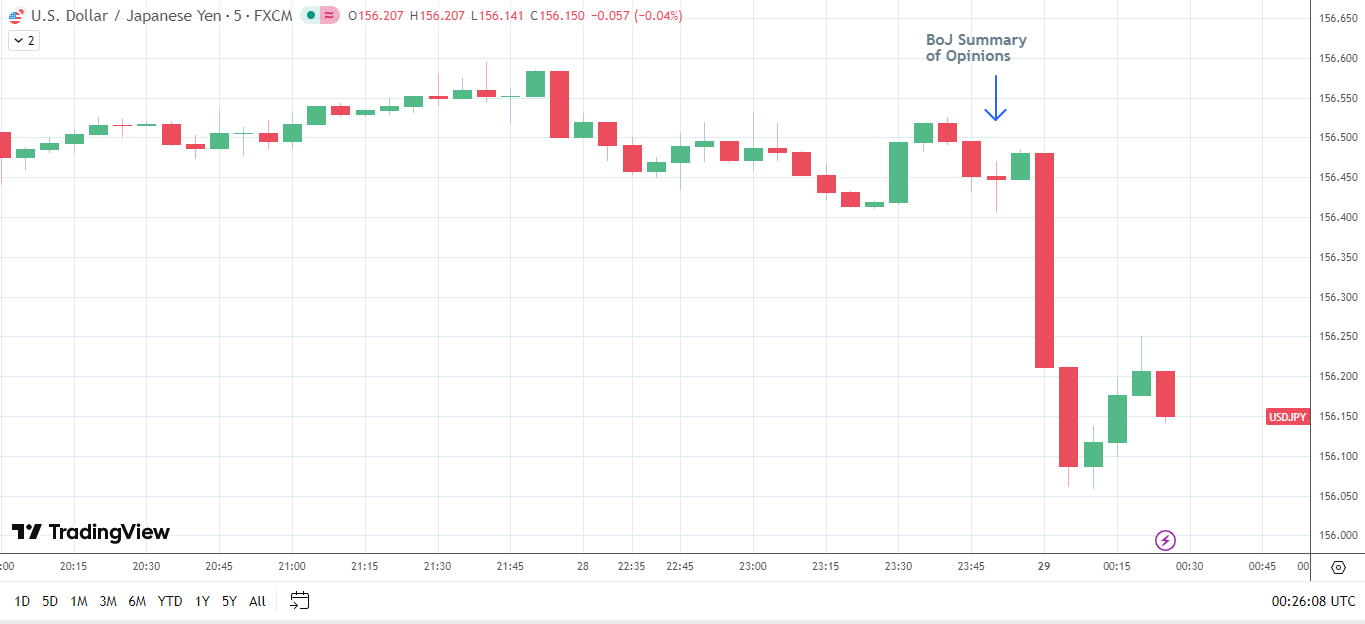
Despite calls for caution, recent economic data suggest the economy and prices are moving in line with the BoJ’s outlook. The hawkish sentiment had a greater influence, bolstering demand for the yen, pushing USD/JPY lower in early trading.
USD/JPY briefly climbed to a post-report high of 156.486 before falling to a low of 156.058. USD/JPY price action reflected a shift in sentiment, given the likelihood of further BoJ rate hikes narrowing US-Japan rate differentials.
US Economic Data and the Fed in Focus
Later on Monday, US economic indicators are likely to influence US dollar demand and USD/JPY. Pending home sales and the Dallas Fed Manufacturing Index will be in focus. Given the strong third-quarter GDP numbers, the Dallas Fed Manufacturing Index will likely influence sentiment more than housing sector numbers.
Economists expect the Dallas Fed Manufacturing Index to increase from -10.4 in November to -2.5 in December.
A weaker-than-expected Dallas Fed Manufacturing index would signal a loss of economic momentum, weighing on the US dollar.
While the data will influence US dollar demand, Fed commentary will be key. Support for further rate cuts on inflation outlook and a weaker labor market would weigh on the US dollar, pushing USD/JPY lower.
According to the CME FedWatch Tool, the probability of a March Fed rate cut increased from 53.3% on December 26 to 54.8% on December 27.
Looking ahead, the prospects for further BoJ rate hikes, a new Fed Chair, and a deteriorating US labor market are likely to remain the key themes. These scenarios continue to support a bearish short- to medium-term outlook for USD/JPY.
Technical Outlook: USD/JPY on a Downward Trajectory
For USD/JPY price trends, technical indicators, and fundamentals will require close monitoring.
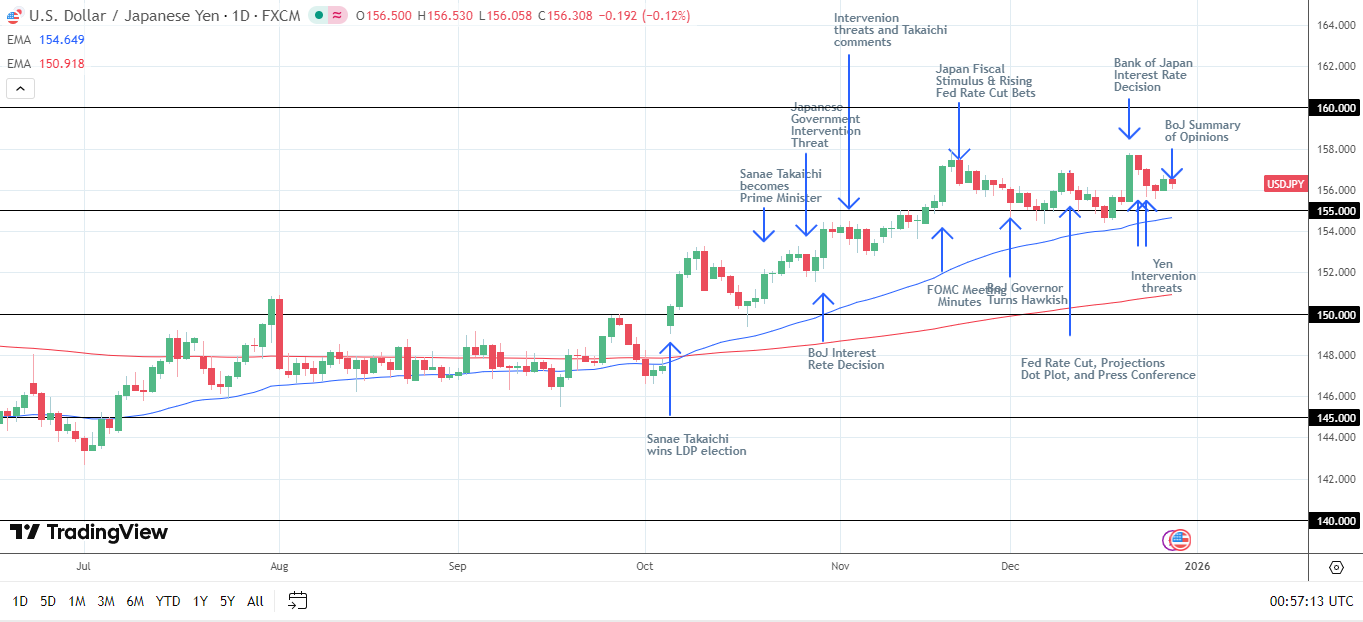
Looking at the daily chart, USD/JPY remained above its 50-day and 200-day Exponential Moving Averages (EMAs), indicating a bullish bias. While technicals remained bullish, fundamentals are outweighing the technical structure, indicating a bearish outlook.
A drop below the 155 support level would bring the 50-day EMA into play. If breached, the 200-day EMA would be the next key technical support level. Crucially, a sustained break below the EMAs would signal a bearish trend reversal, paving the way toward 150.
Position and Upside Risk
In my view, expectations of further BoJ rate hikes, yen intervention threats, and bets on a Fed rate cut indicate a negative price outlook. However, BoJ communication on its neutral interest rate and the upcoming FOMC Meeting Minutes will be key.
A higher neutral interest rate level would point to multiple BoJ rate hikes and a narrower US-Japan rate differential. A narrower rate differential would curb yen carry trades into US assets, sending USD/JPY toward 140 over the longer term.
However, upside risks to the bearish outlook include:
- Dovish BoJ rhetoric and a 1% neutral interest rate.
- Robust US economic data.
- Hawkish Fed chatter.
These events would send USD/JPY higher. However, yen intervention threats are likely to cap any upside at around the 158 level, based on the latest communication.
Read the full USD/JPY forecast, including chart setups and trade ideas.
Conclusion: Focus on the BoJ Neutral Rate
In summary, USD/JPY trends reflect expectations of BoJ rate hikes and Fed rate cuts, narrowing rate differentials. Market focus will remain on the BoJ’s neutral rate, discussed in December’s MPM, and the Fed’s monetary policy stance.
A higher 1.5% to 2.5% neutral rate would suggest a more aggressive BoJ rate path, reinforcing the bearish short- to medium-term bias for USD/JPY. Additionally, dovish Fed chatter would likely send USD/JPY toward 140 over the longer 6-12 month time horizon.
For more in-depth analysis, review today’s USD/JPY trading setups in our latest reports and consult the economic calendar.