
USD/JPY hovers at 158 as markets brace for a snap Japan election. 10-year Japanese Government Bond (JGB) yields have soared amid concerns over Prime Minister Sanae Takaichi’s fiscal spending plans and national debt-to-GDP levels.
The Japanese yen has weakened significantly since Prime Minister Takaichi won the Liberal Democratic Party leadership race to become Prime Minister. USD/JPY has gained 7.3% since October 3, reflecting sentiment toward Prime Minister Takaichi’s stance on fiscal and monetary policy.
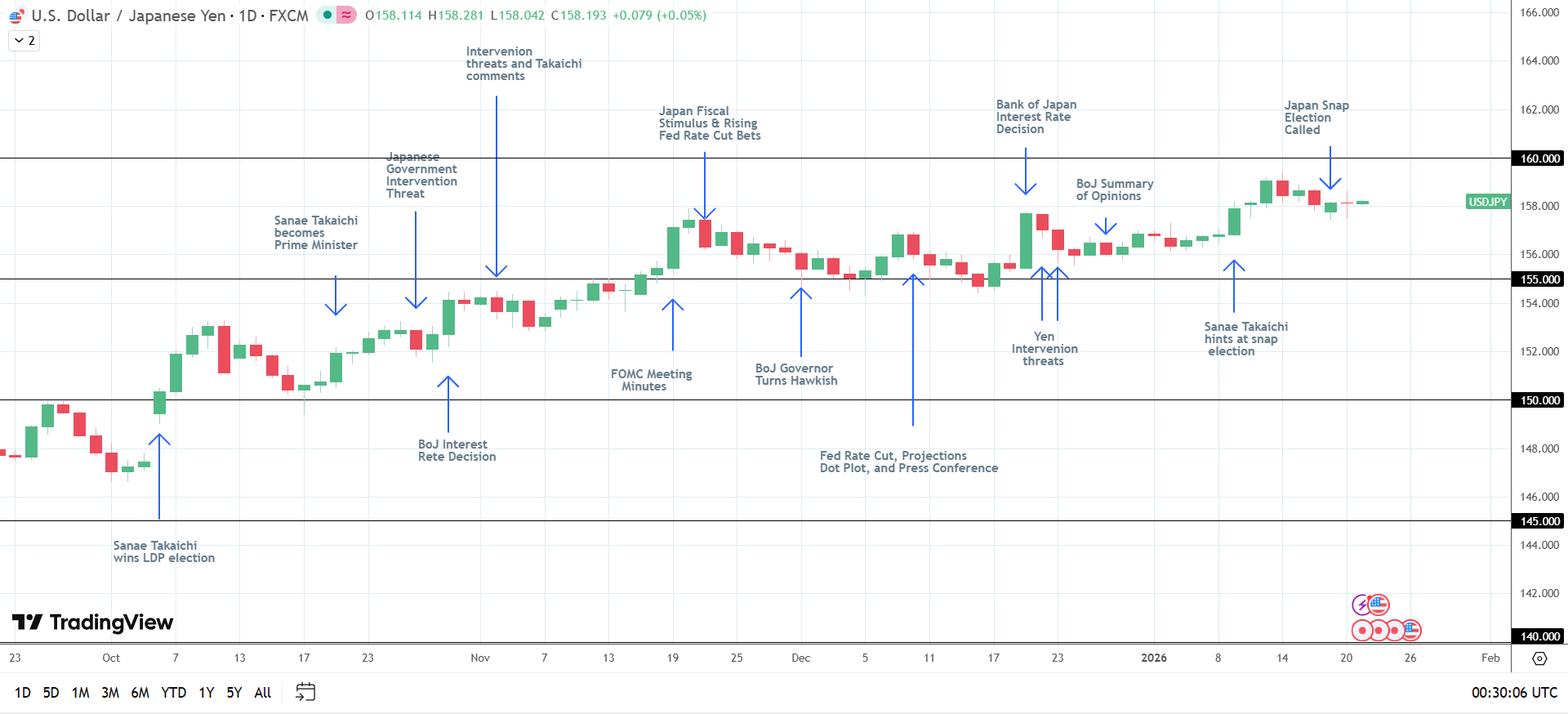
Meanwhile, President Trump’s threat of 10% tariffs on eight European countries weighed on demand for the US dollar, limiting USD/JPY gains.
Despite concerns about Prime Minister Takaichi’s fiscal policy, rising bets on a BoJ rate hike in the second quarter to cool import prices support a cautiously bullish short-term outlook, but a bearish medium-term outlook.
Below, I’ll discuss the macro backdrop, the near-term price catalysts, and technical levels traders should closely watch.

Snap Election and the BoJ Monetary Policy Decision Collide
Prime Minister Takaichi’s call for a snap election sent 10-year JGB yields to 2.382%, the highest level in decades. 10-year JGB yields have climbed in tandem with USD/JPY. The risk premium for holding JGB yields has surged over debt-to-GDP worries.
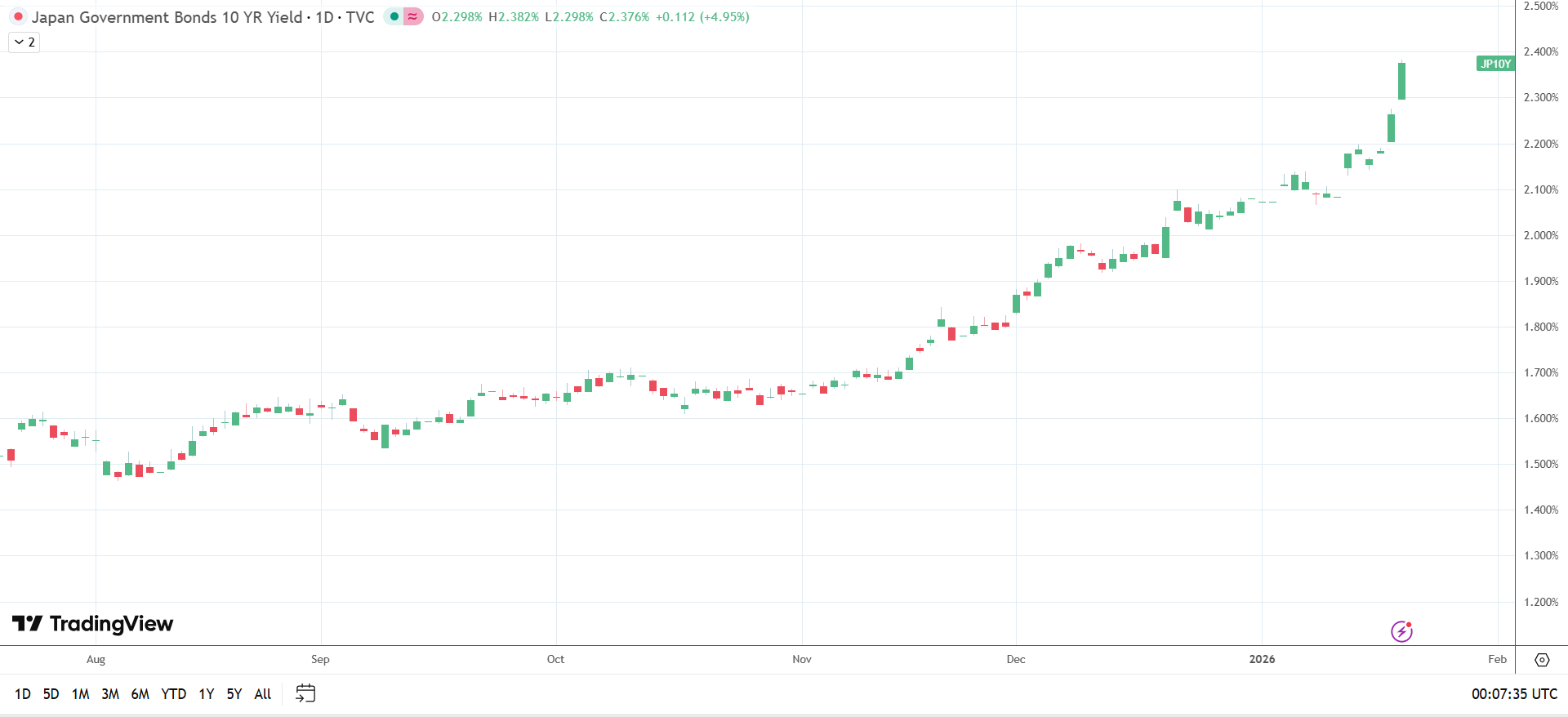
While Prime Minister Takaichi enjoys strong approval ratings, the Liberal Democratic Party remains unpopular with voters. This has created an element of uncertainty about the election outcome. The uncertainty adds another layer of weakness to the yen.
Robin Brooks, Senior Fellow at the Brookings Institution, commented on the risks to the snap election, stating:
“Calling an early election is risky. Just ask Theresa May or Emmanuel Macron. Running on tax cuts in an economy where public debt stands at 240% of GDP is even riskier. Japan’s 30-year JGB yield is already at unprecedented levels and the Yen at record lows.”
The political uncertainty and Prime Minister Takaichi’s policies suggest a cautiously bullish short-term outlook for USD/JPY.
USD/JPY Price Forecast
Every new USD/JPY analysis as it publishes, today's technical signal and key levels, live price — on one page.
See all USD/JPY forecastsBank of Japan Monetary Policy Decision Looms
Meanwhile, the Bank of Japan’s monetary policy stance supports a bearish medium-term outlook. Economists expect the BoJ to stand pat on monetary policy on Friday, January 23. But, economists expect the BoJ to signal an interest rate hike in the summer, which would strengthen the yen. The weaker yen is pushing import prices higher, eroding households’ purchasing power, a key focal point for the BoJ.
According to January’s Reuters poll, conducted between January 6-13, 43% of economists predicted a July BoJ rate hike, 27% a June hike, and just 8% an April hike. Hints at an April hike would boost demand for the yen in the short-term.
Natixis Asia Pacific Chief Economist Alicia Garcia Herrero recently commented on the BoJ’s policy outlook, stating:
“With PM Takaichi’s strong preference for a lax monetary policy to realize her vision, the BoJ is likely to remain cautious in normalizing further. In fact, uncertainties are compounded by the political tension with China, raising the bar to hike. Nevertheless, the ongoing tug of war over policy normalization with the government is anticipated to keep the Yen stubbornly weak. These developments are expected to force the BoJ to hike by 25 bps, possibly in July, to stabilize the currency.”
Expectations of BoJ rate hikes and Fed rate cuts reaffirm the bearish medium- to longer-term price projections.
President Trump and Geopolitics in Focus
While the yen faces selling pressure amid domestic political and policy uncertainty, President Trump’s push to acquire Greenland leaves the US dollar in a precarious position.
On Saturday, January 17, President Trump announced a 10% tariff on Denmark, Finland, France, Germany, Norway, Sweden, the Netherlands, and the UK, all NATO members. However, the EU has threatened to retaliate, potentially triggering a full-blown trade war between the EU and the US. US tariffs will take effect on February 1 if no deal on Greenland is reached.
Crucially, President Trump will give a speech at the World Economic Forum on Wednesday, January 21, 14:30 – 15:15 Central European Time (CET). An aggressive stance toward the EU and threats of proceeding with tariffs would weigh on buying demand for the US dollar.
President Trump’s speech and stance on tariffs will be key for the US dollar mid-week.
Despite rising geopolitical tensions and concerns about Japan’s fiscal spending, expectations of multiple BoJ rate hikes and a new Fed Chair favoring lower interest rates suggest narrower US-Japan rate differentials. These factors reaffirm the bearish medium-term outlook for USD/JPY.
Technical Outlook: Key Levels to Watch
For USD/JPY price trends, traders should monitor technicals and track central bank and political headlines.
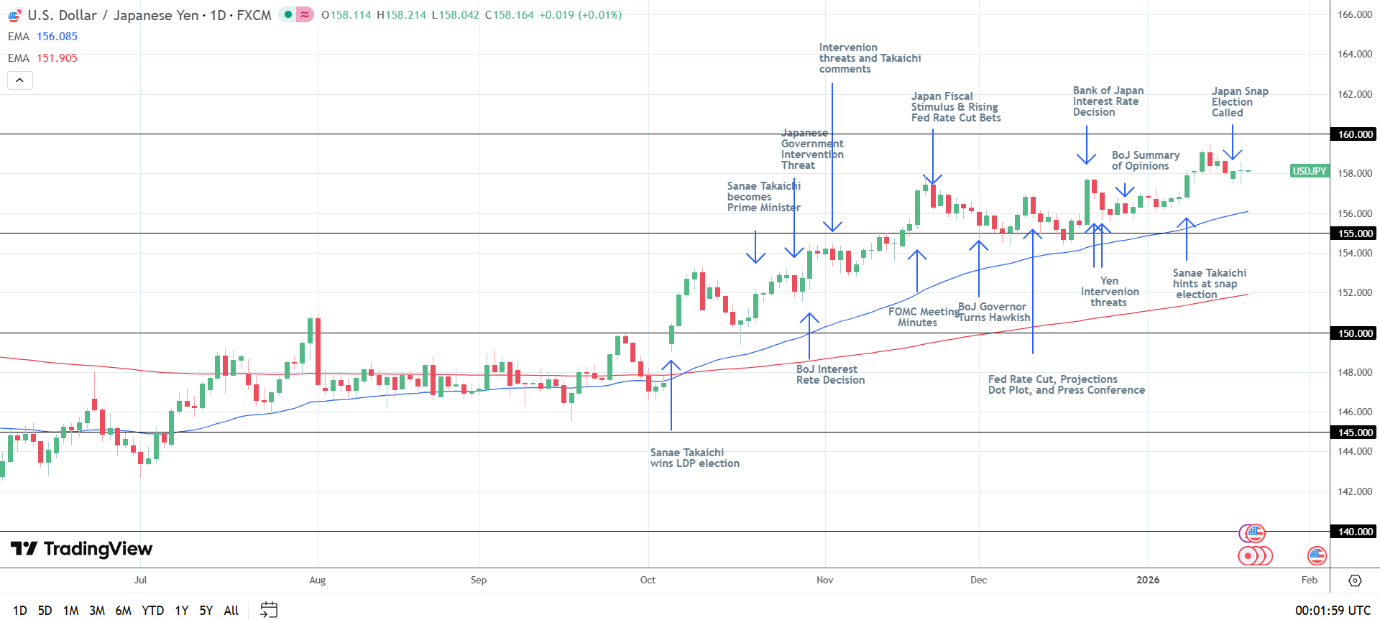
Viewing the daily chart, USD/JPY trades above its 50-day and 200-day Exponential Moving Averages (EMAs), indicating a bullish bias. While technicals remain bullish, bearish fundamentals remain, countering the technicals.
A drop below 157 would bring the 50-day EMA and the 155 support level into play. A sustained fall through the 50-day EMA would signal a bearish near-term trend reversal, exposing the 200-day EMA. If breached, 150 would be the next key support level.
Importantly, a sustained fall through the EMAs would reinforce the bearish medium-term price outlook.
Position and Upside Risk
In my view, expectations for BoJ rate hikes, ever-present yen intervention threats, and bets on Fed rate cuts support a negative price outlook. However, geopolitical events, Japan’s election, the BoJ’s monetary policy decision, and upcoming US data will be crucial, given recent movements in USD/JPY.
A hawkish BoJ neutral interest rate level (potentially 1.5%-2.5%) would suggest multiple BoJ rate hikes and a narrower US-Japan interest rate differential. A narrower rate differential could trigger a yen carry unwind, as seen in mid-2024. A yen carry trade unwind would likely push USD/JPY toward 140 over the longer term.
However, upside risks to the bearish outlook include:
- Dovish BoJ chatter and a dovish neutral interest rate (potentially 1%-1.25%).
- Strong US economic data tempers Fed rate cut bets in H1 2026.
- US Supreme Court rules tariffs legal, suggesting more levies.
- US President Trump U-turns on tariffs.
These events would drive USD/JPY higher. However, the threat of yen interventions is likely to continue capping the upside at the 160 level.
Read the full USD/JPY forecast, including chart setups and trade ideas.
Conclusion: Politics, the BoJ, and US Data in the Spotlight
In summary, the USD/JPY trends will hinge on President Trump’s speech, Prime Minister Takaichi’s election and fiscal spending goals, the BoJ’s monetary policy decision, and the Fed policy stance.
A hawkish neutral rate (1.5%-2.5%) would signal a hawkish BoJ rate path, delivering yen strength. Meanwhile, Japan’s election will be crucial for the near-term USD/JPY trends. Furthermore, a dovish Fed would raise expectations of narrower rate differentials, reaffirming the bearish medium-term outlook for USD/JPY.
Notably, a sharply stronger yen could trigger the unwinding of yen carry trades, which would likely send USD/JPY toward 140 over the longer 6-12 month timeline.
For more in-depth analysis, review today’s USD/JPY trading setups in our latest reports and consult the economic calendar.