
USD/JPY faces downside risk as Japanese exports strengthen BoJ rate-hike expectations.
Japanese exports jumped in November, reinforcing bets on a Bank of Japan rate hike. BoJ Governor Kazuo Ueda hinted at an imminent rate hike last week, citing diminishing US tariff risks and strong wage growth.
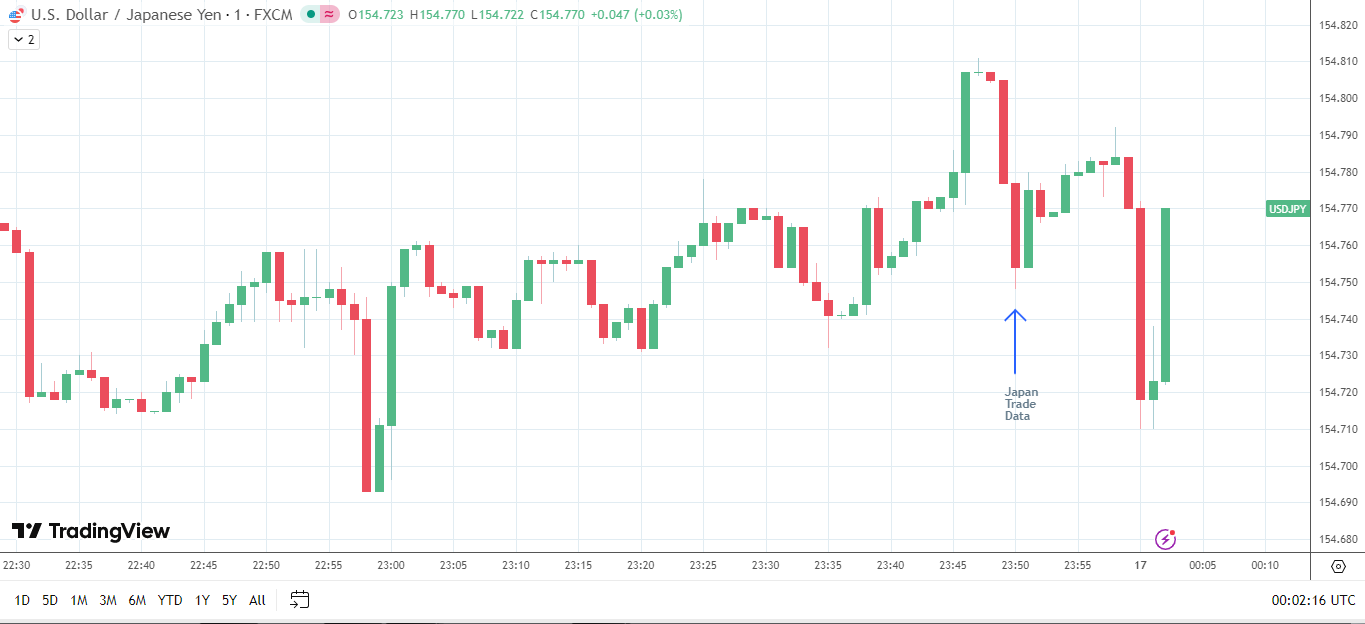
Economists expect the BoJ to raise interest rates by 25 basis points on Friday, December 19. USD/JPY briefly dropped from 154.777 to 154.710 after the data release before recovering, reflecting market caution ahead of Friday’s decision.
The pickup in external demand and the looming BoJ rate hike support a bearish USD/JPY price outlook.
Below, I’ll discuss the macro backdrop, the near-term price catalysts, and technical levels traders should closely watch.

Japanese Exports Signal Robust External Demand
Japanese exports increased 6.1% year-on-year (YoY) in November, up from 3.6% in October, while imports rose 1.3% (Oct: 0.7%). A rebound in demand from the US boosted exports midway through Q4. According to the Ministry of Finance, exports to the US increased 8.8% YoY in November after falling 3.1% YoY in October,
The upswing in external demand and stronger imports will boost Japan’s economy, given its 45% trade-to-GDP ratio. For context, the Japanese economy contracted by 0.6% quarter-on-quarter in Q3, with external demand declining 0.2% quarter-on-quarter, a drag on the economy.
Lower US tariffs on Japanese goods contributed to the pickup in US demand. The US administration dropped tariffs from 25% to 15% in the third quarter.
Stronger external demand and a pickup in economic momentum will likely strengthen the yen. Rising yen demand supports a bearish USD/JPY trajectory in the lead-up to the BoJ’s monetary policy decision, with 153 in view.
While market bets on a December BoJ rate hike have strengthened the yen, US retail sales data will give insights into the US economy, triggering USD/JPY volatility.
USD/JPY Price Forecast
Every new USD/JPY analysis as it publishes, today's technical signal and key levels, live price — on one page.
See all USD/JPY forecastsUS Retail Sales to Spotlight the Greenback
Later on Wednesday, US retail sales will fuel speculation about a March Fed rate cut, influencing the US dollar’s trajectory. Economists forecast retail sales to rise 0.3% month-on-month in November after stalling in October.
Stronger retail sales would boost the US economy, given that private consumption accounts for roughly 65% of the GDP. Additionally, consumer spending typically fuels demand-driven inflation, suggesting a more hawkish Fed rate path. Fading bets on a March Fed rate cut will likely lift US dollar demand, cushioning the near-term downside for USD/JPY.
Beyond the data, traders should monitor FOMC members’ speeches for reactions to November’s jobs report and the timeline for a rate cut. Fed Board of Governors Christopher Waller, New York Fed President John Williams, and Atlanta Fed President Raphael Bostic are due to speak mid-week. Support for further monetary policy easing would overshadow upbeat retail sales data, sending USD/JPY lower on weaker US dollar demand.
For context, US unemployment rose from 4.4% in October to 4.6% in November, while wage growth slowed from 3.7% YoY to 3.5% YoY in November. Rising unemployment and softer wage growth may curb consumer spending and dampen demand-driven inflation.
A cooler inflation outlook would support a more dovish Fed rate path and weaken US dollar demand.
According to the CME FedWatch Tool, the probability of a March Fed rate cut increased from 51% on December 15 to 53.3% on December 16 as markets reacted to the US jobs data. A BoJ rate hike and a March Fed rate cut would narrow the US-Japan rate differential, favoring the yen.
The BoJ and the Fed’s policy outlooks support a bearish short- to medium-term outlook for USD/JPY.
Technical Outlook: USD/JPY on a Downward Trajectory
With markets focused on monetary policy, technical indicators, and fundamentals, they will offer critical insights into potential USD/JPY price trends.
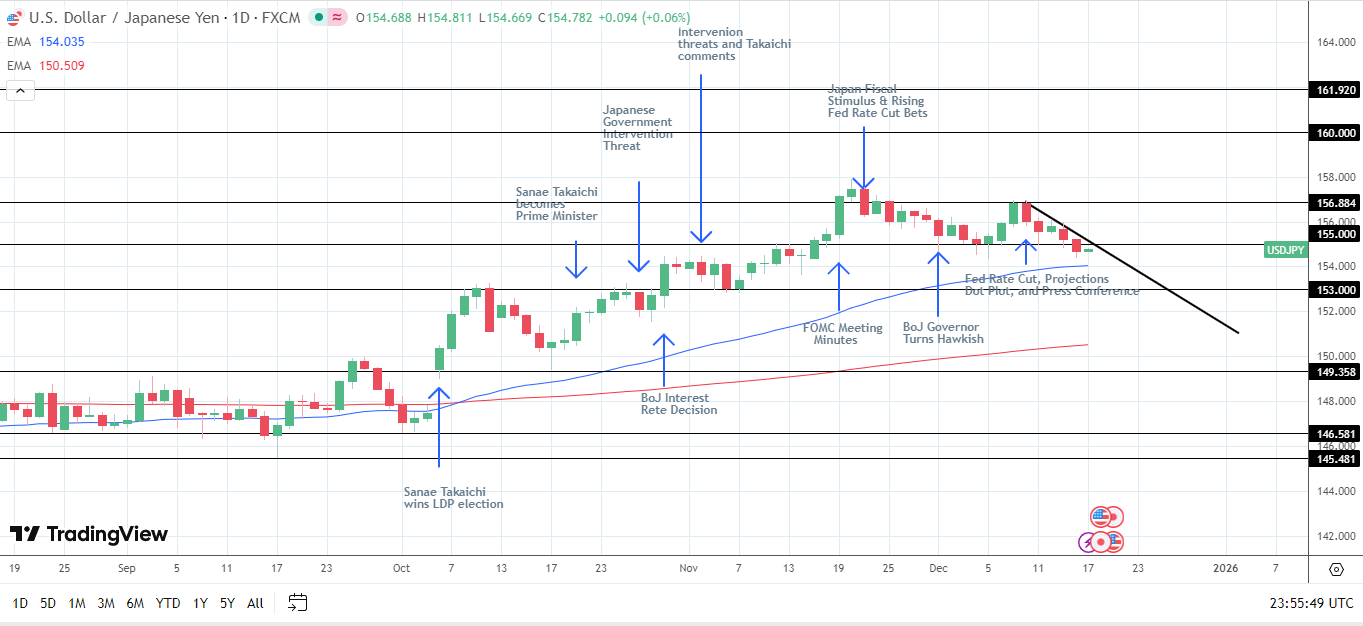
Looking at the daily chart, USD/JPY remained above the 50-day and 200-day Exponential Moving Averages (EMAs), signaling a bullish bias. While technicals remained bullish, fundamentals are increasingly outweighing the technical structure, suggesting a bearish outlook.
A break below the Tuesday, December 16, low of 154.394 would bring the 50-day EMA into play. If breached, 153 would be the next key support level. Importantly, a sustained drop below the 50-day EMA would signal a bearish near-term trend reversal, exposing the 200-day EMA and 150.
Position and Upside Risk
In my view, expectations of a hawkish BoJ rate hike and rising bets on a March Fed rate cut support a bearish short- to medium-term outlook. However, the BoJ’s neutral interest rate will be the key driver of USD/JPY. A higher neutral rate, between 1.5% and 2.0% would signal multiple BoJ rate hikes and a substantially narrower US-Japan rate differential.
A significantly narrower rate differential could trigger a yen carry trade unwind, sending USD/JPY toward 130.
However, upside risks to the bearish outlook include:
- A dovish BoJ rate hike and a 1% neutral rate.
- Strong US data.
- Hawkish Fed commentary.
These scenarios would send USD/JPY higher. Nevertheless, yen intervention warnings are likely to cap any rebound at around the November 20 high of 157.893, based on past communication.
Read the full USD/JPY forecast, including chart setups and trade ideas.
Conclusion: Longer-Term Fall to 130 Hinges on the BoJ’s Neutral Rate
In summary, with USD/JPY trends reflect bets on a BoJ rate hike. Market focus will be on the BoJ’s policy outlook and neutral rate setting. A higher neutral rate and support for multiple rate hikes would reinforce the bearish short- to medium-term outlook for USD/JPY.
Softer US inflation and a cooling labor market, coupled with a hawkish BoJ rate path, will likely send USD/JPY toward 130 in the 6-12 month time horizon.
For more in-depth analysis, review today’s USD/JPY trading setups in our latest reports and consult the economic calendar.