2025 Performance and Reversal Signals
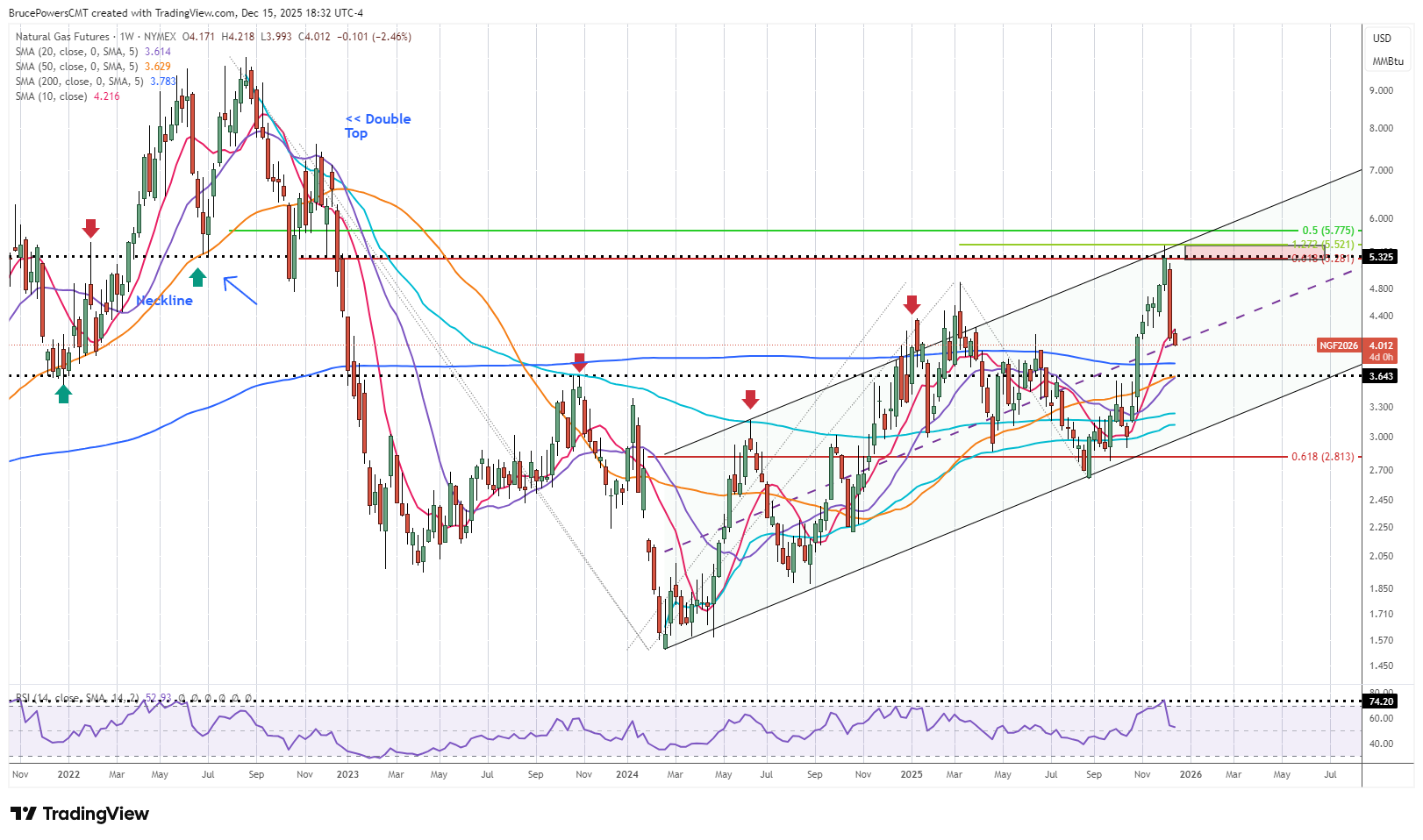
Year-to-date through mid-December 2025, natural gas delivered a solid advance, culminating in a December high that tested a critical resistance cluster. At that high natural gas was up by 51% for the year but as of December 15, performance had weakened to a 34% year-to-date gain. That high encountered the $5.50 resistance zone—previously significant support and resistance—along with a 61.8% Fibonacci retracement near $5.28 and a 127.2% Fibonacci extension at $5.52. More importantly, this area aligned closely with the neckline support (now resistance) of a large double top that terminated the prior uptrend in 2022. When former support flips to resistance, it often marks a meaningful barrier.
Adding to the evidence, the weekly Relative Strength Index (RSI) reached its most overbought extreme since April 2022, signaling price exhaustion. A parallel upper channel line connecting the June swing high also converged in the same region. The violent bearish reaction that followed the peak reinforces the view that sellers have taken firm control, at least temporarily. Such reversals from channel tops frequently lead to tests of the opposite boundary, setting the stage for a deeper correction into early-2026.

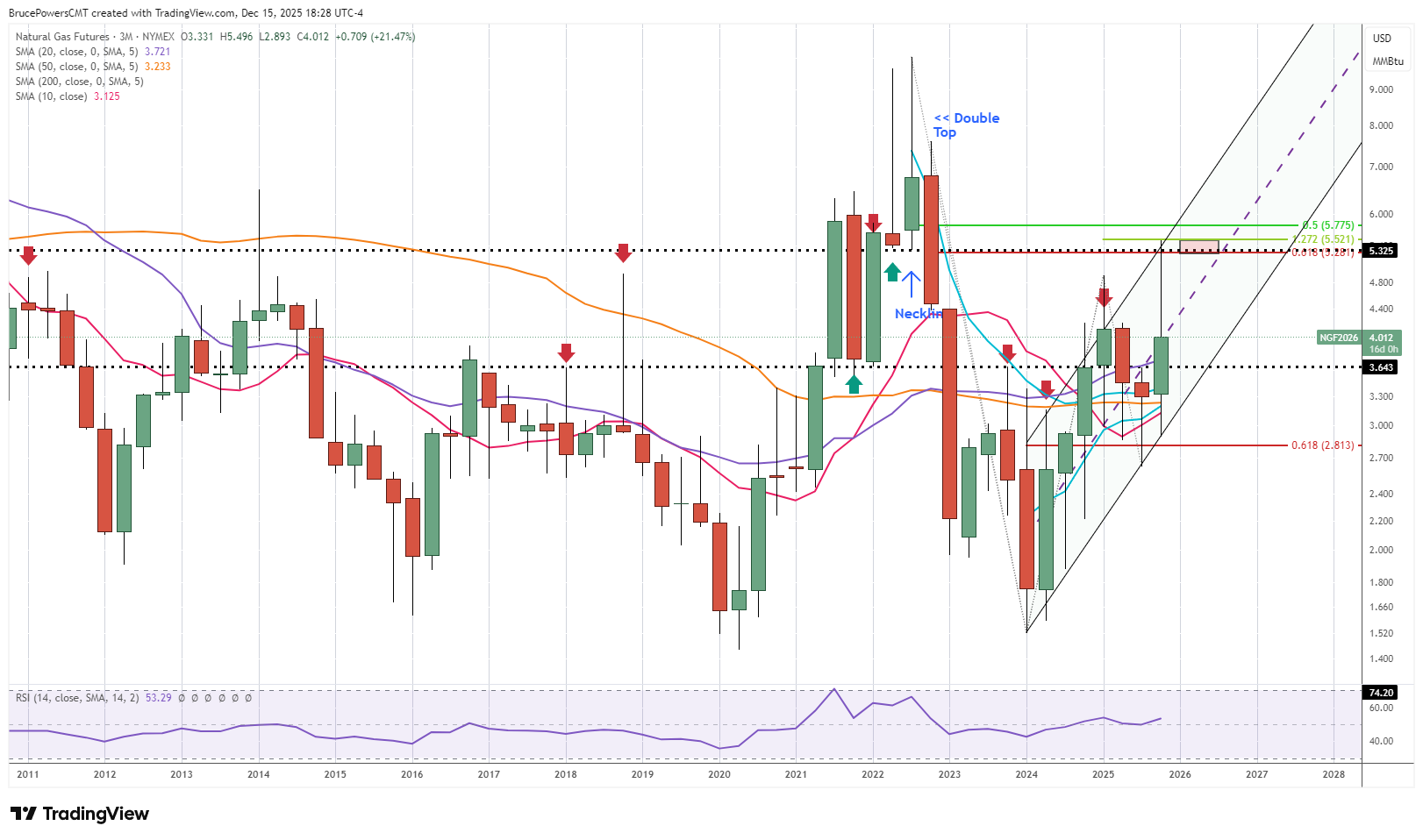
Big Picture – Quarterly Perspective
Stepping back to the quarterly chart keeps the longer-term context in focus. Natural gas has been in a clear ascending trend since the 2024 low around $1.52. A bullish hammer candle in the third quarter of 2025 broke out decisively in the fourth quarter above $3.63, with confirmation likely on a year-end close above that level. Key quarterly levels that carry weight across timeframes include potential support near the 2025 Q3 high at $3.63, the Q4 open at $3.33, and the higher low around $2.89.
A year-end close above the Q2 high of $4.20 would further solidify underlying strength and mark the highest quarterly close of the current uptrend. Even if late selling prevents that outcome, the quarterly structure continues to point higher, suggesting any 2026 weakness represents a correction within a larger bull move rather than a trend reversal.
Monthly View and Dynamic Support
On the monthly timeframe, natural gas had maintained a sequence of higher highs and higher lows for three consecutive months before December violated that structure and triggered a monthly reversal. A close for December below November’s low of $4.09 would confirm a bearish monthly reversal—the fourth-month breakdown after a clean uptrend, as well as a bearish outside month.
Price reclaimed the 200-month moving average in October and held above it through November. As the correction unfolds, this average—currently near $3.44—lines up with the lower uptrend line and offers a logical area for buyers to step in and establish a floor.
Natural Gas Price Forecast
Every new Natural Gas analysis as it publishes, today's technical signal and key levels, live price — on one page.
See all Natural Gas forecasts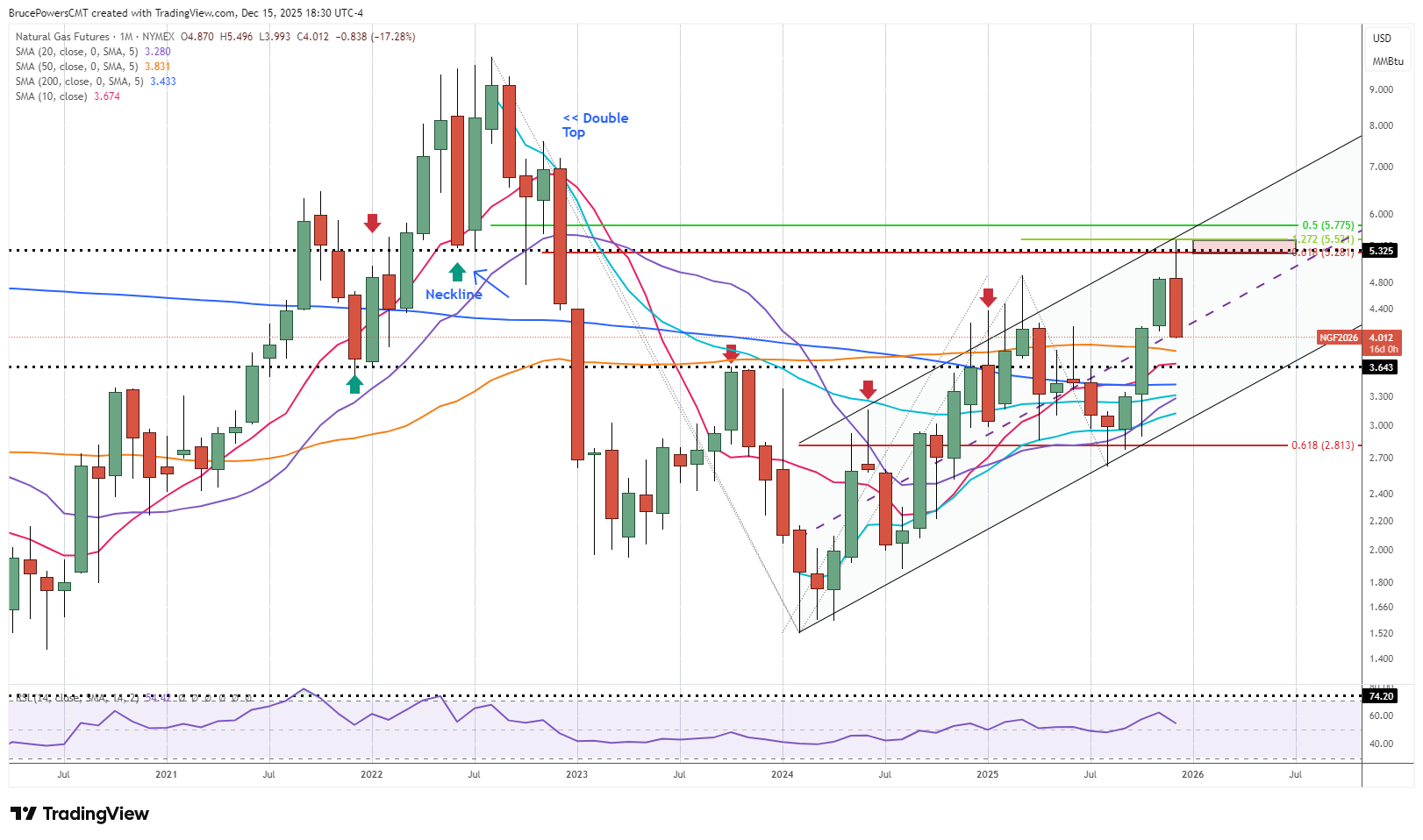
Weekly Channel and Near-Term Targets
The weekly chart sharpens the view of the rising channel that contained the 2025 advance. A well-defined support zone emerges around $3.64, a level that previously capped swings and acted as both support and resistance (marked clearly on charts). This area finds additional confluence from the 200-week moving average near $3.78 and the 50-week average at $3.62.
Until price reaches and holds these zones, bounces are likely to remain corrective and attract selling pressure. Traders often use such rallies to exit longs or initiate shorts in anticipation of a continuation lower. Only a sustained break above recent swing highs would challenge the bearish correction scenario.
Fundamental Developments Impacting Natural Gas in 2026
A major wave of new LNG supply is set to hit markets in 2026, with global capacity expected to rise around 7% (or 40 bcm)—the largest increase since 2019—driven primarily by projects in the United States, Qatar, and Canada (IEA Gas Market Report Q3-2025). This influx could ease fundamentals and spur demand growth in price-sensitive Asian markets, while U.S. dry natural gas production is forecast to average around 109 Bcf/d, supported by rising LNG exports and power sector needs, including emerging data center load (EIA Short-Term Energy Outlook, December 2025). Weather remains the key wildcard, as colder-than-normal conditions could quickly tighten balances amid limited short-term supply responsiveness.
Summary
Natural gas heads into 2026 with near-term downside momentum but within a constructive multi-year uptrend. The path of least resistance points toward lower channel support and key moving averages in the first half of the year, setting up potential buying opportunities once the correction completes.
For a look at all of today’s economic events, check out our economic calendar.