
Market Overview
On Friday, oil markets are shifting fast, and USOIL and UKOIL traders need to adjust. Overall, the prices of WTI and Brent futures spiked earlier this week on Iran supply fears, pushing WTI toward multi-month highs. But that risk premium is now unwinding. With the likelihood of US military action fading, the market is refocusing on fundamentals.
OPEC is seeing supply is likely to stay balanced into 2026, while analysts warn that inventories remain comfortable. Without any real disruption or a surge in demand from the Chinese, upside price action looks limited.
This puts USOIL back into a headline-driven, range-trading environment, where rallies are sold and dips attract short-term buyers. For now, fundamentals favor selling strength near resistance rather than chasing breakouts.

Natural Gas Price Forecast
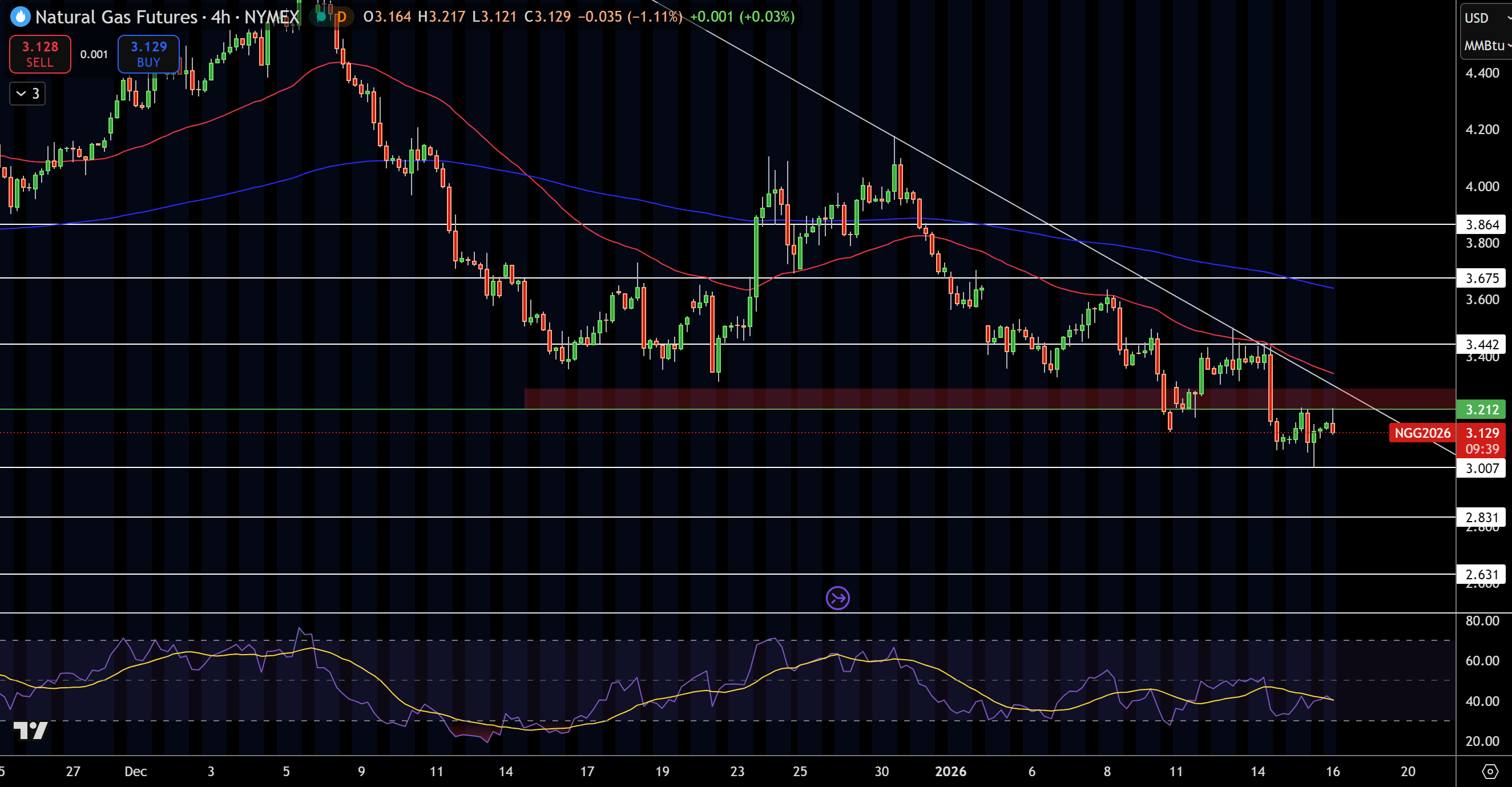
Natural gas futures are currently stuck down at around $3.12 hanging precariously at the lower end of this down trend that’s been going on for a while on the 4 hour chart. The price is being kept in check by a descending trendline that formed when it peaked in December – and at the same time, it’s still stuck below both the 50 day moving average at $3.35 and the 200 day moving average at $3.75 which all together adds up to a pretty clear picture of bearish control.
Recent action on the chart shows small candles that don’t really follow through, suggesting sellers are firmly in charge but their grip is starting to slip. The area between $3.20-$3.25 is no longer support but instead resistance, while any dips below $3 should find some decent support at $3.00 and another layer of support kicks in at $2.83.
The plan would be to sell any rallies that come in but only if its under $3.25, aiming to hit $3.00, and set a stop loss above $3.40.
WTI Oil Price Forecast
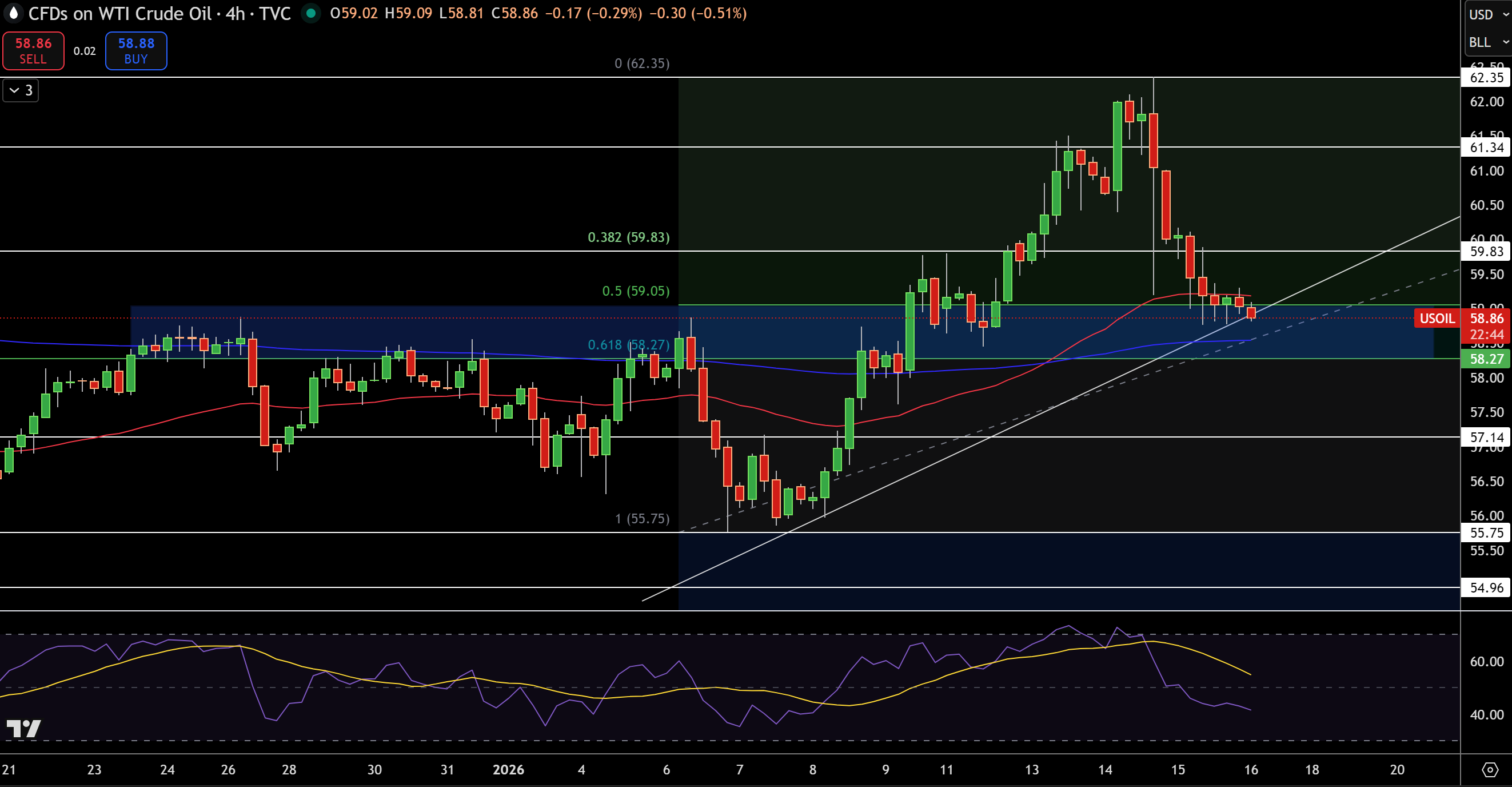
The WTI crude oil is trading at around $58.90 during the early European session. USOIL is extending its pullback as it failed to keep its gains above the $62.30 swing high. Taking a look at the 4-hour chart, the price of USOIL has retraced into a key Fibonacci cluster, trading near the 61.8% retracement level at $58.27 and the 50% retracement level at $59.05.
Natural Gas Price Forecast
Every new Natural Gas analysis as it publishes, today's technical signal and key levels, live price — on one page.
See all Natural Gas forecastsThe closing of a candlestick above 50% Fibo level shows consecutive bearish bodies with limited lower wicks. Typically, it suggests that sellers remain active, yet momentum is slowing as price approaches rising trendline support at $55.75.
The 50-day EMA has rolled over near $59.50, while the 200-day EMA below $58.00 continues to slope higher, keeping the broader structure constructive. On the support side, $58.30–$58.00 levels are acting as a major support, followed by $57.15. Whereas, resistance is layered at $59.80, then $61.35. Summing this up, the trade idea is to look for a buy near $58.20, target $61.00, and stop below $57.10.
Brent Oil Price Forecast
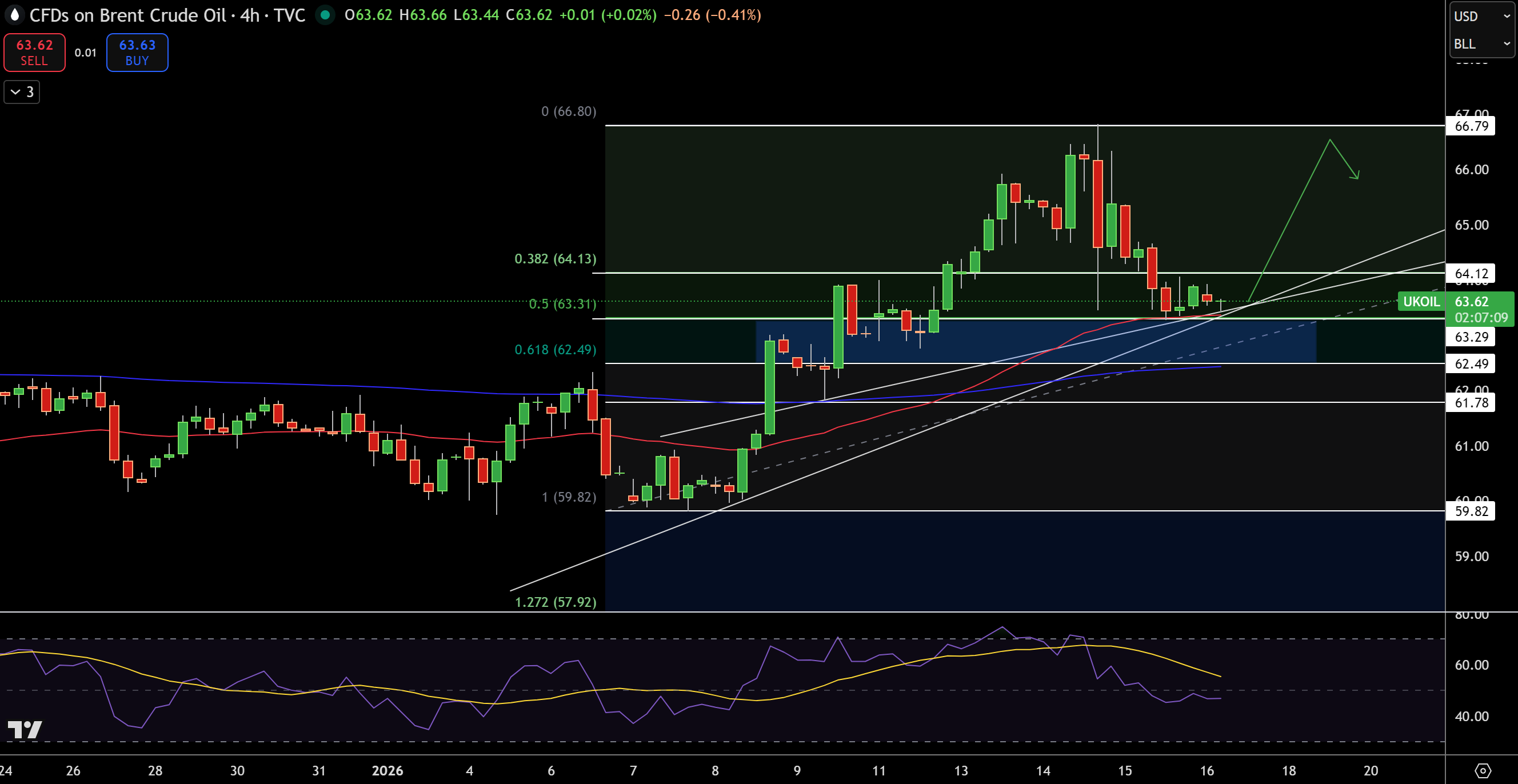
Brent crude is currently trading at around $63.60 after a sharp pullback from its recent high of $66.80. The price dropped, but so far its decline is shaping up more like a brief pause than the start of a bigger fall. Looking at the 4-hour chart, the price has pulled back into a key area where it’s been finding support – you know, the 50% retracement zone. And it’s holding up pretty well at $63.30 – just barely above the 61.8% level ($62.50). At this point Brent is still staying true to the rising trendline that comes down from the $59.80 low, and that’s helping keep the bigger picture looking promising for now.
In terms of moving averages, the 50 EMA is flattening out around $63.20 – that’s a sign that short term momentum has taken a bit of a breather, but the 200 EMA is still pointing upwards, near $62.00. If we’re looking for key levels to watch, the first bit of resistance is around $64.10, then there’s a more significant cap up near Brent’s recent high at $66.80. On the downside, $63.30 is the first line of support – then we have the deeper Fibonacci level at $62.50.