



Market Overview
WTI crude futures edged lower to $56.48 per barrel, yet prices remain near a two-month low, reflecting ongoing oversupply concerns as markets digest rising geopolitical tensions. Diplomatic activity around Eastern Europe has increased, but continued disruptions, including drone attacks on energy infrastructure, have kept risk premiums modest rather than explosive.
Elsewhere, heightened military activity involving major oil-producing regions in the Americas and shipping incidents near key maritime routes have added uncertainty to global supply chains.
For oil and natural gas markets, these tensions introduce short-term volatility without fundamentally tightening supply. As a result, prices remain capped, with traders balancing geopolitical risk against abundant inventories and muted demand growth.
Natural Gas Price Forecast
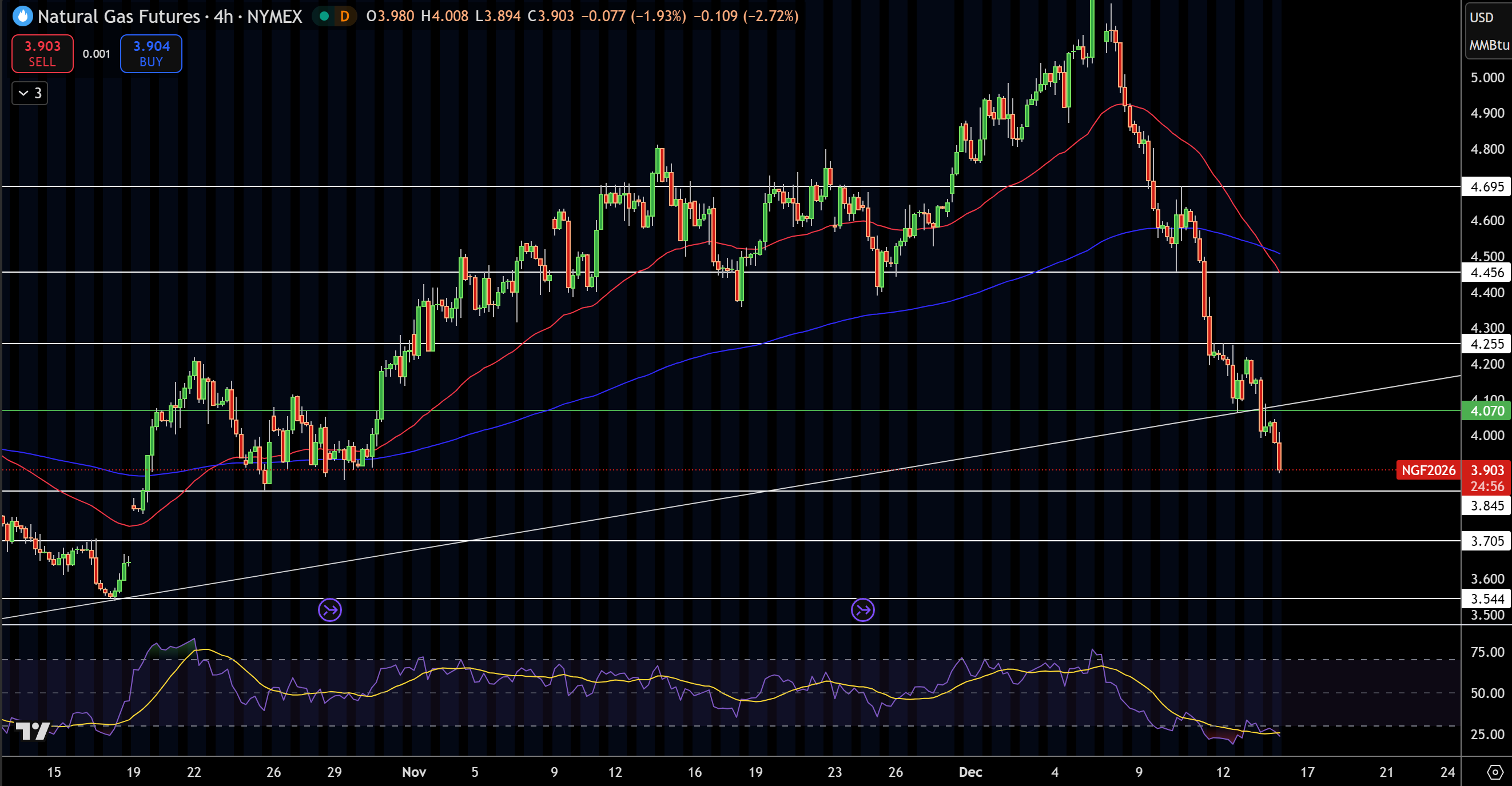
Natural gas futures are trading near $3.90 on the 4-hour chart after a steep reversal from highs above $5.00, firmly shifting the short-term bias lower. Recent candlesticks show large bearish bodies with minimal lower wicks, highlighting sustained selling pressure rather than panic-driven exhaustion. Price has broken decisively below the 50-EMA at $4.55 and the 100-EMA near $4.25, both now acting as overhead resistance.
The October rising trendline has failed, and price is drifting toward a key support band at $3.85–$3.80. A clear break below this zone would open downside risk toward $3.70 and $3.55. On rebounds, resistance sits at $4.07, then $4.25.
RSI is hovering near 30, signaling oversold conditions but no confirmed reversal yet. Without a quick reclaim of $4.25, rebounds are likely corrective.
WTI Oil Price Forecast
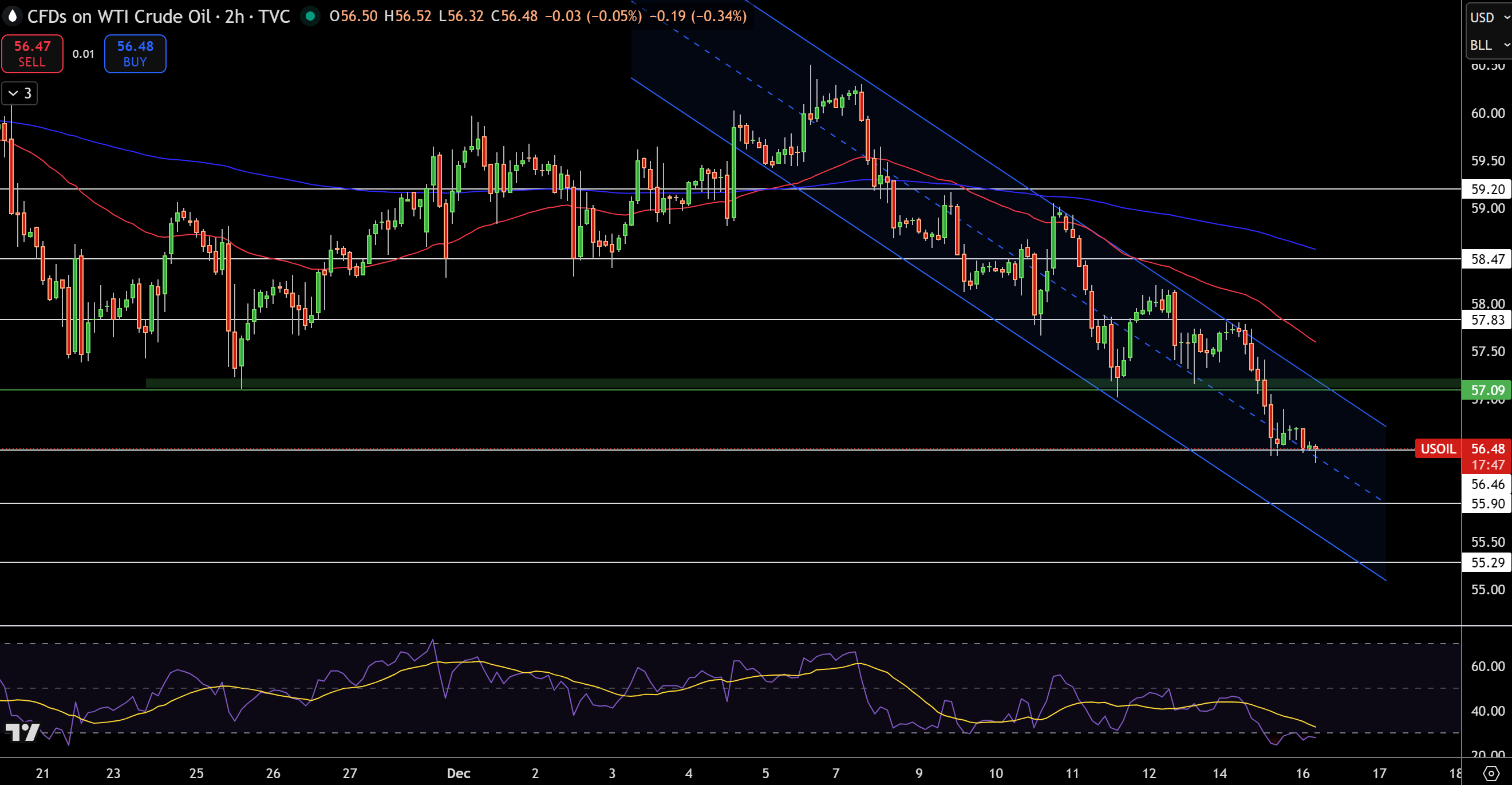
WTI crude is trading near $56.48 on the 2-hour chart, extending losses within a well-defined descending channel. Recent candlesticks show brief rebounds followed by renewed selling, while long upper wicks near $58.00–$58.50 point to supply on rallies rather than firm dip buying. Price remains capped below the falling channel midline and the 50-EMA around $57.80, keeping short-term pressure in place.
Natural Gas Price Forecast
Every new Natural Gas analysis as it publishes, today's technical signal and key levels, live price — on one page.
See all Natural Gas forecastsFormer range support near $57.10 has flipped into resistance. Immediate support sits at $56.20, followed by $55.90 and $55.30, which aligns with the lower channel boundary. A break below this zone would deepen downside risk. RSI near 35 reflects weak momentum without extreme oversold conditions, suggesting rebounds may stay corrective unless $57.80 is reclaimed.
Brent Oil Price Forecast
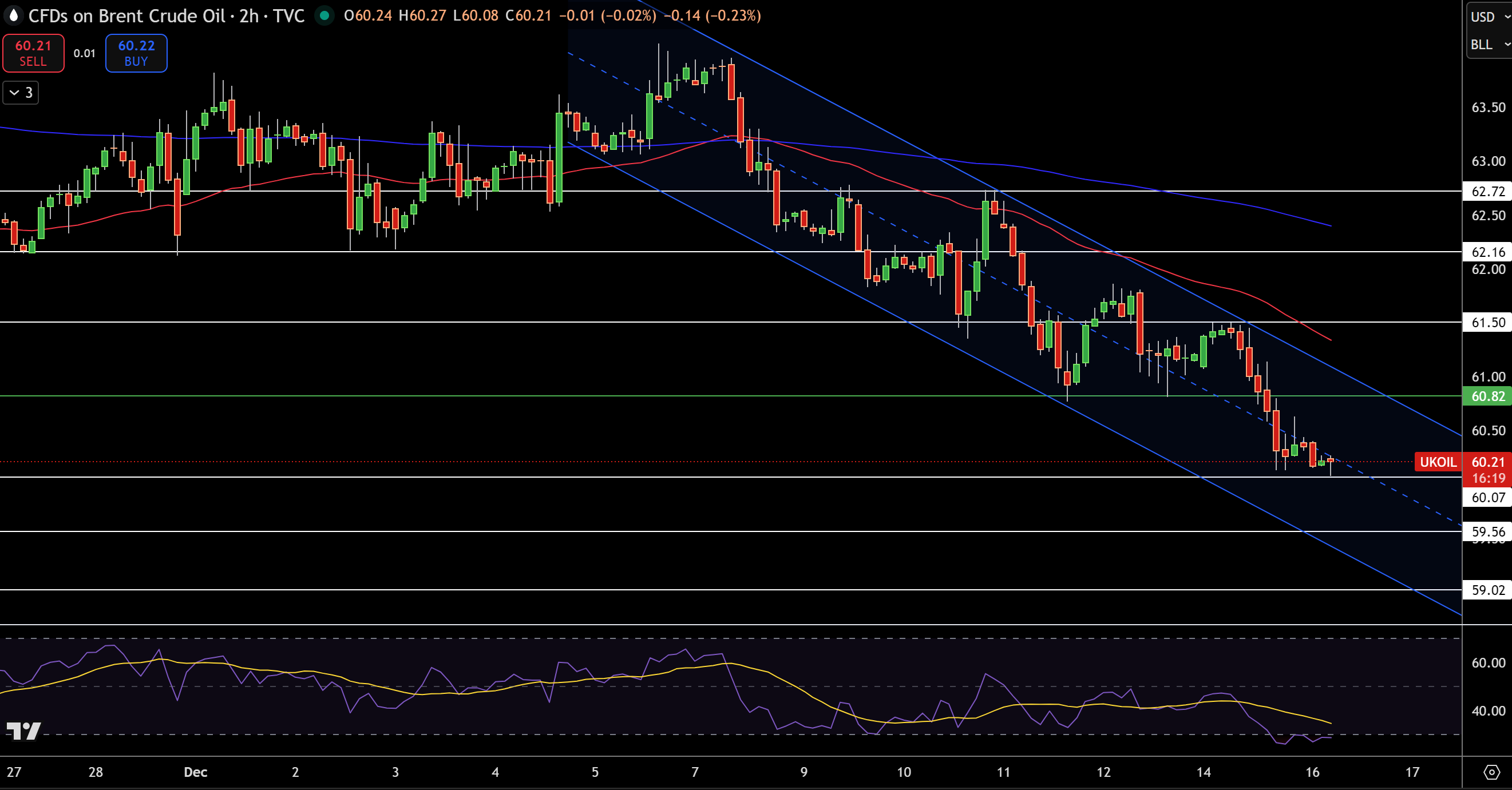
Brent crude is trading near $60.21 on the 2-hour chart, extending its decline within a clear descending channel. Recent candlesticks show repeated lower highs and small bodies near the channel base, signaling controlled selling rather than panic-driven liquidation. Price remains firmly below the 50-EMA at $61.50 and the 100-EMA near $62.70, both acting as dynamic resistance.
The downward trendline from early December remains intact, while former support at $60.80 has flipped into resistance. Immediate support is located at $60.00, followed by $59.55, aligning with the lower channel boundary. A break lower could expose $59.00. RSI near 38 reflects weak momentum without oversold conditions, suggesting rebounds may stay corrective.