
Natural Gas Slips After EIA Miss — Is This the Start of a Pullback?
Natural gas futures are retreating Thursday as traders digest a weaker-than-expected storage draw from the EIA. After briefly spiking to $5.046 early in the session, prices turned lower and fell beneath the $4.953 pivot — a key level that now looks like short-term resistance. The move puts gas in position for a potential bearish reversal, with downside levels coming into focus fast.
At 15:58 GMT, January Natural Gas Futures are trading $4.940, down $0.055 or -1.10%.

Why Did the EIA Print Disappoint Bulls?
The EIA reported a net storage withdrawal of 12 Bcf for the week ending November 28 — well below consensus estimates calling for an 18 Bcf draw. It’s also only slightly larger than last week’s 11 Bcf decrease. While any drawdown implies demand, the market was clearly expecting more. The miss suggests commercial and residential demand fell short, even with colder weather in the northern U.S. during the reporting period.
The big tell? Stocks remain 191 Bcf above the five-year average. And year-over-year, inventories are just 18 Bcf below 2024 levels. The market wanted a stronger signal of early winter demand — and didn’t get it.
Buyers Back Off After Early Spike — What’s the Trade?
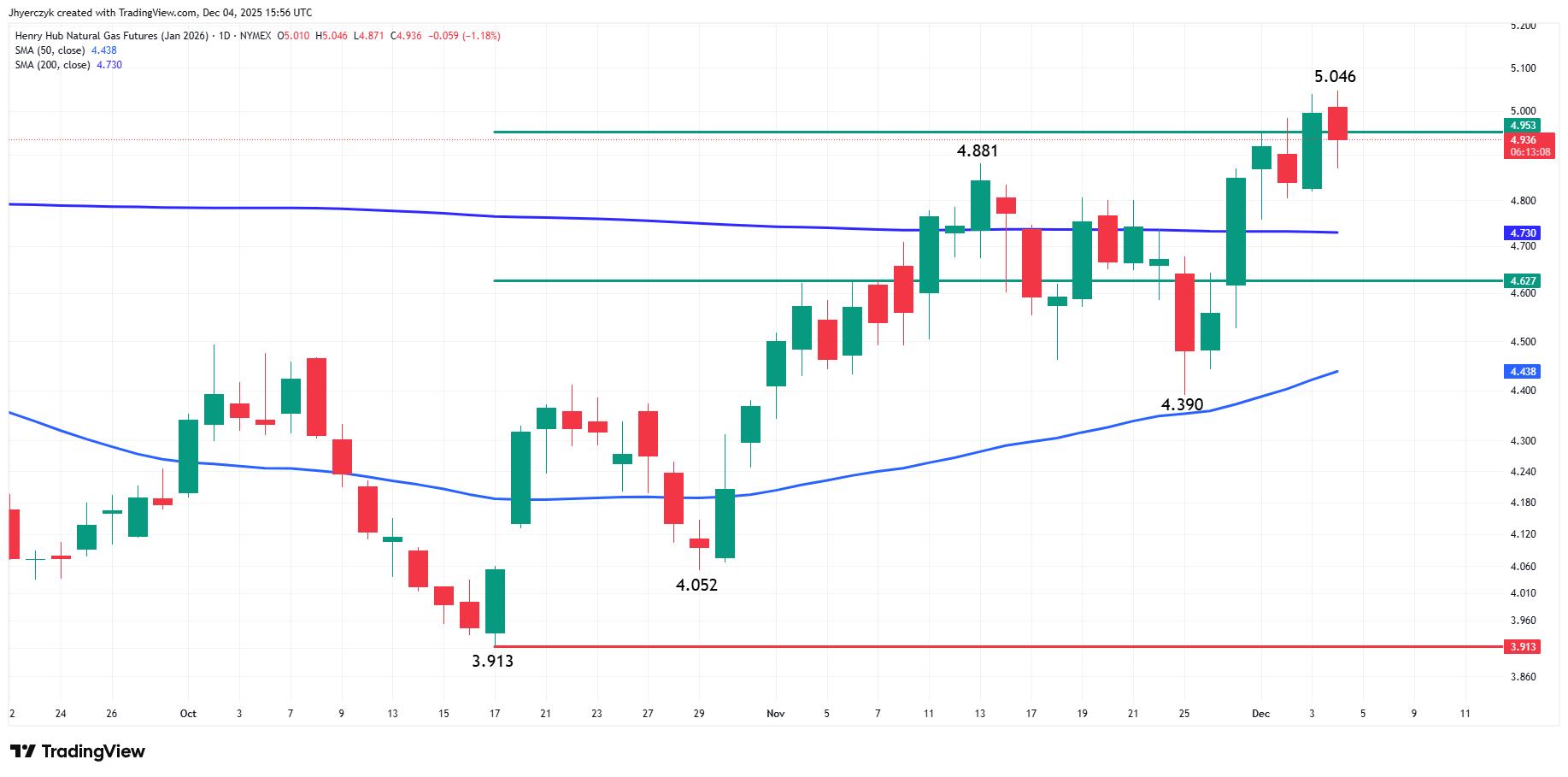
Traders came in strong early, pushing the January contract over $5.00. But the EIA miss and failure to hold the $4.953 pivot flipped the tone quickly. Sellers stepped in. Now, with prices slipping toward $4.90, chart watchers are eyeing the 200-day moving average at $4.730 as the next test.
If that level doesn’t hold, things could get choppy. A broader range between $4.438 (50-day MA) and $4.730 might come into play. That zone has acted as a buyer’s base in recent weeks, but positioning here likely depends on weather updates and short-term demand expectations.
Natural Gas Price Forecast
Every new Natural Gas analysis as it publishes, today's technical signal and key levels, live price — on one page.
See all Natural Gas forecastsIs Weather Still Supportive of Demand?
Near-term forecasts offer a mixed bag. NatGasWeather sees strong national demand continuing through the weekend, with frigid conditions holding over the northern U.S. But by next week, demand eases back to “Moderate-High” as milder conditions move in across the East and South.
Bottom line — the next few days could still show decent heating demand, but traders may be hesitant to chase unless the forecasts firm up again. If the early December cold snap fades too quickly, the case for a sustained rally weakens.
Outlook: Cautious Bearish Near-Term Unless $4.730 Holds
With the EIA print falling short and the contract slipping below a key pivot, near-term momentum favors the bears. A close below $4.995 sets up a textbook reversal signal, and the technical path now points toward $4.730.
Unless that support level holds — or unless weather models turn significantly colder — the smart money may stay on the sidelines or look to sell rallies. The next few sessions will be critical.
More Information in our Economic Calendar.