
Natural Gas Futures Drop as Warm Weather Destroys Demand and Storage Surplus Widens
Natural gas futures are under pressure at the mid-session on Wednesday on reports that a warm start to 2026 has destroyed demand, widening storage surpluses and leading to speculation that inventories are back on track to finish the winter withdrawal period above 2 Tcf.
At 17:18 GMT, February Natural Gas Futures are trading $3.115, down $0.304 or -8.89%.

EIA Forecasts Price Decline in 2026, Sharp Rally in 2027
Earlier today, the U.S. Energy Information Administration (EIA) reported in its January Short-Term Energy Outlook that they expect the U.S. benchmark natural gas spot price at the Henry Hub to decrease about 2% to just under $3.50 per MMBtu in 2026 before rising sharply in 2027 to just under $4.60 per MMBtu.
“We expect the annual average Henry Hub price in 2026 to decrease slightly as annual supply growth keeps pace with demand growth over the year. However, in 2027, we forecast demand growth will rise faster than supply growth, driven mainly by more feed gas demand from U.S. liquefied natural gas (LNG) export facilities, reducing the natural gas in storage. We forecast annual average spot prices will decrease by 2% in 2026 and then increase by 33% in 2027,” according to the EIA.
Weather Forecasts Fail to Support Prices as Cold Snap Already Priced In
The latest weather forecasts from NatGasWeather.com couldn’t stop the selling either. It calls for “frosty air” to advance into the northern half of the U.S. late in the week and next weekend with highs of 0s to 40s, lows of -0s to 30s for stronger national demand. They’re also calling for stronger demand for Thursday through Sunday. From the price action, it looks as if these events have already been discounted as normal winter weather patterns. Absent from any reports is a “polar vortex” or “lingering cold front”, which would have underpinned the market. Now it looks like we have to guess at what level the professional traders will stop shorting.
Weekly Storage Report Expected to Show 89 Bcf Drawdown
On Thursday, the weekly EIA storage report is expected to show an 89 Bcf drawdown. Last week’s report was bullish as inventories for the week ended January 2 fell by 119 Bcf, a larger draw than the market consensus of 113 Bcf and much larger than the 5-year weekly average draw of 92 Bcf.
Natural Gas Price Forecast
Every new Natural Gas analysis as it publishes, today's technical signal and key levels, live price — on one page.
See all Natural Gas forecastsAs of January 2, natural gas inventories were down 3.5% year over year and were 1.0% above their 5-year seasonal average, signaling ample natural gas supplies.
Technical Analysis: Downtrend Remains Intact With Key Support Levels Ahead
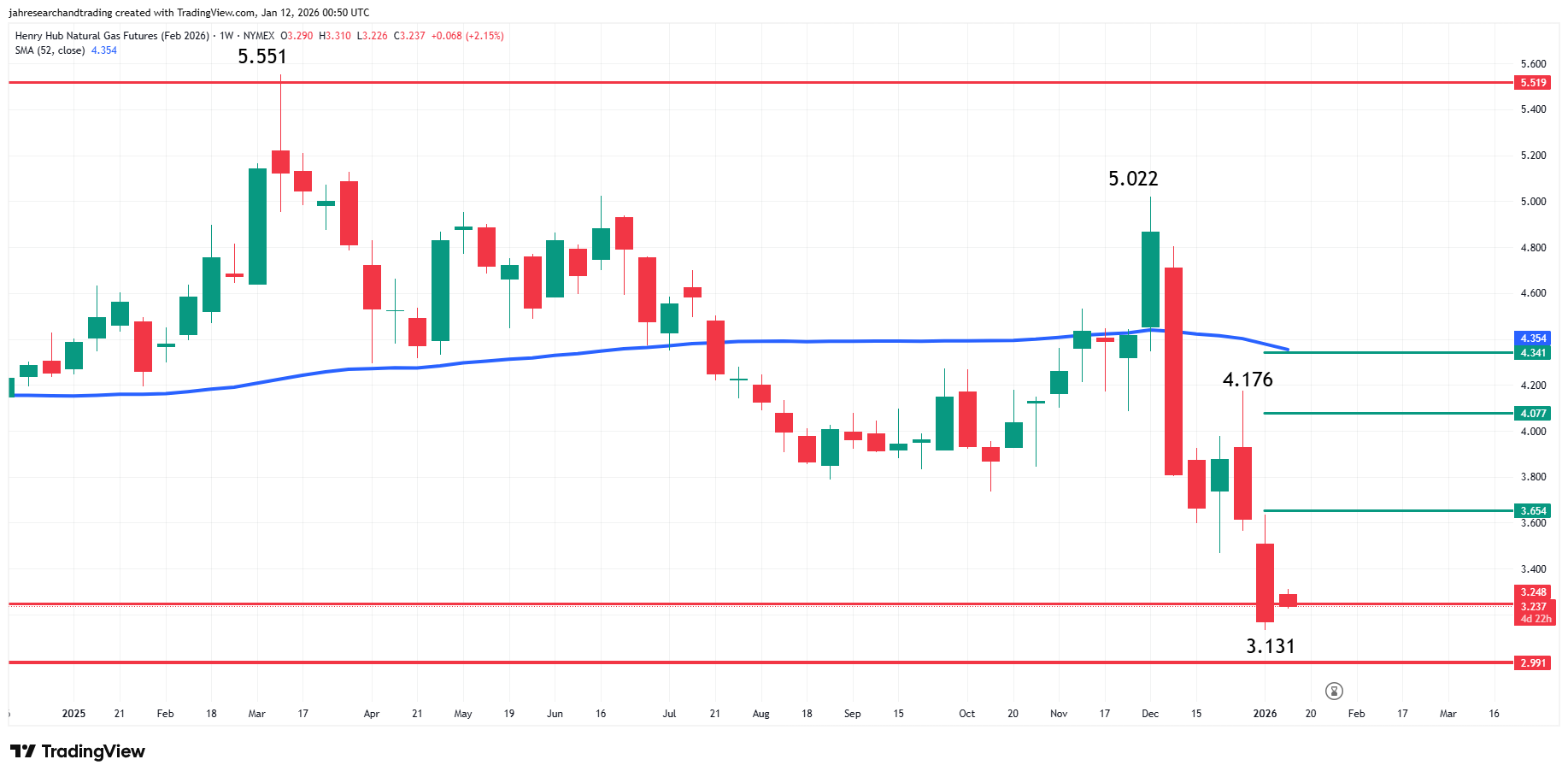
Technically, the main trend is down according to the daily swing chart. There are two downside targets at $2.991 and $2.770. A trade through $3.499 will change the minor trend to up with $3.634 the next objective. Taking out this level could have a bigger impact on prices with the next major target the 50-day moving average at $4.034.
We don’t foresee any extended rally until there is a sustained move over the 200-day moving average at $4.273. Until then, the market will remain in “sell the rally” mode.
More Information in our Economic Calendar.