
The Numbers: Both Contracts Soared, But February Doubled March’s Gain
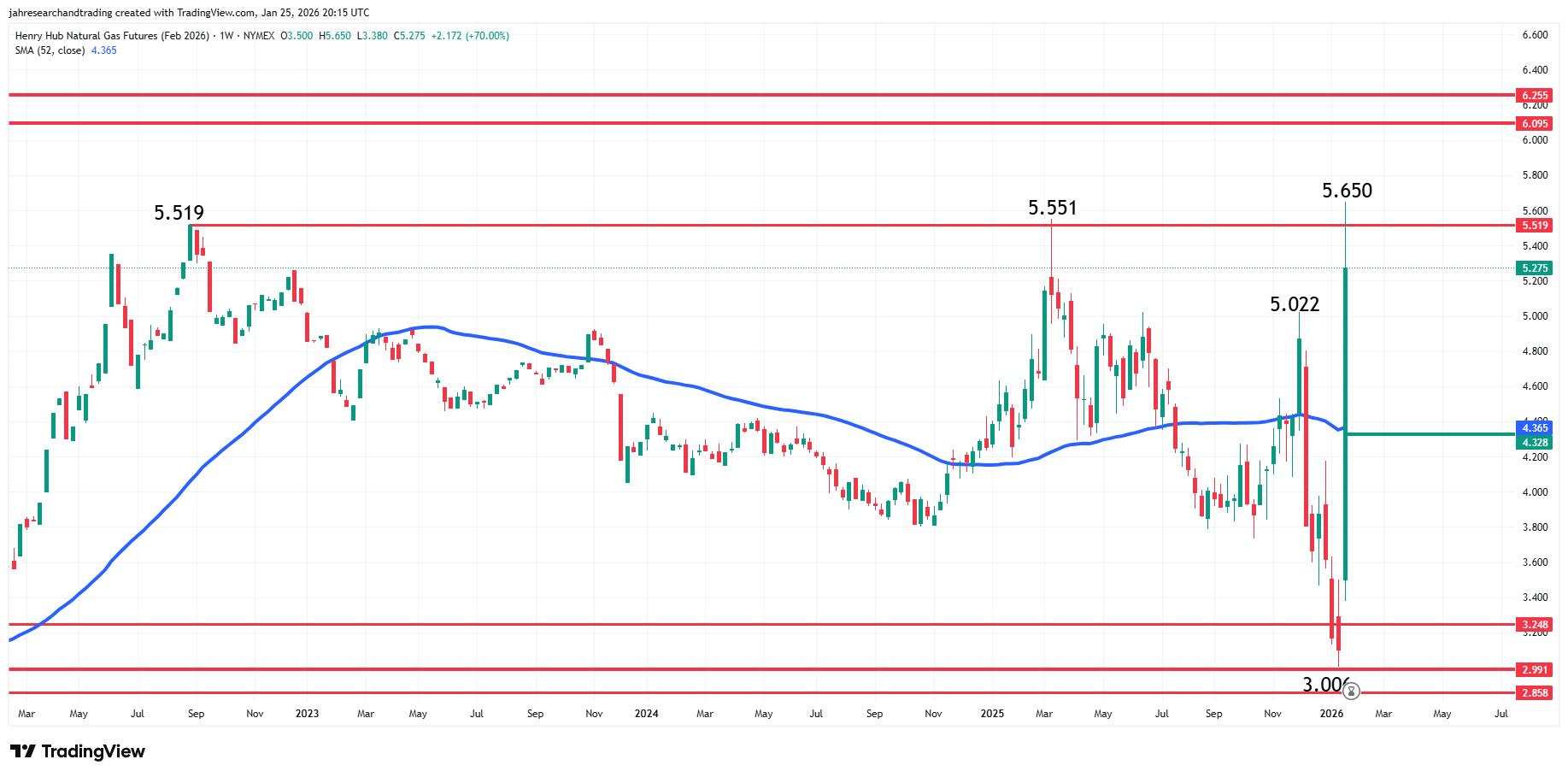
Last week, the February natural gas futures closed at $5.275, up $2.172 (+70.00%). March futures settled at $3.609, up $0.911 (+33.77%). Both months exploded higher, but the Feb/March spread widened to $1.666 from $0.508 the previous week—a jump of $1.158 that tells you everything about what’s happening. February settles January 28, 2026, just three days away.

The Setup: How Traders Got This Spectacularly Wrong
The rally started before the cold actually hit. Weather forecasts showed Arctic cold heading toward gas-producing regions, threatening pipeline freezes like the 2021 Texas disaster that killed 200+ people. But this wasn’t just about weather—it was a massive short squeeze.
Going into last week, traders had completely written off winter. Months of mild weather and ample supplies convinced them prices would fall. The positioning was extreme: storage up 6.0% year-over-year and 6.1% above the five-year average, hedge funds at their most bearish in over a year, and trading algorithms 100% short.
The Squeeze: When Everyone Runs for the Same Exit
Then forecasts worsened and panic set in. Shorts started covering, prices jumped, forcing more shorts to cover at losses, pushing prices higher still. By Thursday, algorithms had flipped from 100% short to only 45% net short. The actual cold hit over the weekend with 10% of U.S. production going offline, but by then February had already spiked to $5.275.
February’s Final Days: Expiration Panic Meets Weather Fear
February at $5.275 rallied 26% above its moving average of $4.365. Three factors drove this: shorts forced to cover, weather fear, and contract expiration in three days. With immediate delivery needed during peak heating demand, buyers are paying whatever it takes. February’s 70% gain reflects the desperation.
Natural Gas Price Forecast
Every new Natural Gas analysis as it publishes, today's technical signal and key levels, live price — on one page.
See all Natural Gas forecastsMarch Rallied Too—But Faces Key Technical Resistance
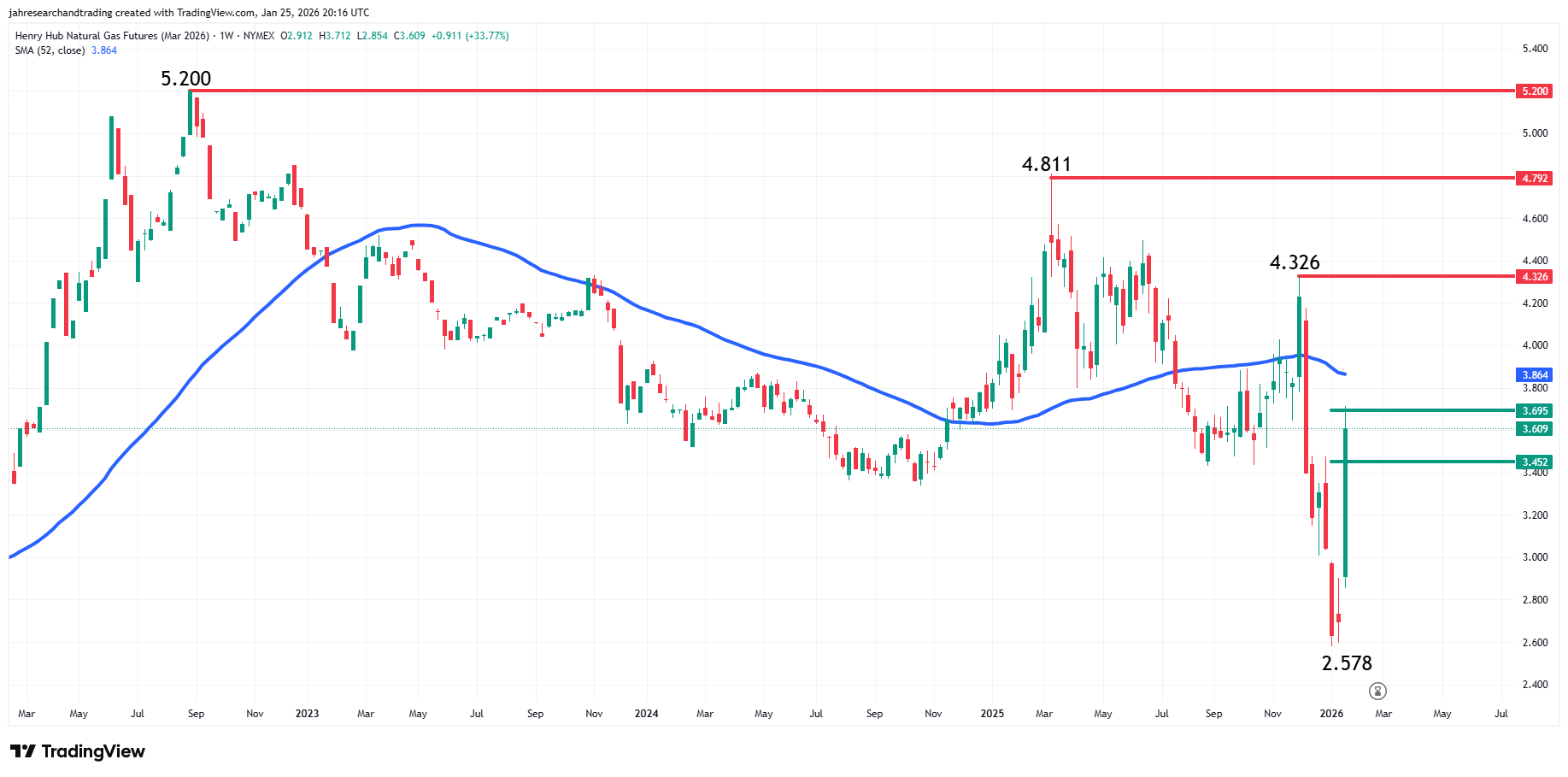
March at $3.609 also surged 33.77%, but that’s only half of February’s move. The March contract, which becomes the front-month futures contract on Monday, settled on the weak side of the 52-week moving average at $3.864, but inside a pair of 50% pivots at $3.452 to $3.695. Last week’s high was $3.712, which means the rally was stopped by the top end of the pivot zone. Trader reaction to this zone will likely set the tone for the week. Trend traders will be watching for the reaction to the 52-week moving average.
The market knows this cold snap won’t last. The 6-10 day outlook shows severe cold in the East (60-80% probabilities below normal), but the 8-14 day forecast shows significant moderation. The extreme cold retreats while Western states stay warmer than normal.
The Play: How to Trade This Dislocation
The $1.666 spread widened by $1.158 in one week—that’s the panic premium on February. February reflects expiration pressure and immediate delivery fears. March reflects post-storm reality. When February expires on January 28th and March becomes the front month, expect this spread to disappear and volatility to compress sharply.
However, don’t expect March to collapse immediately. The storm is ongoing and could extend into early next week. With 10% of production already offline and temperatures forecast to stay bitterly cold, additional freeze-offs are likely. Wells and pipelines freezing off could keep March bid even after February expires, especially if production disruptions last longer than the market expects.
Key technical levels to watch: March is trapped between the 52-week moving average at $3.864 (resistance) and the pivot zone at $3.452-$3.695. A break above $3.864 signals continued weather/freeze-off premium. A drop back into the pivot zone suggests the panic is fading. The $3.712 high from last week is the immediate battleground.
Bottom line: The spread tells you February is overpriced relative to March. Stay away from February’s final three days unless you need physical delivery. Once we roll to March on Monday, watch how it reacts to the $3.864 moving average. If freeze-offs are severe and March breaks above $3.864, it could run to $4.00+. If production recovers quickly and the $3.452 pivot price fails as support, that’s your signal the panic is over.
Storage was 6% above normal going into this week, but the massive heating demand and production freeze-offs will significantly draw down inventories. We won’t know the full damage until EIA reports over the next 2-3 weeks, which could keep uncertainty—and prices—elevated even as weather moderates.”
More Information in our Economic Calendar.