
Natural Gas Futures Edge Higher as Counter-Trend Rally Extends from Key Support
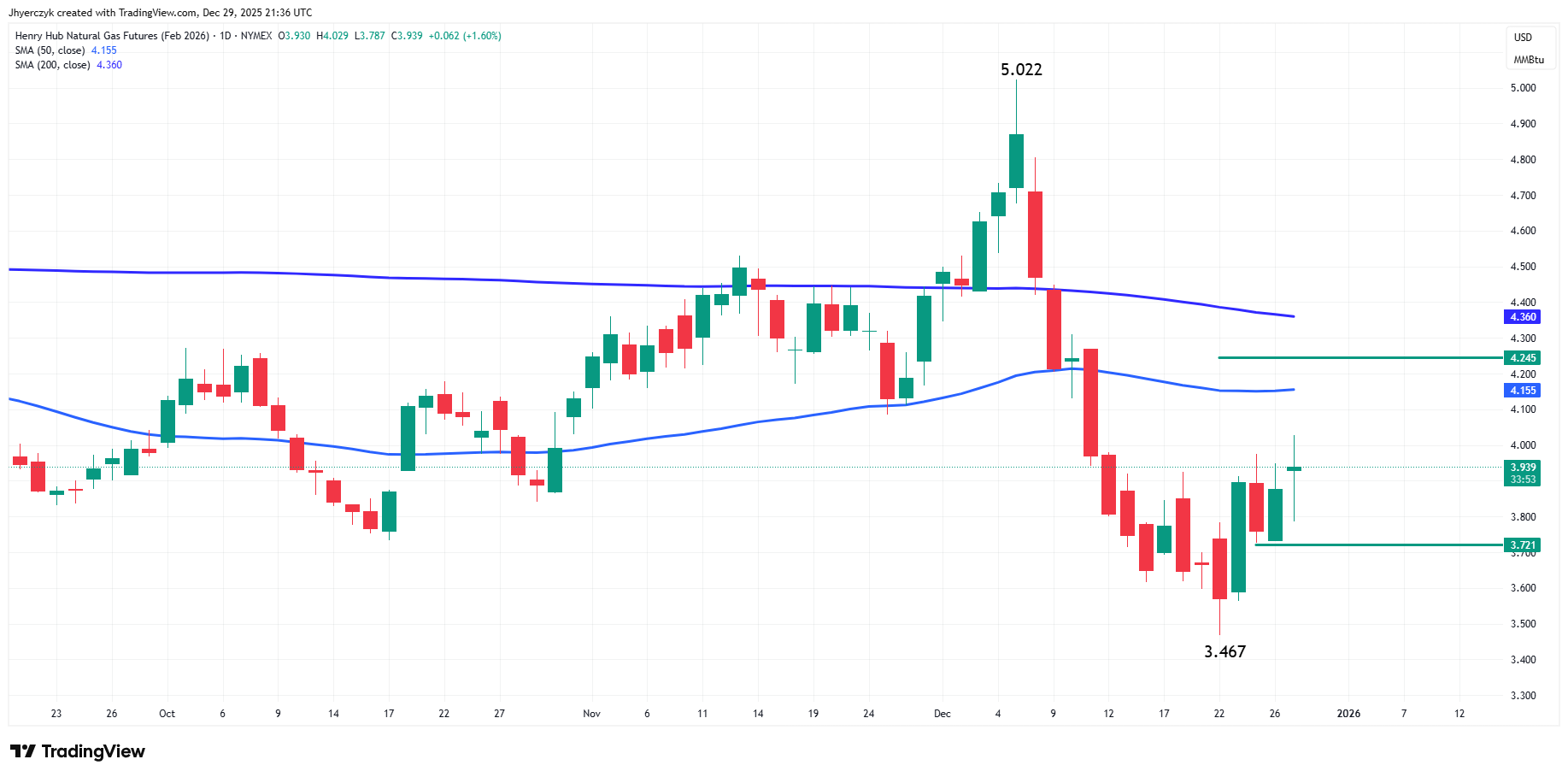
February natural gas futures edged higher on Monday, pulling a little further away from short-term 50% support at $3.271. The market is still trending lower, but there is room to the upside to extend the counter-trend trade.
At 21:32 GMT, February Natural Gas Futures are trading $3.938, up $0.061 or +1.57%.

50-Day Moving Average at $4.155 Emerges as First Major Resistance Target
The daily chart shows plenty of room to the upside, with the 50-day moving average at $4.155 the first key target. This is followed by a 50% level at $4.245 and the 200-day moving average at $4.360.
Rally to $4.155-$4.360 Likely to Face Renewed Selling Without Bullish Weather
In my opinion, any extension of the rally into $4.155 to $4.360 is likely to be met with resumed selling pressure unless the weather is overwhelmingly bullish.
Failure Below $3.721 Could Trigger Retest of Main Bottom at $3.467
On the downside, a failure to hold $3.721 will indicate the start of a reset. Traders will either continue forming a support base or retest the main bottom at $3.467.
Delayed EIA Storage Report Shows Massive 166 Bcf Withdrawal, Flips Inventories to Deficit
Today’s main event at the start of this holiday-shortened week was the U.S. government’s weekly storage report that had been postponed from last week.
Natural Gas Price Forecast
Every new Natural Gas analysis as it publishes, today's technical signal and key levels, live price — on one page.
See all Natural Gas forecastsNatural gas futures added to gains after the U.S. Energy Information Administration (EIA) on Monday reported a heavier-than-normal withdrawal of 166 Bcf from working storage for the week ended Dec. 19. This wiped out what was left of a surplus to the five-year average. The result of the oversized draw flipped inventories to deficit versus the five-year trend. Next week is forecast to show a more modest draw because of Christmas week.
Chilly Weather Systems Target Midwest and Northeast, But 8-15 Day Outlook Turns Warm
Also on Monday, NatGasWeather reported that “… a couple chilly weather systems track across the Great Lakes, Ohio Valley, and Northeast the next 6-days for stronger national demand. However, the 8-15 day forecast pattern is too warm in much of the data.”
The service also forecast chilly weather systems across Midwest, Ohio Valley, and Northeast with highs of 10s-30s, lows of -0s-20s for regionally strong demand. The rest of the US will be mild to nice with highs of upper 40s to 70s, although with cooler temperatures at times into Texas and the South with lows into the 30s, locally 20s. Overall, moderate-high demand the next 6-days, then light.
Storage Deficit Makes Prices More Weather-Sensitive, But Bearish Outlook Limits Upside
The storage report is interesting because falling to deficit versus the five-year average means prices will be more sensitive to extreme changes in the weather. However, that’s not a concern at this time. Traders are primarily focused on the short-term weather outlook, and it’s not very bullish. Pockets of cold could spike prices, but gains will likely be capped by the resistance on the charts. Nonetheless, the overall weather outlook is bearish—maybe enough to cap rallies at resistance levels, but not bearish enough to trigger a new low.
More Information in our Economic Calendar.