



Natural Gas Plunges on Warm Weather Forecasts
Natural gas futures fell sharply last week on warm U.S. weather forecasts, dropping to a 2.5-month low for the nearest-futures contract. The news was bearish because warmer temperatures will reduce heating demand and allow storage levels to rebuild, undercutting prices.
Last week, February Natural Gas Futures settled at $3.169, down $0.449 or -12.41%.
Multi-Month Lows Breached as Warming Trend Emerges
The selling pressure started early in the week when sellers took out the previous main bottom at $3.467. On Friday, it accelerated through a multi-month low at $3.252. The catalyst for the end-of-week weakness was a NatGasWeather report calling for warming across most of the U.S. for January 9-15, with temperatures shifting even warmer across most of the country for January 16-23.
Supply Surge Meets Weak Demand
On the supply side, U.S. natural gas production is currently near a record high, with active U.S. natural gas rigs recently posting a 2-year high.
Additionally, gas production ended the week at 113.5 bcf/day, up 10.7% year-over-year. On the flip side, gas demand was 87.9 bcf/day, down 28.1% year-over-year. Meanwhile, LNG net flows to U.S. LNG export terminals on Friday were 19.5 bcf/day (+0.1% w/w), according to Bloomberg.
Storage Data Shows Larger-Than-Expected Draw
Last Thursday’s weekly Energy Information Administration (EIA) storage report was bullish as natural gas inventories for the week ended January 2 fell by 119 bcf, a larger draw than the market consensus of -109 bcf, and much larger than the 5-year weekly average draw of -92 bcf.
Brent Oil Price Forecast
Every new Brent Oil analysis as it publishes, today's technical signal and key levels, live price — on one page.
See all Brent Oil forecastsAs of January 6, gas storage in Europe was 58% full, compared to the 5-year seasonal average of 72% full for this time of year.
Rig Count Edges Lower from Recent Peak
Finally, Baker Hughes reported Friday that the number of active U.S. natural gas drilling rigs in the week ending January 9 fell by -1 to 124 rigs, modestly below the 2.25-year high of 130 set on November 28. In the past year, the number of gas rigs has risen from the 4.5-year low of 94 rigs reported in September 2024.
Technical Outlook: Downtrend Firmly in Control
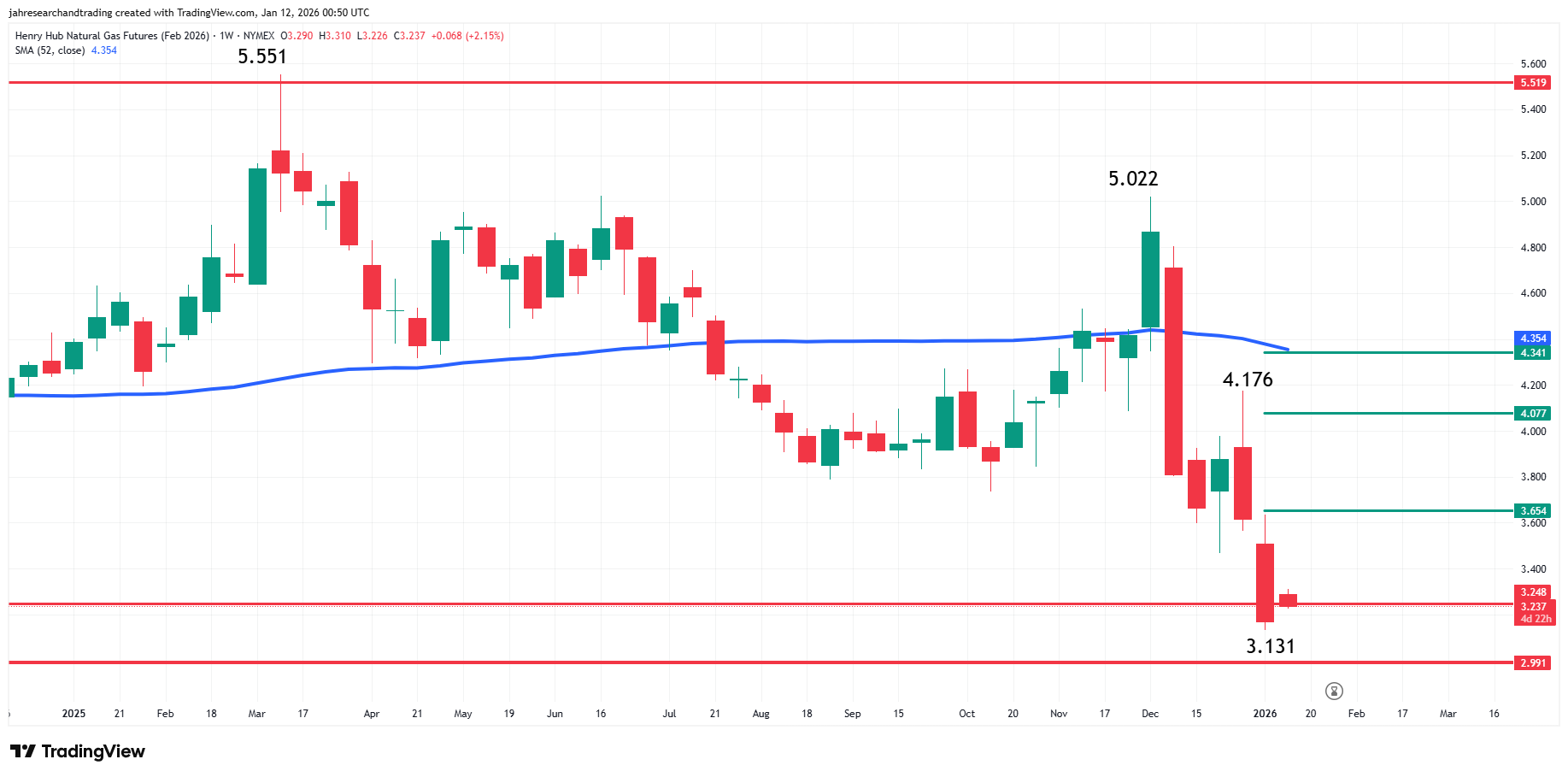
Technically, the main trend is down on the weekly chart. A trade through $3.131 will signal a resumption of the downtrend with $2.991 the next target.
It’s going to take the recovery of the pivot at $3.654 just to shift momentum to the upside and a move through $4.176 to change the minor trend to up. And after accomplishing that, it’s likely to run into renewed selling pressure at the 52-week moving average at $4.354.
Normal Winter Pattern Suggests Continued Pressure
Unless a lingering polar dome forms over high-demand areas, it looks as if this is shaping up to be a normal winter, which means traders are going to remain in “sell the rally” mode over the near-term.
More Information in our Economic Calendar.