


Henry Hub kicks off the Friday session with fresh information. EIA’s report yesterday estimated Lower 48 working gas at 3,724 billion cubic feet for the week ended October 23, with an 80 billion cubic feet injection. Stocks were 147 billion cubic feet below the year-earlier level and 38 billion cubic feet above the five-year average of 3,686 billion cubic feet.
The seasonal surplus is a bit modest, while the year-over-year comparison still shows less stored gas. That being said, we have seen an improvement in the buffer without establishing a massive, abundant supply under every winter scenario. The seasonal average and last year answer slightly different questions. The first describes the historical benchmark for this point in the calendar. The second describes a particular year. Neither will establish how much gas will be required if the coming winter is unusually cold.
Details Per Region Still Matter, Though
South Central inventories reached 1,168 billion cubic feet, up 43 billion cubic feet during the week, but remained 2.3% below their five-year average. Salt cavern stocks rose to a reading of 274 billion cubic feet but were still 11.6% below their seasonal average. The region’s weekly improvement did not eliminate its shortfall, but it is moving in the correct direction.
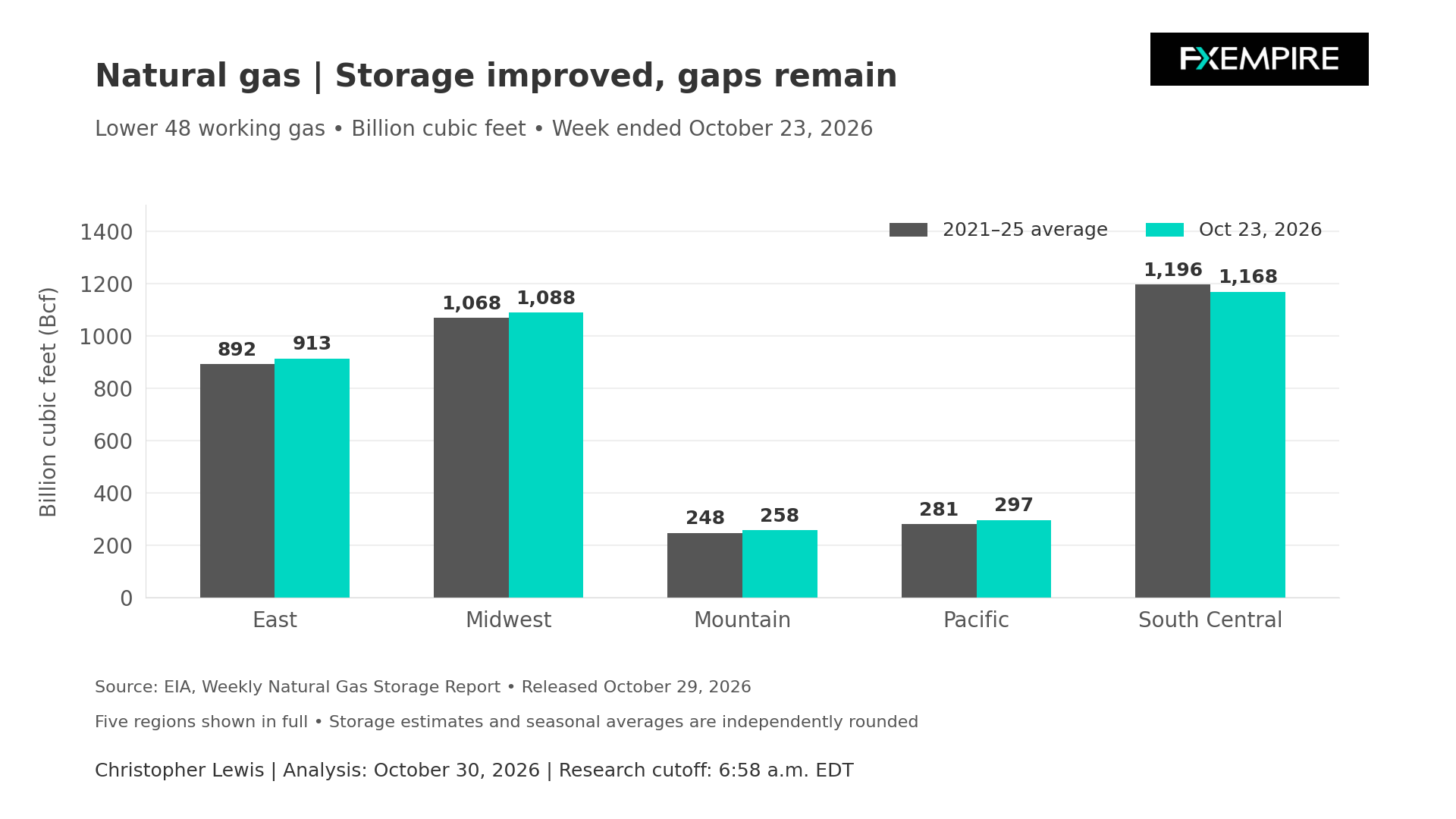
This argues that examining the location and flexibility of stored gas alongside the national total is the correct way to look at the market. A regional deficit is not necessarily proof of an immediate delivery problem, though, because pipeline capacity, production, terminal demand, and operating conditions would need verification before making that claim.
Weather
The latest official weather outlook leans toward restraint on early November heating expectations. Issued yesterday at 3 p.m. Eastern, CPC’s 6–10 day forecast for November 4–8 favors above-normal temperatures across the East. Probabilities exceed 70% from the Mid-Atlantic to the southern Northeast and the Great Lakes.
If those conditions do end up being true, milder weather will presume more gas will remain in storage than a significant drawdown. This, of course, will depend on temperatures, which population is exposed, and the balance between residential heating and power-sector demand. A warm forecast can weaken the immediate heating argument without establishing that the full winter will be mild, clearly.
Natural Gas Price Forecast
Every new Natural Gas analysis as it publishes, today's technical signal and key levels, live price — on one page.
See all Natural Gas forecastsThe upcoming weekend could matter because weather guidance can change before the next storage reading is published. EIA lists November 5 as the next release. In the meantime, updated forecasts will offer expectations about heating consumption, while the next storage release will provide a measured checkpoint.
October Short-Term Energy Outlook
The October Short-Term Energy Outlook supplies a broader supply framework. Released October 6, with its forecast completed on October 1, it projected dry gas production averaging 112.20 billion cubic feet per day in 2026 and 116.16 billion cubic feet per day in 2027. LNG exports were forecast at 17.6 and 18.6 billion cubic feet per day over the next couple of years. These are forecasts and, of course, should be taken as such.
Right now, the framework that the U.S. natural gas market finds itself in is a competition between additional production growth and additional export demand. More output can offset higher LNG requirements for the rest of the world, but the timing and location of each matter.
Will Heating Pick Up?
The next useful test is whether the small seasonal surplus will persist as heating demand becomes more important. A larger injection at the next reading would be more informative when compared to normal seasonal flows and weather than judged by absolute size alone. The same caution can apply to power-sector consumption. Reduced heating demand does not necessarily guarantee an equal fall in gas-fired generation because electricity load and the availability of other generation sources can change independently.
Technical Outlook
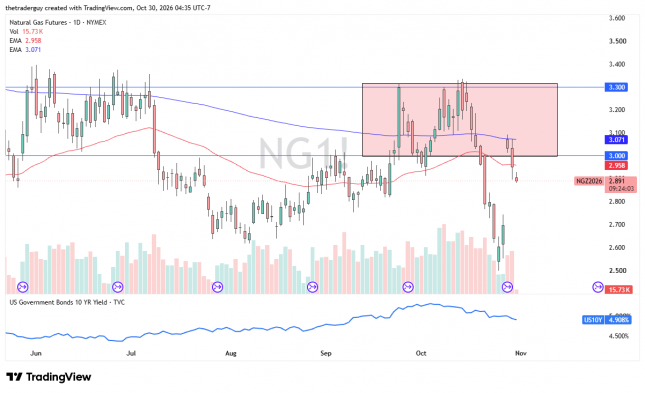
The technical analysis continues to show weakness as we are adjusting to the December contract. The initial gap higher slammed into the 200-day EMA, but the last couple of days have, in fact, been rather negative. I am looking for a buy-the-dip type of scenario and would be particularly interested anywhere near $2.80 on a bounce.
I am waiting for a daily candlestick to give me the signal that perhaps the buyers are coming back. So far, it does not look like that, and natural gas is more or less a wait-and-see type of market.
If you’d like to know more about how to trade natural gas, please visit our educational area.