


The latest U.S. storage report for natural gas supplies shows a cushion entering the heating season, but regional balances and the weather outlook still make the picture a lot less uniform.
The Energy Information Administration’s report, published November 13, covered the week ending November 6. Working gas in storage across the Lower 48 reached 3,862 billion cubic feet after a 61 billion cubic feet injection. This left inventories 92 billion cubic feet below the same week a year earlier, but 75 billion cubic feet above the 5-year average of 3,787 billion cubic feet.
National Stocks
National stocks were within the 5-year average. The total doesn’t indicate an immediate nationwide shortage, while the year-on-year deficit still shows that the system has less gas in storage than last autumn. Looking at the regional split is a better guide to where the cushion is concentrated.
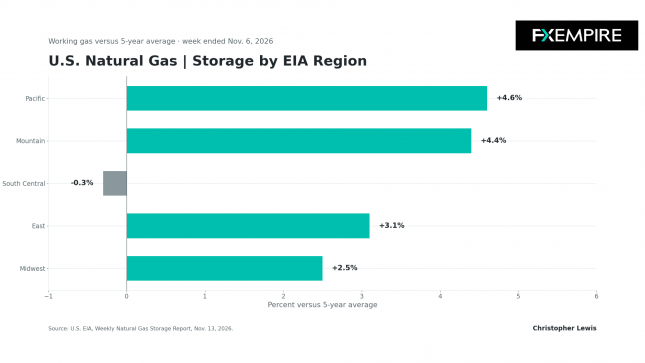
East inventories were 938 billion cubic feet, 3.1% above the 5-year average. The Midwest held 1,129 billion cubic feet, 2.5% above average. The Mountain and Pacific regions were 4.4% and 4.6% above their respective averages. South Central stocks were 1,235 billion cubic feet, just 0.3% below the 5-year average and 6.1% lower than a year earlier.
The Gulf-adjacent region is strategically important because it connects production, pipeline flows, LNG facilities, and storage. Its near-average aggregate masks a wider difference by storage type. Salt cavern inventories were 5.7% below their 5-year average, while non-salt stocks were above average. A thin salt cushion can affect short-term operational flexibility even when national stocks remain relatively comfortable.
Injections Continue
The latest weekly injection also needs some seasonal context. A 61 billion cubic feet build adds to the national buffer, but its market meaning depends on the weather ahead and withdrawals at the same time. If early-season temperatures continue to stay mild, storage can retain more gas for later winter. A sudden cold pattern could quickly change the balance by lifting residential and commercial heating demand.
Natural Gas Price Forecast
Every new Natural Gas analysis as it publishes, today's technical signal and key levels, live price — on one page.
See all Natural Gas forecastsWeekly storage data are estimates and, of course, can be revised. The next scheduled EIA storage update, expected on Thursday, will cover the following week and show whether injections are ending or continuing as colder conditions approach.
Weather forecasts available before the cutoff point to above-normal temperatures across much of the country in the November 22-26 period, with the Climate Prediction Center also favoring warmth in the November 24-30 outlook. Regional probabilities are not uniform, though. The strongest above-normal signal is in the Northeast, while parts of the Southern Plains and Lower Mississippi Valley have a weaker probability. A warm Eastern forecast would be especially relevant to heating load because population and gas use are concentrated there.
Short-term Energy Outlook
EIA’s November Short-Term Energy Outlook, issued November 10, had already incorporated a warmer start to the month. It forecast 13% fewer heating degree days nationally in November than the 10-year monthly average and projected end-November storage of 3,840 billion cubic feet, 67 billion cubic feet above its prior month’s estimate.
The agency expected residential and commercial consumption to average 36.4 billion cubic feet per day from November through March, 3.8% below the prior winter, and forecast Henry Hub spot prices to average $2.87 per million British thermal units over that period, 16% lower than its previous forecast. These are model projections finalized on November 5, so anything after that will have to be taken into account.
For Henry Hub, the immediate fundamental question is whether mild conditions and above-national storage will keep winter risk premiums contained, or whether regional salt storage tightness and colder revisions force a faster assessment.
The Technical Analysis for Natural Gas Shows Support
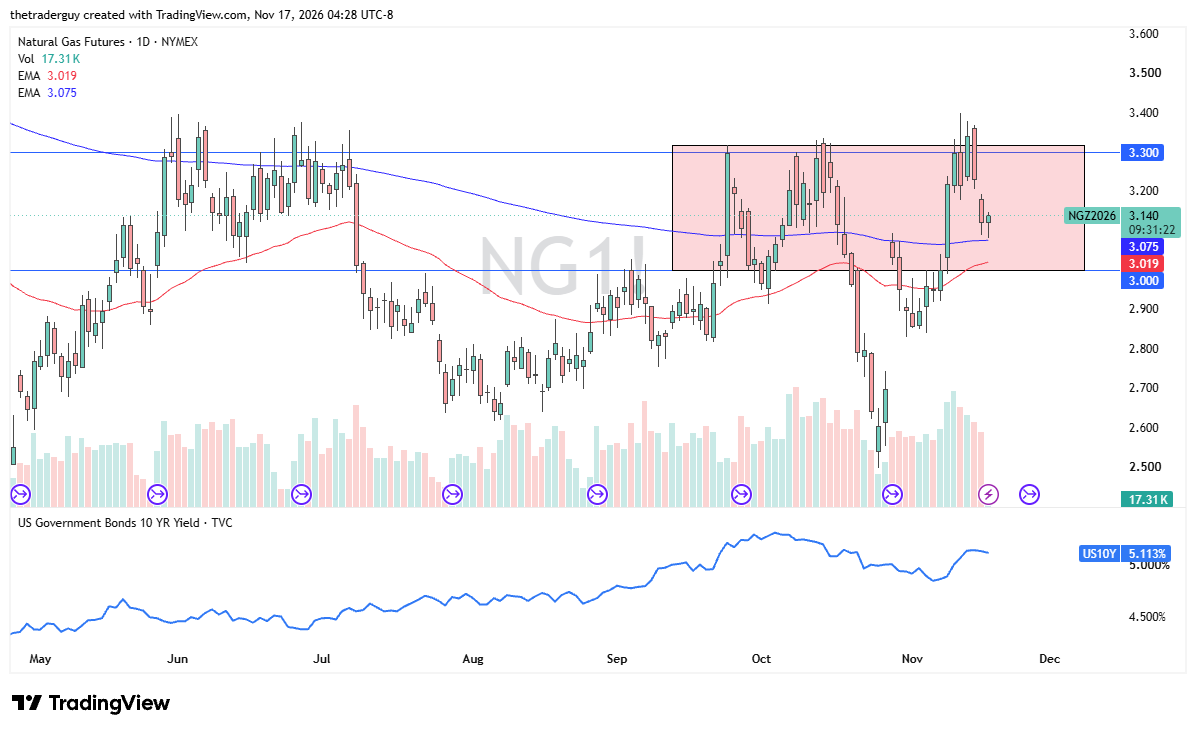
Especially near the 200-day EMA at $3.07. Ultimately, this is a market that I do think will continue to have support and interest. It’s just that we need weather to go with it.
I have no interest in shorting natural gas this time of year. I do believe that eventually we may try to challenge for a breakout to the upside, although we are most certainly stymied by warmer-than-anticipated weather forecasts.
If you’d like to know more about how to trade natural gas, please visit our educational area.