


December natural gas contracts rolled off the board lower, and January takes over the prompt with a heavy premium over the last couple of days. The expiring December contract settled Wednesday at $3.269 per million British thermal units, down 5.4 cents, while January settled at $3.658, down half a cent, after a $3.588 to $3.773 range on 188,713 contracts.
Spot Price
EIA’s Henry Hub spot price was $3.30 two days ago, which was its latest posting. On Thursday, front-month gas was seen at $3.63 early in the session. The January contract seems to be edging lower in holiday-shortened trade.
Withdrawal
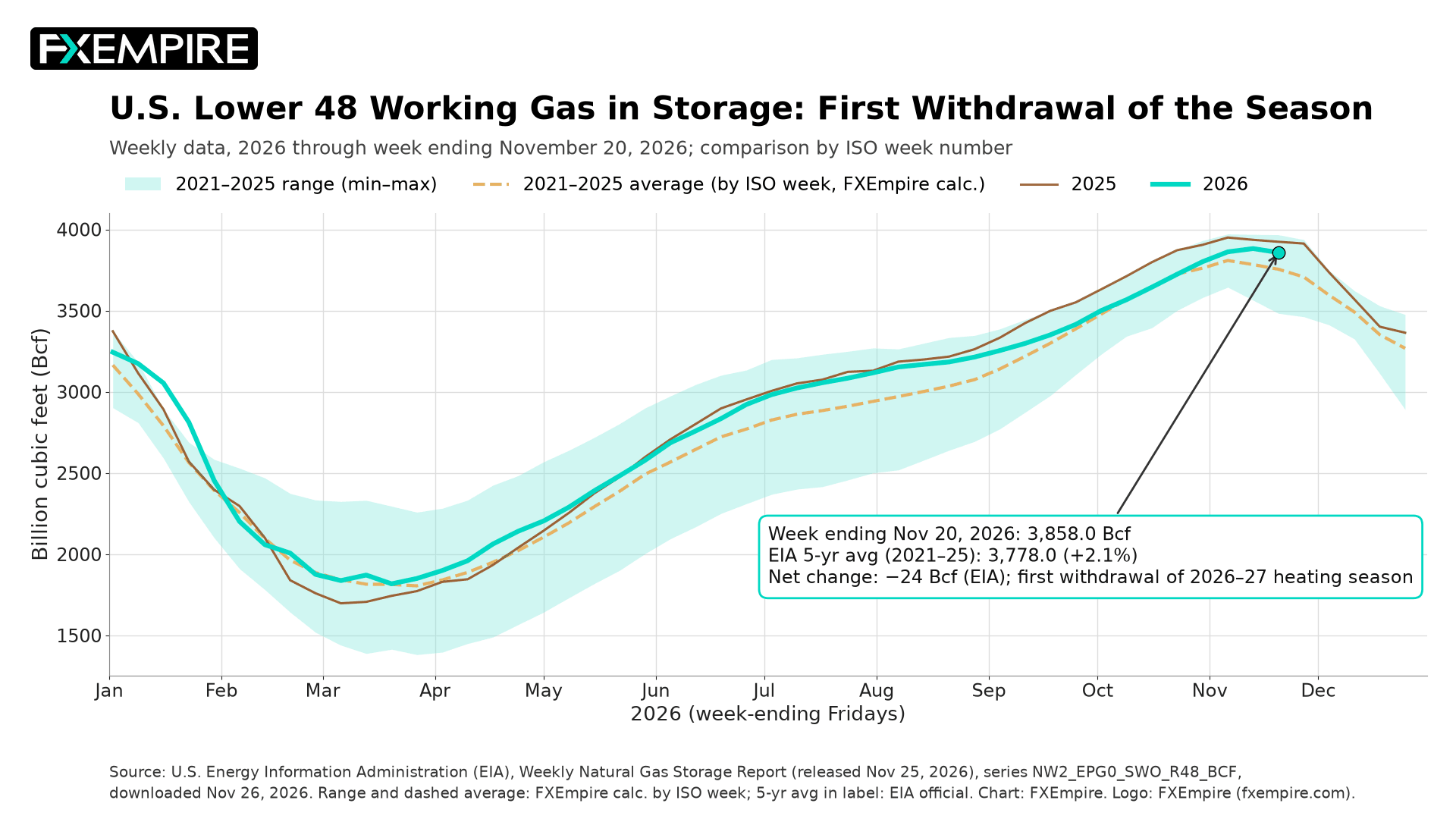
EIA reported a 24 BCF withdrawal for the week ending November 20, taking Lower 48 working gas to 3,858 BCF. That is 79 BCF below a year ago and 80 BCF, or 2.1%, above the average from 2021 to 2025, as its average during that time frame was 3,778 BCF. The East grew 19 BCF and the Midwest 11 BCF, while South Central added 8 BCF, led by a 9 BCF salt cavern injection.
Expectations vary. Energy Edge said the draw matched Bloomberg survey expectations and the five-year average draw, leaving surplus unchanged, while Reuters’ poll was negative 19 BCF, against a 12 BCF draw in the same week last year. “This report does little to change the amount of gas available heading into winter,” Gilbert & Associates said on Energy Intelligence.
Output for the Week
Energy Edge’s Wednesday update put output at 112.3 BCF per day, revised, and Wednesday’s early print near 113 BCF per day, with Northeast EGTS volumes up 1 BCF per day since the weekend. LNG feed gas nominations were 21.7 BCF per day, with Golden Pass at 0.9 BCF per day and Sabine Pass above 5.3 BCF per day, subject to revision, and Mexican exports at 6.8 BCF per day.
Natural Gas Price Forecast
Every new Natural Gas analysis as it publishes, today's technical signal and key levels, live price — on one page.
See all Natural Gas forecastsEstimates Changing
Bank of America raised its end-of-March storage estimate to 2.128 TCF after milder weather model changes. NOAA’s Climate Prediction Center outlook, issued Wednesday at 3 p.m. Eastern Time, favors above-normal temperatures coast-to-coast for December 1-5, with 80-90% odds over parts of the Upper Mississippi Valley. For December 3-9, it favors above-normal temperatures for everything east of the Continental Divide, with 70-80% odds from the eastern Dakotas to the Mississippi Valley to the Atlantic coast. That is a direct hit to early December heating demand. El Niño, expected to peak in November or December, is one of the main factors.
January’s premium over the expired contract was roughly 38 cents. That matters for continuous charts. The roll creates an apparent jump that is not a price increase for any fixed month. On settlements, January to February is 46 cents, and January to March is $1.21. March to April is just 2.5 cents, signaling an expected end-of-winter glut.
Large Short Positioning at the Moment
As of November 17, Managed Money in NYMEX Henry Hub held a 211,545-contract net short. That large short is fuel for a squeeze if forecasts do, in fact, turn colder, but warm outlooks give funds little reason to cover. The COT report is delayed until Monday due to the Thanksgiving holiday.
The Chart Looks Very Bullish, in Theory, at Least
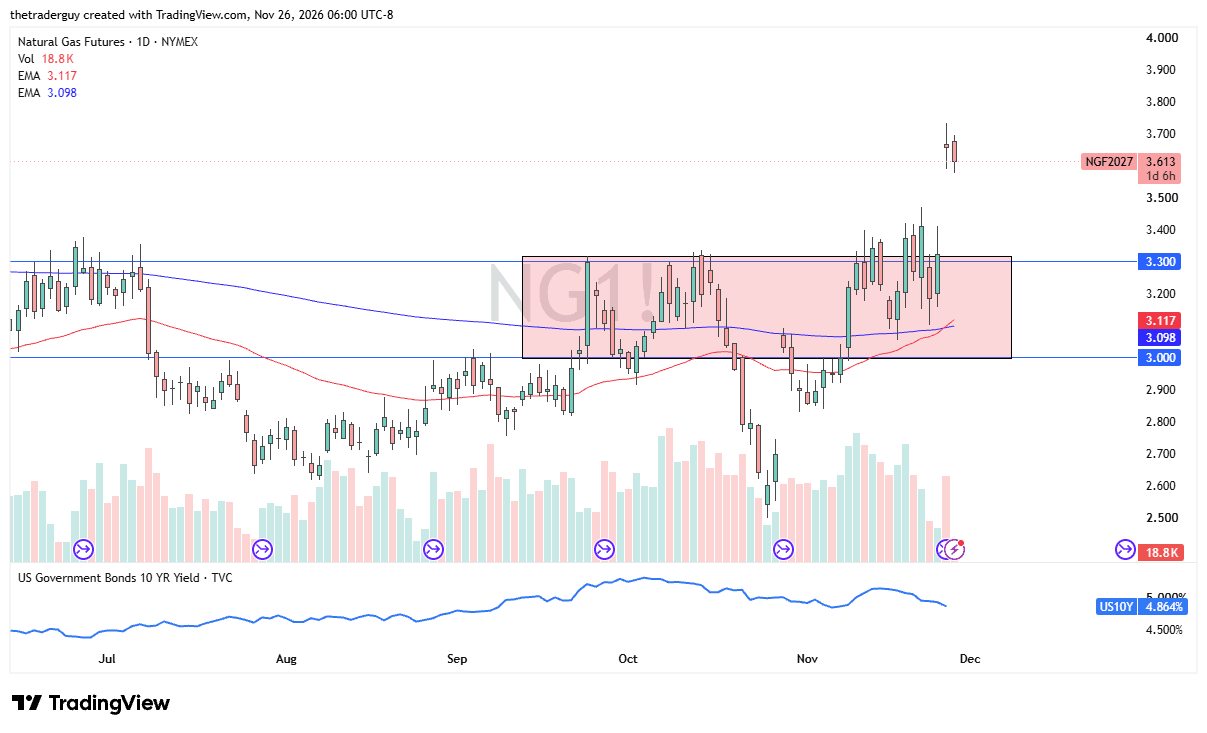
The chart looks very bullish in theory at least, but keep in mind this is a rollover into the January contract, which is not a major surprise. At this point in time, short-term pullbacks would be potential buying opportunities, and I do like buying natural gas this time of year, but I also would have to pay close attention to weather patterns coming out of the NOAA climate report, as the reality is that milder temperatures in early December could continue to allow supplies to increase in America.
Nonetheless, there will be a couple of winter storms through the season that could cause volatile jumps to the upside, so I position natural gas as long-only this time of year.
If you’d like to know more about how to trade natural gas, please visit our educational area.