


Natural gas is trading flat-to-slightly lower early Wednesday as investors digest the latest weather forecasts while preparing for this week’s U.S. Energy Information Administration’s weekly storage report on Thursday.
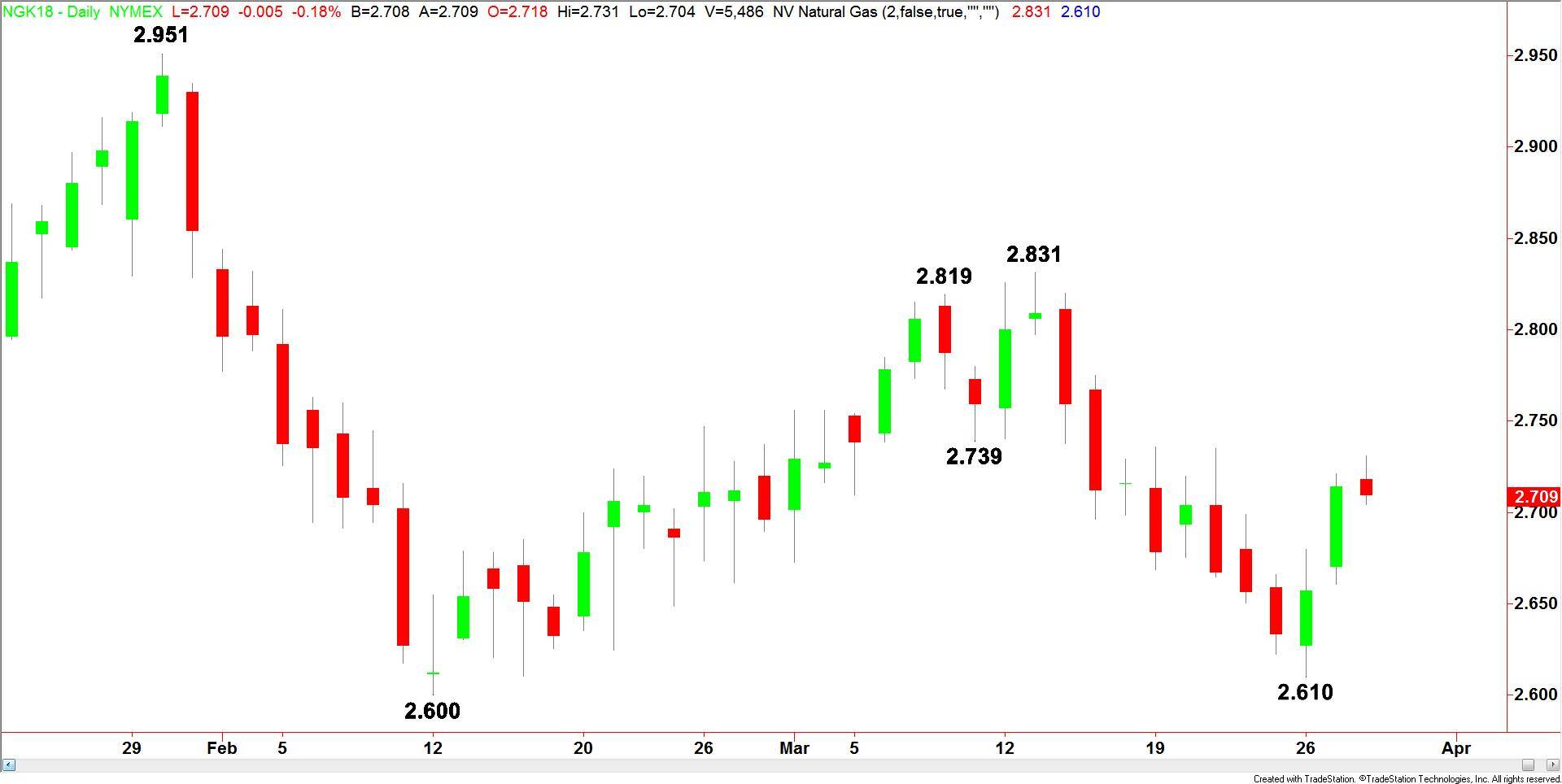
At 0736 GMT, May Natural Gas futures settled at $2.709, down $0.005 or -0.18%.
Prices rose to their highest level since March 21 on Tuesday on reports that overnight weather models continued to show colder temperatures lingering well into next month.
According to Bespoke Weather Services, the cold weather is likely to trend into early April, with some of the changes likely “standard model noise…as models struggle to determine the exact intensity of the cold shot,” Bespoke said. “The main trend we picked up on European and overnight GEFS guidance was a continuation of cold through at least April 10 that will keep heating demand quite elevated for the time of year.”
Radiant Solutions reported colder trends in both its six- to 10-day (April 1-5) and 11-15 day (April 6-10) forecasts Tuesday.
Colder adjustments in the six- to 10-day were “focused in the Midwest and Northeast. Much belows are forecast for most days in the Midwest, with belows also in Texas in the mid-period under a Canadian air mass,” Radiant said. “As this surface high pushes eastward, temperatures fall into the below and much below normal categories late in the period in the East as well, where additional colder risks are based on some models intruding a lobe of the polar vortex into central and eastern Canada at that time.”
In the 11-15 day outlook, “below and much below normal temperatures highlight” the period “from the Midwest to the East…however, the connection to colder source regions may start to wane as the period progresses, as model trends over the past 24 hours have been for lower upper air heights over Alaska,” Radiant said. “…As such, the forecast starts to ease on the intensity of belows while keeping a Midwest to East coverage into late period.”
According to NatGasWeather.com for the March 27 to April 3 period, “A weak weather system with mostly rain will track into the east-central U.S. Mild high pressure will expand over the eastern U.S. through Thursday with conditions warming above normal and into the upper 50s and 60s. Brief cooling will sweep across the Midwest and Northeast late Thursday and Friday as a weather system races through, then warming Saturday. Next week, cooling will arrive across the northern U.S. for high demand, while the southern and western U.S. remains mild to warm with highs of 50s to 80s.
Forecast
The weather forecasts are expected to be supportive, but prices aren’t likely to rally unless the EIA report on Thursday comes out better than expected.
According to reports, lingering cold of late is expected to have driven a better-than-average rate of weekly storage withdrawals in the forthcoming inventory data due out from the U.S. Energy Information Administration on March 29, despite higher low temperatures associated with the arrival of spring.
Looking ahead to Thursday’s report, traders are estimating another draw, ranging from the upper 60s to the low 70s Bcf, which would exceed the 46 Bcf five-year average withdrawal and a 58 Bcf year-ago pull.
Approaching the traditional end of the withdrawal season on March 31, the EIA sees working gas stocks ending the season 19% lower than the five-year average at 1,373 Bcf, assuming storage draws match the five-year average the remainder of the season.
Prices could firm on a sustained move over $2.688. Prices will strengthen if the buying is strong enough to overcome and sustain rallies over $2.716 and $2.747.
The strongest resistance comes in at $2.775 to $2.831.
Look for weakness to return and momentum to shift back to the downside on a sustained move under $2.688.