


The U.S. natural gas situation enters Friday with a small national storage cushion and a weather outlook that does not indicate that we are about to see a broad surge in demand for heating.
Regional Detail Is More Informative Than the National Total Alone
The November 5 EIA release estimated working gas at 3,801 billion cubic feet for October 30, following a 77 billion cubic feet weekly injection. Inventories were 54 billion cubic feet above the five-year average, but 109 billion cubic feet below the corresponding year-earlier comparison. These support different conclusions, and both of these conclusions will matter as the seasonal surplus offers some protection against demand increases.
The year-earlier deficit shows that the cushion is smaller than it was last year, but neither figure alone establishes an outright shortage or an overwhelming surplus at this point. South Central storage was 1,208 billion cubic feet, below its 1,221 billion cubic feet five-year average. Salt storage within that region was 296 billion cubic feet, against an average of 322 billion cubic feet. The East and Midwest, by contrast, held inventory above their respective averages. The chart below shows how uneven the distribution is.
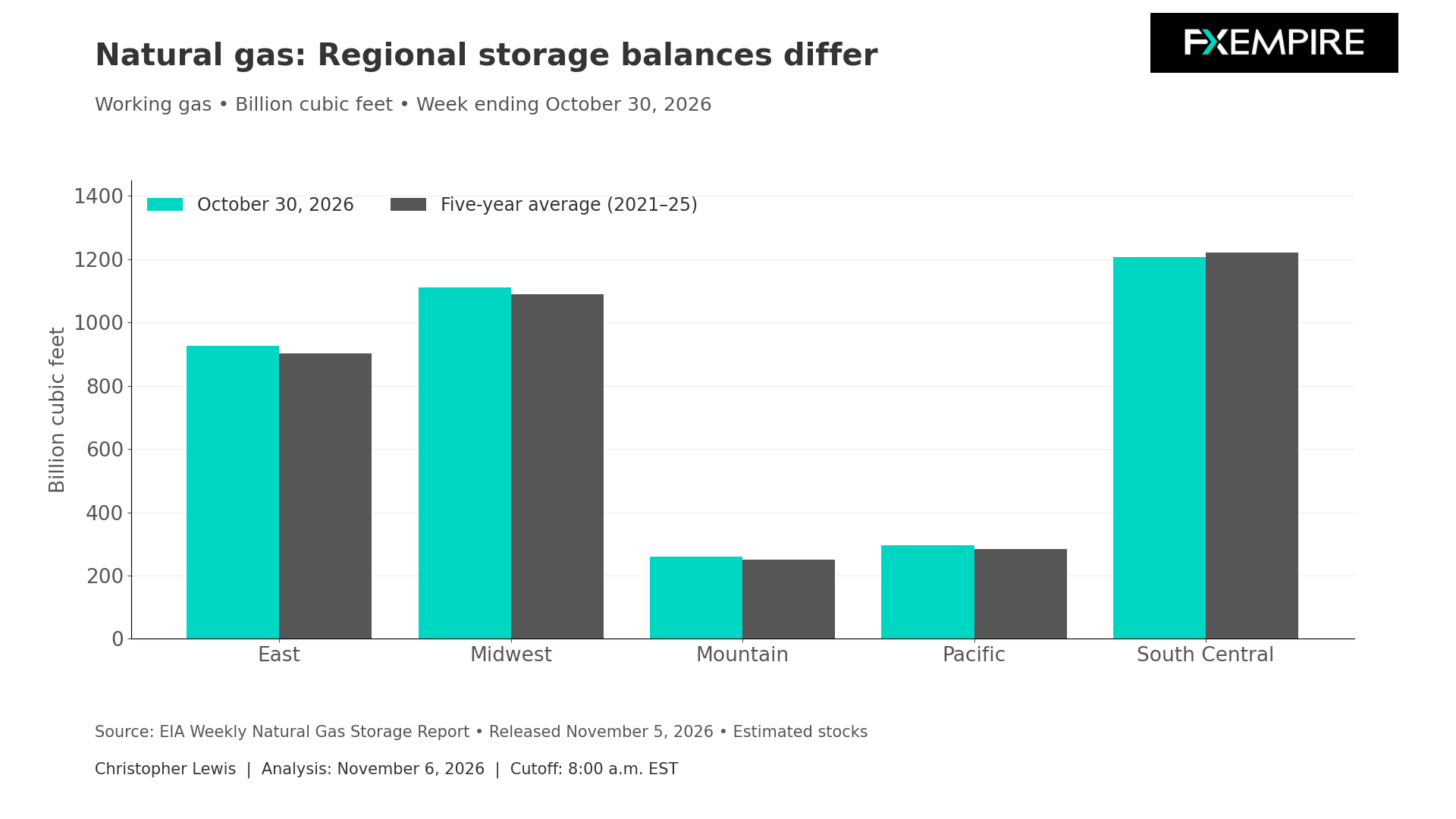
My interpretation of this situation is that the regional split limits how confidently the national surplus can be treated as a complete answer to winter risk. Gas must be available where and when it is needed. Pipeline capacity, withdrawal capability, and the location of demand will all determine how things play out.
Weather Remains Bearish
Weather currently offers a bit of a bearish argument. NOAA’s Climate Prediction Center outlook, issued at 3 p.m. yesterday, favors above-normal temperatures across the western and central contingents of the United States for November 11-15. The probabilities reached up to 90% in the Northern Plains and Minnesota. Most of the eastern third of the country favored near-normal temperatures, with a narrow cooler area along the New England coast.
Natural Gas Price Forecast
Every new Natural Gas analysis as it publishes, today's technical signal and key levels, live price — on one page.
See all Natural Gas forecastsThis ends up being a very problematic forecast, but not necessarily a direct estimate of gas consumption. Regardless, though, a warmer outcome in heating-sensitive regions would tend to delay stronger seasonal demand relative to a colder outcome. The distinction between temperature probabilities and demand volumes is important to pay attention to. An above-normal forecast does not necessarily mean heating demand disappears, and a brief cold period does not necessarily mean that we are going to see an overwhelming draw on storage. Duration, geographic coverage, and the degree of departure from normal determine the effect. Forecast changes become more consequential when they are in heavily populated areas.
Supply Growth
Supply growth remains part of the broader background. EIA’s October 6 Short-Term Energy Outlook forecast U.S. dry production averaging 112.2 billion cubic feet per day this year and 116.13 next year. LNG exports were forecast to be 17.6 billion cubic feet and 18.6 in 2027. These are annual forecasts based on information available through October 1.
The implication is a continuing contest between production growth and expanding demand. Higher exports can absorb some additional domestic supply, but export growth alone does not necessarily guarantee tightening if output starts to rise yet again. On the other hand, a production interruption during a cold spell could produce a sharper short-term response than the annual averages suggest.
EIA Releases
EIA plans to release its next STEO on October 10. The weekly storage page lists the next gas report for Friday, November 13, rather than the usual Thursday. The revised calendar matters because a longer wait for official confirmation can leave weather expectations carrying a bit more weight in the meantime.
For now, the fundamental assessment on natural gas is cautious about assuming an immediate weather-driven tightening. Above-average national stocks and the warm central U.S. forecasts provide resistance to that narrative. Below-average South Central inventories preserve a reason to monitor regional conditions closely. A stronger bullish case could be had if we saw a meaningful cold revision, unexpected weak supply, or faster inventory erosion.
Technical Analysis
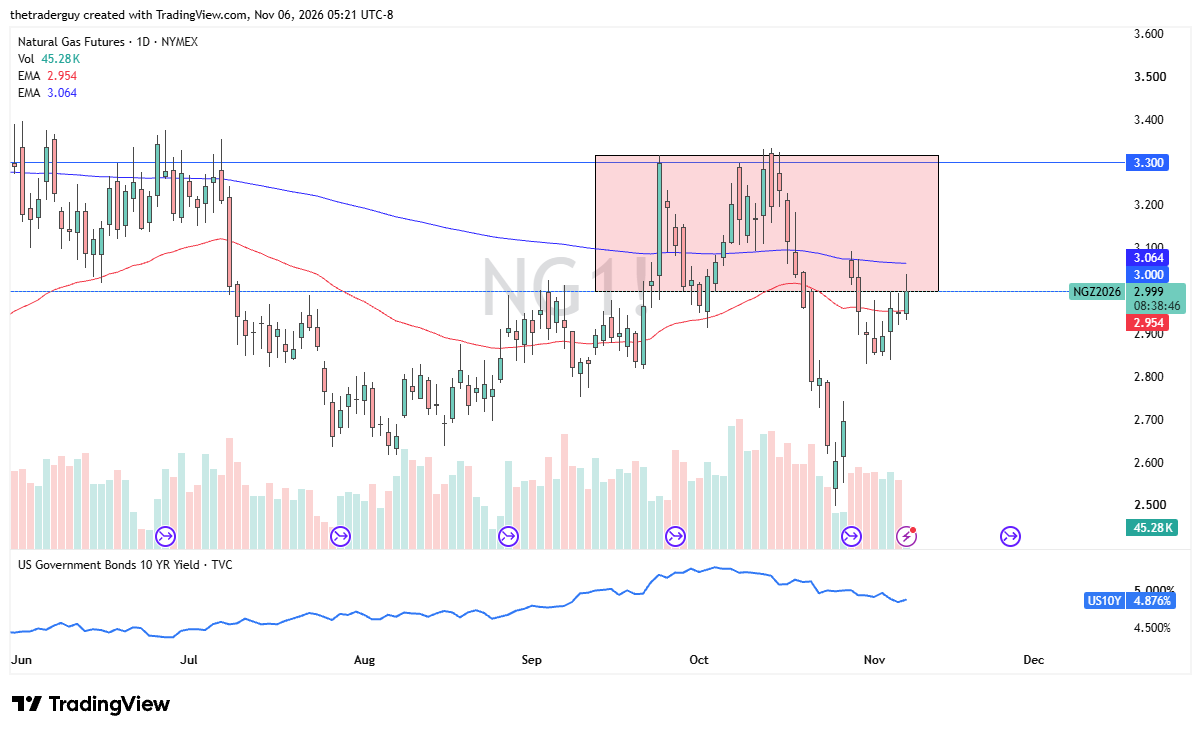
From a technical analysis standpoint, natural gas is rallying during the early part of the Friday session and is trying to stick above the $3 level. Whether or not it actually can remains to be seen, but it is worth noting that the $3.06 level also features the 200-day EMA. Breaking that area would be bullish.
This time of year, I do not like shorting natural gas, despite the fact that the weather is not cooperating, but short-term dips continue to be buying opportunities.
If you’d like to know more about how to trade natural gas, please visit our educational area.