


U.S. natural gas kicks off Wednesday with a weather outlook that does not yet establish a broad cold-driven demand surge. The latest official forecast favors above-normal temperatures across northern areas next week, while the available storage data show a modest national surplus to the seasonal average. Regional differences do still exist, and the next storage release can remain essential in judging how comfortable the balance actually ends up being.
Weather Prediction
NOAA’s Climate Prediction Center discussion, issued yesterday at 3 p.m. Eastern, covers November 9–13 in its 6–10-day outlook. It favors warmth across the West and North Central United States, with probabilities exceeding 80% in parts of the Northern Rockies, Northern Plains, and Upper Mississippi Valley. Near-normal temperatures are favored across the Eastern Seaboard and much of the Southeast.
This implication, of course, is conditional if that pattern does in fact come to be true. Warmer northern conditions would tend to restrain heating needs relative to a colder seasonal outcome. However, above-normal temperatures don’t necessarily mean that heating demand disappears. Actual consumption depends on absolute temperatures, population exposure, and the duration of the weather.
Storage Figures
Storage offers the latest balance reference. EIA’s October 29 release estimated Lower 48 working gas at 3,724 billion cubic feet for the week ending October 23, following an 80 billion cubic feet injection. Inventories were 38 billion cubic feet above the five-year average, but 147 billion cubic feet below the comparable year-earlier level. The next release is scheduled for tomorrow.
The comparisons support a more nuanced assessment than simply calling inventories high or low. Stocks exceeded the recent seasonal norm, providing some buffer against potential demand increases, yet the system has less gas than it did a year ago. Whichever comparison ends up mattering more will depend on subsequent weather, supply, and export requirements.
Natural Gas Price Forecast
Every new Natural Gas analysis as it publishes, today's technical signal and key levels, live price — on one page.
See all Natural Gas forecastsThe regional distribution is particularly relevant. South Central inventory stood at 1,168 billion cubic feet against a five-year average of 1,196 billion cubic feet, whereas the East, Midwest, Mountain, and Pacific regions were all above their respective averages. The chart below shows each region against its own seasonal benchmark. These are estimates, not complete measurements.
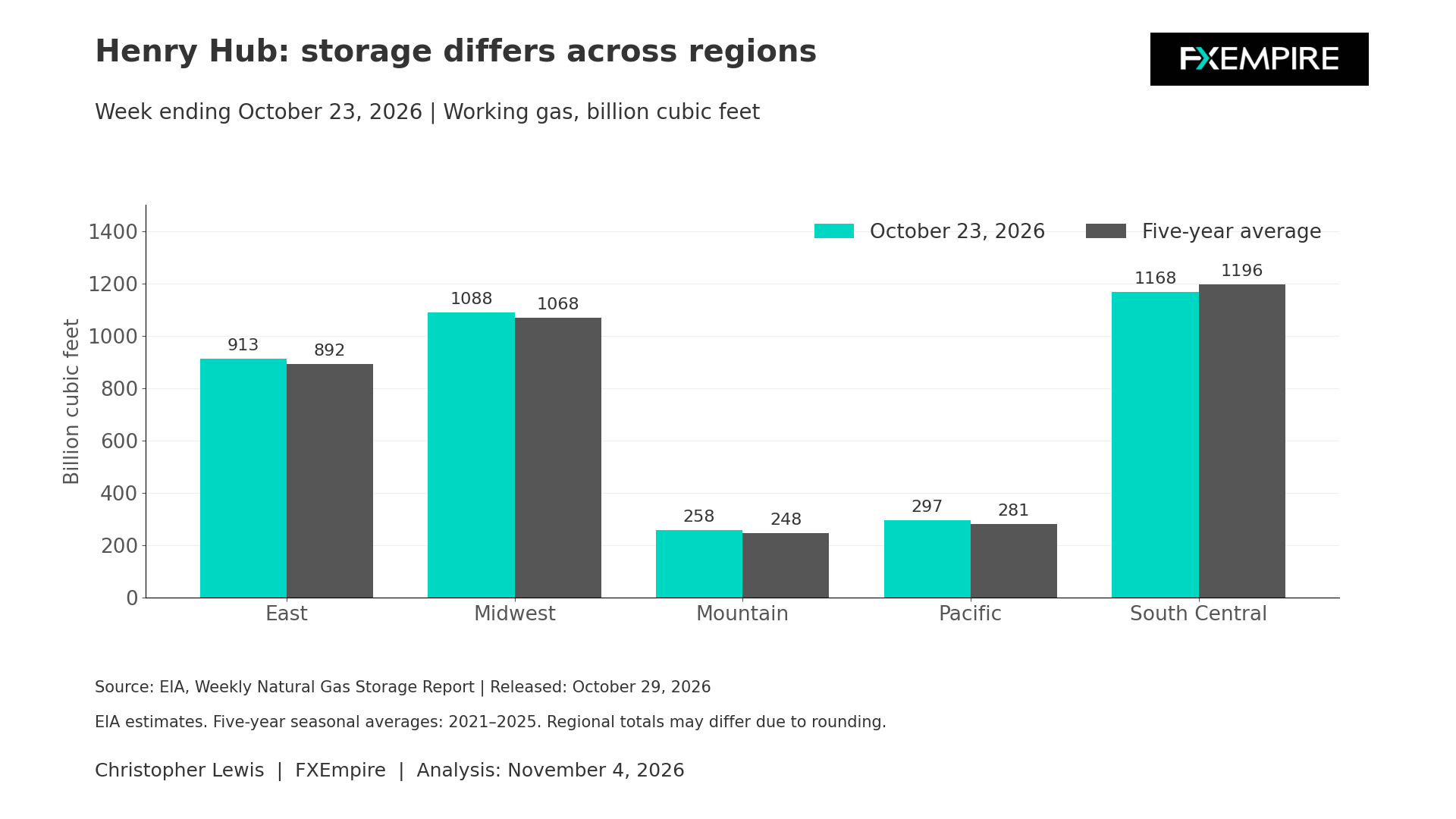
My interpretation of this is that the national surplus shouldn’t be mistaken for an identical cushion across the board. Gas must be transported through available infrastructure to reach consumers and export facilities. Regional storage can consequently matter, even when the aggregate balance looks adequate.
Longer-term supply and export framework remains the EIA’s October Short-Term Energy Outlook, released October 6 using a forecast completed October 1. It projected U.S. dry production averaging 112.2 billion cubic feet per day this year and LNG averaging 17.6 billion cubic feet per day. These are forecasts, not observed flow rates. Later disruptions, changes in weather, or terminal operations after the October 1 cutoff cannot automatically be assumed to be incorporated into these projections. The forecast for end-of-October storage cannot be substituted for the actual weekly storage simply because October has ended.
International Demand for US Gas
International LNG risk also requires careful translation. Qatar’s Foreign Ministry condemned the targeting of the gas carrier Al Mayeda in its November 3 briefing. That official statement establishes a shipping concern but doesn’t quantify a verified reduction in U.S. gas supply or an increase in American terminal demand. Higher overseas demand for replacement cargoes would affect Henry Hub only through feasible changes in U.S. liquefaction and feed gas requirements.
The immediate catalyst, therefore, will be Thursday’s storage report and subsequent weather revisions. A smaller seasonal cushion alongside a colder northern outlook would strengthen the tightening narrative. Continued rebuilding and verified mild conditions would weaken it.
Looking at the Charts
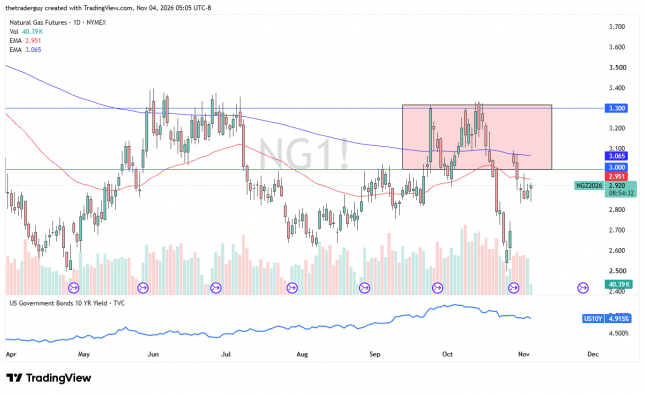
The technical analysis of this market looks as if it is trying to find some type of floor at $2.80. I do believe that buying dips in natural gas makes the most sense this time of year, but I also recognize that there is a huge gap underneath that could eventually get filled if the weather doesn’t cooperate. In general, I buy the dips, but I’m not looking for anything major quite yet. If we can clear the $3 level to the upside, I would become much more constructive.